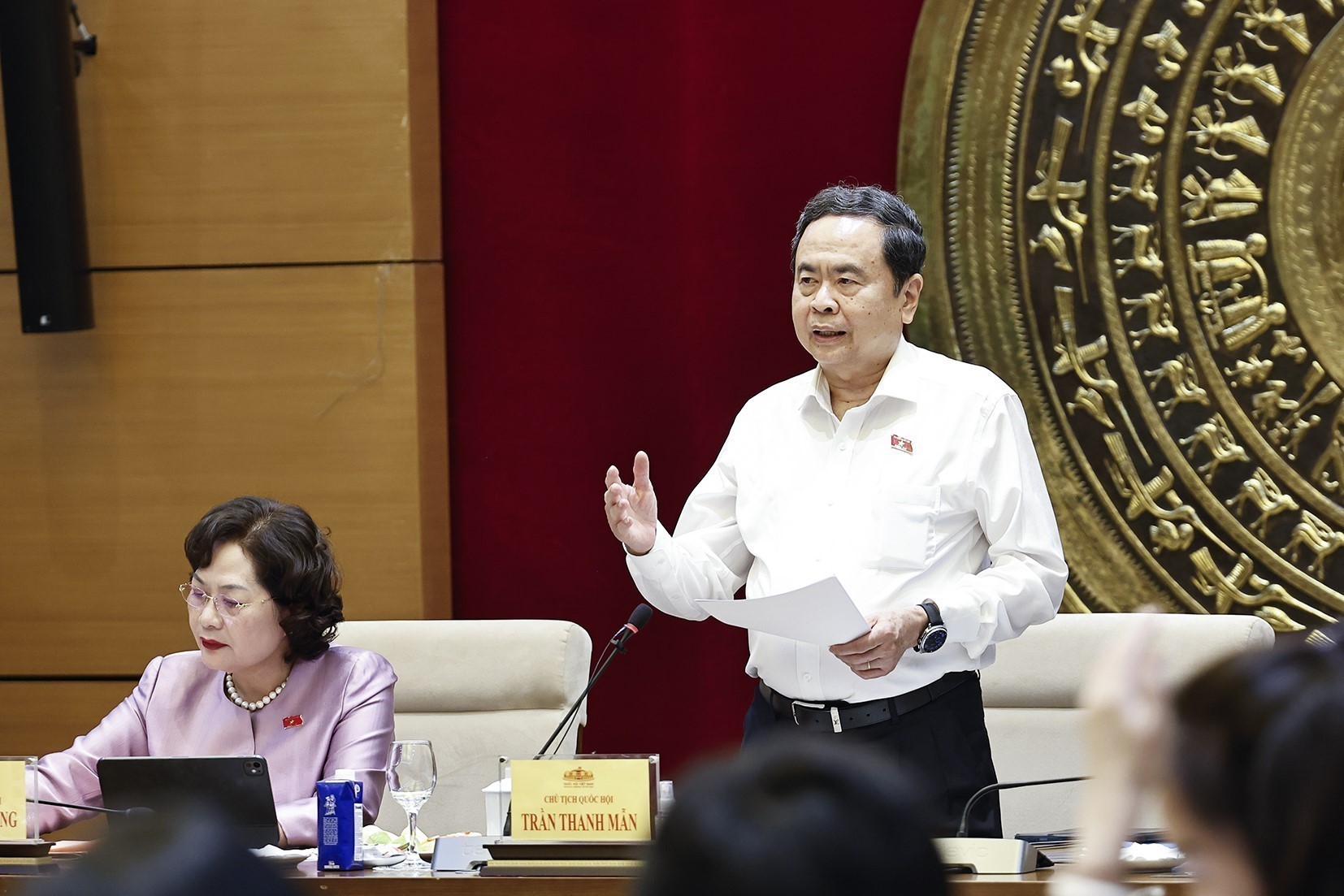
NA Chairman Tran Thanh Man speaks at the working session. Photo: VNA
Addressing a working session with the committee’s standing members in Hanoi on May 20 on its key tasks for 2026 and the 2026–2031 tenure, the top legislator highly valued the committee’s proactive and responsible performance in recent months, noting that it has handled a heavy workload in reviewing and monitoring many laws for the 2026–2030 period and ensuring greater policy coherence across the legal system.
He said the committee must continue to closely follow Resolution of the 14th National Party Congress and the Resolution of its first Party Congress for the 2025 – 2030 tenure, and actively implement the legislative programme of the 16th NA. He noted that beyond reviewing draft laws, it should comprehensively identify institutional bottlenecks and practical shortcomings to propose timely amendments.
A key priority is improving the quality of policy advice to the NA so that decisions can unlock development space without compromising macroeconomic stability, fiscal safety, public debt sustainability, or long-term growth quality, Chairman Man noted.
The top legislator underlined that the supervision should focus on removing obstacles to development rather than merely identifying violations. He urged the committee to pinpoint where national resources are being blocked - whether by legal frameworks, coordination failures, institutional hesitation, or implementation capacity - and to present data-driven, location-specific recommendations.
He requested the committee to immediately incorporate several concrete tasks into its 2026 action plan, including prioritising the review of nine draft laws submitted to the NA and six submissions to the NA Standing Committee; addressing delays in 34 implementing legal documents; and developing a roadmap to review 29 laws during 2026–2030 based on major policy clusters. Six specialised sub-committees, he added, must operate more substantively with measurable outputs.
The NA Chairman also called for a shift in legislative review methodology from “document-based appraisal” to “policy-based appraisal”, which relies on deeper analysis of policy design, data, impact assessment, and risk forecasting. The committee should engage earlier in the policymaking cycle to improve legislative quality, he stressed.
On fiscal and budgetary discipline, he emphasised that all proposals related to spending increases, tax reductions, tax exemptions, bond issuance, borrowing, guarantees, public investment, and state asset use must be rigorously reviewed in line with legal principles. The committee must help design mechanisms that are both safe for development and flexible enough to mobilise resources, while ensuring transparency, accountability, and risk control.
Strict fiscal discipline must go hand in hand with open development policies; tight management should not block resource flows; and macroeconomic stability must be maintained without missing growth opportunities, the leader stressed.
Regarding supervision, he urged a strategic focus on high-risk and high-impact areas, including public investment efficiency – particularly key national projects, delayed or cost-overrun programmes, and low disbursement rates - along with public debt management, state asset governance, and financial markets such as banking, securities, corporate bonds, insurance, and real estate. He also highlighted the need to evaluate policies supporting the private sector, state-owned enterprises, and public–private partnerships.
The NA Chairman also requested the committee to build itself into a strong institution in expertise, data capability, and analytical capacity, leading digital transformation and the application of artificial intelligence to enhance legislative supervision, and policy analysis./.