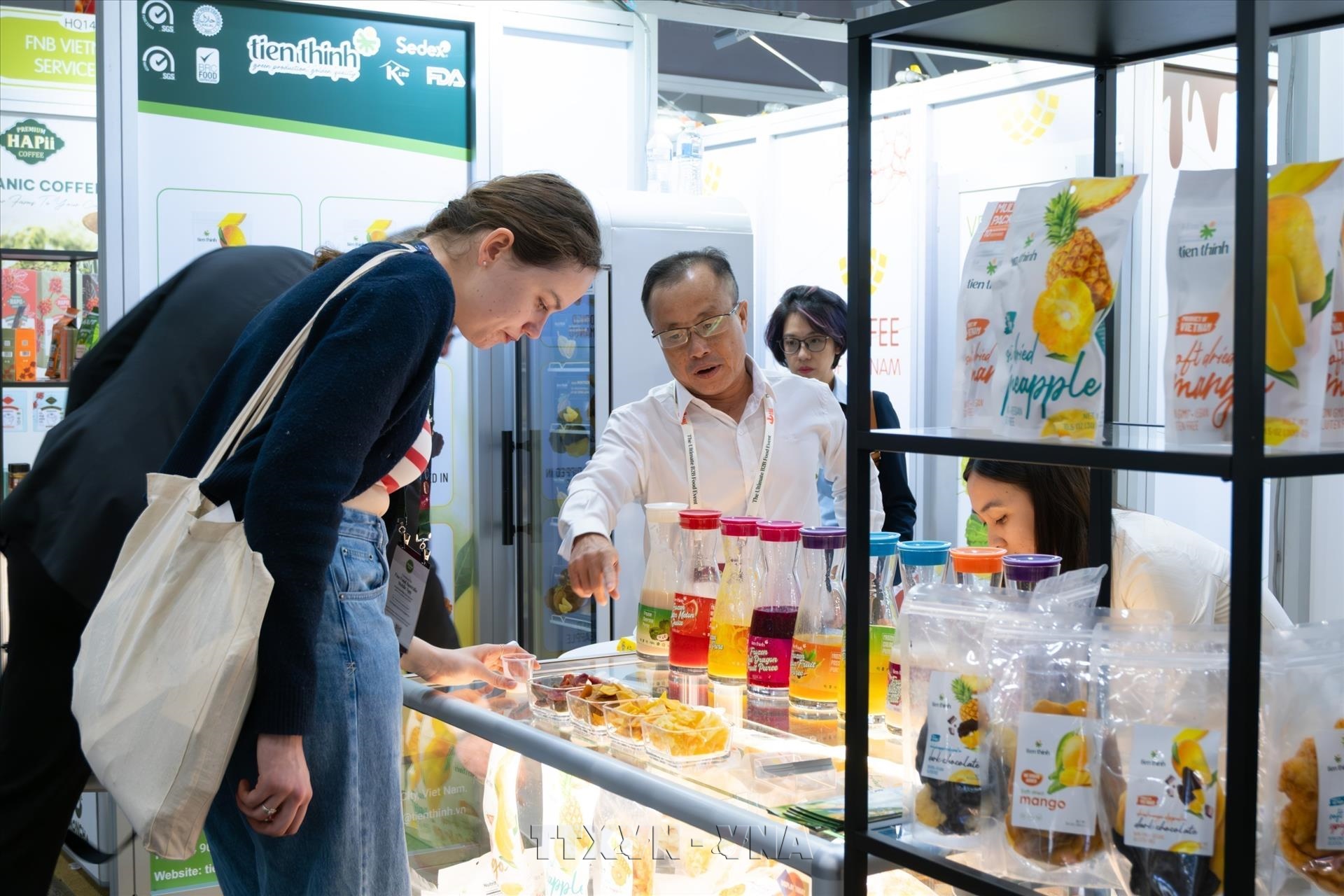
Through the “FOODS OF VIETNAM” pavilion, nine Vietnamese businesses are showcasing a range of high-value processed food products to Australian consumers and importers.
The annual Fine Food Australia fair is expected to attract more than 26,000 trade visitors from over 50 countries this year. More than 950 businesses and organisations are taking part, while over 115 experts are joining around 70 specialised seminars.
Vietnamese businesses are not only displaying their products but also organising product tasting sessions at their booths.
Luu Thi Lan Phuong, Director of Import-Export at Fancy Foods Manufacturing and Trading Co., Ltd., said the company’s booth received a large number of Australian visitors interested in its Vietnamese chocolate products from the opening day.
She said the products stand out by combining distinctive tropical flavours that are not widely available in Australia, providing a basis for the company to develop products tailored to local tastes.
For Tien Thinh Group JSC, this is the third time the company has attended Fine Food Australia. The company’s General Director To Thai Thanh said the fair is showing clear signs of a breakthrough this year, with a sharp increase in interest in Vietnamese products.
The company is focusing on promoting processed specialty fruits from the Mekong Delta, including mango, pineapple, custard apple and soft-dried jackfruit.
Vietnamese processed foods and individually quick frozen (IQF) fruit products are also attracting considerable interest from Australian distributors.
Henriette de Koning, an experienced Australian food trader, said demand for IQF tropical fruits is currently high in the Australian market, and she is studying potential cooperation involving Vietnamese passion fruit, mango, banana and dragon fruit.
She also praised the Vietnamese booth’s unique chocolate-coated fruit products, saying Australian consumers like Vietnamese fruits and generally have a positive view of the quality of Vietnamese products.
However, De Koning noted that Vietnamese products need to meet Australia’s strict technical standards to move further into local supply chains, while competitive pricing is increasingly important amid the global rise in living costs./.