
In the News
Vietnam's demographic transition lays foundation for long-term development: French study
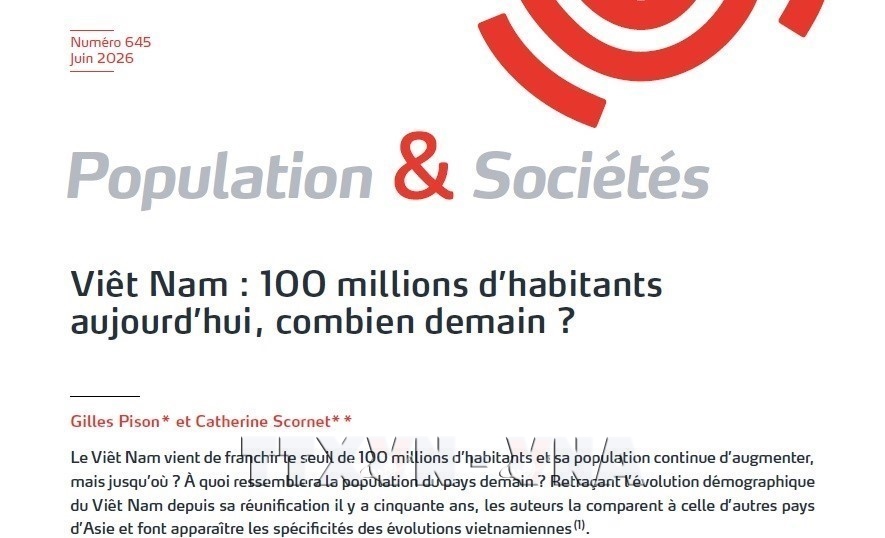
The assessment was made by Gilles Pison and Catherine Scornet from France's National Institute for Demographic Studies (INED) in their study, "Vietnam: 100 million inhabitants today, how many tomorrow?”, published in the June issue of the Population & Sociétés magazine.
The study noted that Vietnam's population surpassed 100 million in 2023, more than doubling the size in 1976, after the country's reunification, and increasing more than sixfold compared with a century ago. Citing the United Nations' medium projection, the authors said the population is expected to continue growing to around 110 million by the middle of the 21st century before stabilising.
The researchers attributed the achievement to decades of sustained demographic transition. As economic development and living standards improved, mortality rates, particularly infant mortality, declined sharply while fertility gradually fell to a reasonable level, they noted, adding that this has enabled Vietnam to maintain steady population growth and a large workforce, providing an important advantage for national development.
The study also highlights significant progress in health care. Average life expectancy increased from about 48 years in 1950 to nearly 75 years in 2023 thanks to an early-established primary healthcare system, large-scale vaccination programmes and improved nutrition in the post-war period. By the early 1980s, life expectancy in Vietnam had reached levels comparable to the Republic of Korea and exceeded those of China and Thailand.
Another notable achievement is that Vietnam has maintained a relatively stable fertility rate. After dropping sharply from around six children per woman in the 1960s and 1970s, the rate has remained at about 1.9 children per woman for more than two decades. Researchers consider this a relatively favourable level at a time when many Asian countries are grappling with severe fertility decline. In 2023, fertility rates stood at about 0.7 children per woman in the Republic of Korea, around 1.0 in China and approximately 1.2 in Thailand.
According to the INED, declining fertility reflects socio-economic progress, higher educational attainment and improved living standards. In response to population ageing, Vietnam abolished its long-standing one-or-two-child policy in 2025 and now encourages couples to have two children to help maintain a balanced population structure over the long term.
The study also points to emerging challenges, including rapid population ageing and imbalanced sex ratio at birth in some localities, particularly in the north.
Nevertheless, the authors believe the country's large population, improving population quality and comparatively higher fertility rate than many regional peers place it in a favourable position to adapt to demographic changes in the future.
They said that Vietnam's demographic priority has shifted from controlling population growth to maintaining an appropriate fertility level and preparing for an ageing society, factors that will shape the country's future population size, labour force and development potential in the second half of the 21st century./.