The event, organised by the Ministry of Agriculture and Environment and the Ministry of Public Security, looked to promote science, technology, innovation and digital transformation to promote agricultural growth in the northern region.
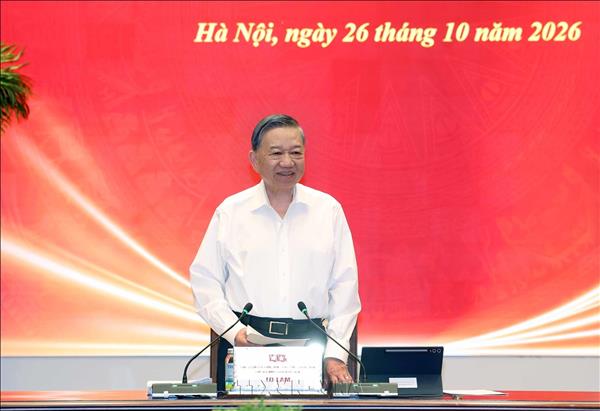
Opening the conference, Minister of Agriculture and Environment Trinh Viet Hung said the agricultural and environmental sector has maintained positive growth despite global uncertainties, intensifying trade competition, stricter green standards and traceability requirements, as well as increasingly unpredictable natural disasters and climate change.
In the first nine months of 2026, agriculture, forestry and fisheries grew 4.02%, while exports of their products reached 56.3 billion USD, up 7.8% year on year. Advances in plant and animal varieties, biotechnology, mechanisation, preservation, processing and traceability have helped improve productivity, quality and production efficiency.
Hung stressed that in the new development phase, the sector must shift from growth driven mainly by production scale and output to a model based on science, technology, innovation and digital transformation to boost productivity, quality, efficiency and value added under Politburo Resolution No. 57-NQ/TW on breakthroughs in science – technology development, innovation and national digital transformation.
The northern region has advantages in research institutes, universities, scientific expertise and technology businesses. However, links between research and production, as well as technology transfer and practical application, remain limited, he pointed out.
Deputy Minister of Agriculture and Environment Dang Ngoc Diep said that during 2027–2030, the sector needs to shift from a growth model mainly based on scale and output to one focused on high technology, deeper processing and higher value added.
First, the sector needs to innovate thinking and the way scientific and technological tasks are developed, focusing on solving specific problems of each sector, value chain, and locality. Priority should be given to matering core and strategic technologies, and linking research with practical application and socio-economic efficiency.
At the same time, it is necessary to develop value chains for key agricultural products tied to the advantages of each region; improve quality, reduce input costs and post-harvest losses, promote deep processing, make use of by-products, and build brands. Strengthening the connectivity between raw material regions and research centres, processing businesses, logistics systems, and consumer markets is also equally important.
Digital transformation is another priority, with efforts to standardise and connect databases covering land, plant varieties, farming areas, forests, diseases, output, product quality, traceability and markets. Performance should be assessed through measurable results, including higher productivity and value added, lower costs and emissions, reduced post-harvest losses, and wider commercialisation, Diep noted.
During 2021–2025, the sector implemented 1,373 science and technology tasks. A total of 225 new crop, livestock, aquaculture and forestry varieties were recognised and introduced into production, alongside 150 technical advances and 158 patents and useful solutions. More than 2,000 models for high-tech, circular and low-emission agriculture were also deployed, delivering reported economic gains of around 10–30%.
In the North, notable results include high-quality and cold-resistant rice varieties, biomass maize varieties and the technology for producing African swine fever vaccine.
The sector has also developed 25 specialised databases and information systems, with direct connections to 12 national databases, providing a foundation for more effective management and technology-driven agricultural production./.
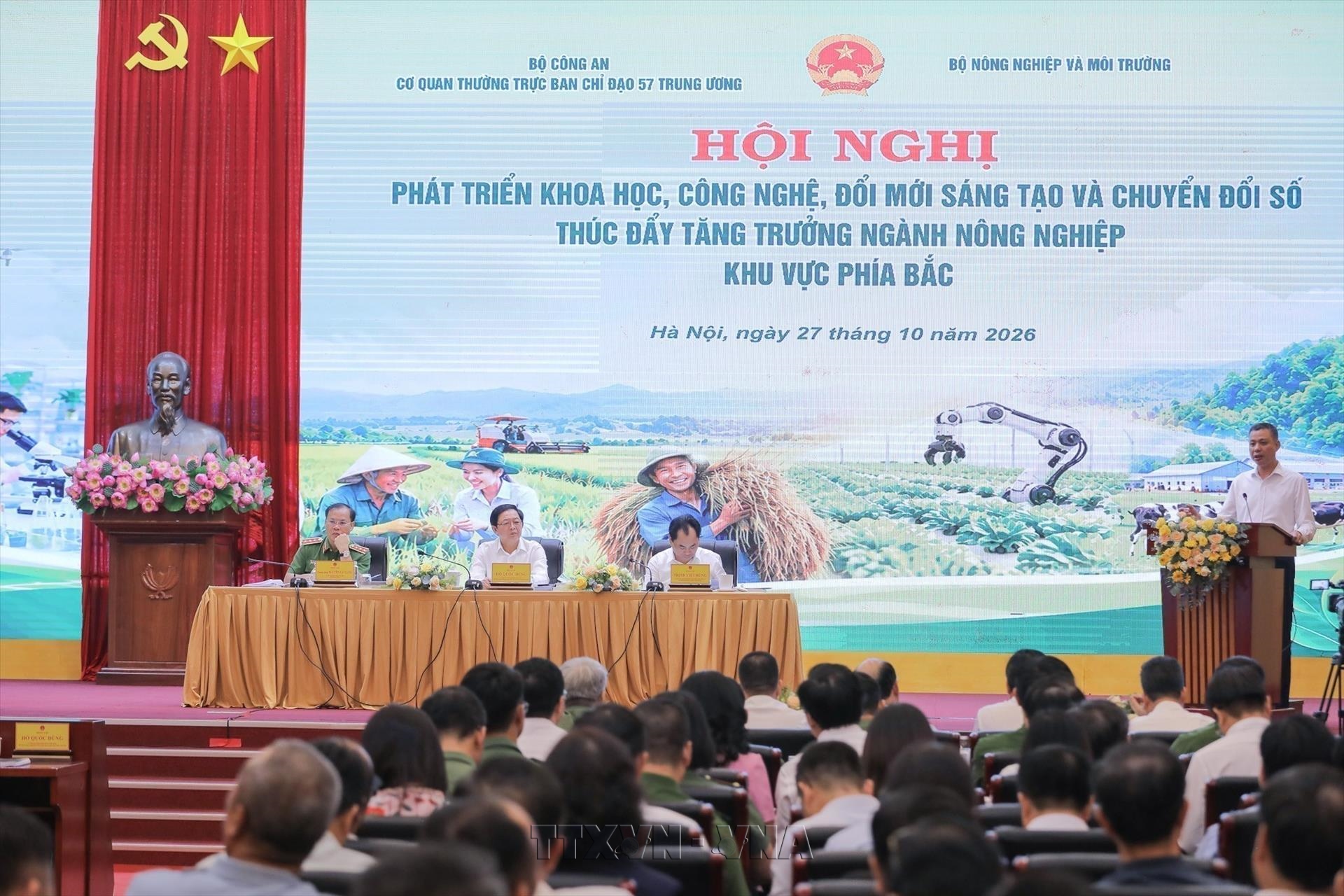
Opening the conference, Minister of Agriculture and Environment Trinh Viet Hung said the agricultural and environmental sector has maintained positive growth despite global uncertainties, intensifying trade competition, stricter green standards and traceability requirements, as well as increasingly unpredictable natural disasters and climate change.
In the first nine months of 2026, agriculture, forestry and fisheries grew 4.02%, while exports of their products reached 56.3 billion USD, up 7.8% year on year. Advances in plant and animal varieties, biotechnology, mechanisation, preservation, processing and traceability have helped improve productivity, quality and production efficiency.
Hung stressed that in the new development phase, the sector must shift from growth driven mainly by production scale and output to a model based on science, technology, innovation and digital transformation to boost productivity, quality, efficiency and value added under Politburo Resolution No. 57-NQ/TW on breakthroughs in science – technology development, innovation and national digital transformation.
The northern region has advantages in research institutes, universities, scientific expertise and technology businesses. However, links between research and production, as well as technology transfer and practical application, remain limited, he pointed out.
Deputy Minister of Agriculture and Environment Dang Ngoc Diep said that during 2027–2030, the sector needs to shift from a growth model mainly based on scale and output to one focused on high technology, deeper processing and higher value added.
First, the sector needs to innovate thinking and the way scientific and technological tasks are developed, focusing on solving specific problems of each sector, value chain, and locality. Priority should be given to matering core and strategic technologies, and linking research with practical application and socio-economic efficiency.
At the same time, it is necessary to develop value chains for key agricultural products tied to the advantages of each region; improve quality, reduce input costs and post-harvest losses, promote deep processing, make use of by-products, and build brands. Strengthening the connectivity between raw material regions and research centres, processing businesses, logistics systems, and consumer markets is also equally important.
Digital transformation is another priority, with efforts to standardise and connect databases covering land, plant varieties, farming areas, forests, diseases, output, product quality, traceability and markets. Performance should be assessed through measurable results, including higher productivity and value added, lower costs and emissions, reduced post-harvest losses, and wider commercialisation, Diep noted.
During 2021–2025, the sector implemented 1,373 science and technology tasks. A total of 225 new crop, livestock, aquaculture and forestry varieties were recognised and introduced into production, alongside 150 technical advances and 158 patents and useful solutions. More than 2,000 models for high-tech, circular and low-emission agriculture were also deployed, delivering reported economic gains of around 10–30%.
In the North, notable results include high-quality and cold-resistant rice varieties, biomass maize varieties and the technology for producing African swine fever vaccine.
The sector has also developed 25 specialised databases and information systems, with direct connections to 12 national databases, providing a foundation for more effective management and technology-driven agricultural production./.