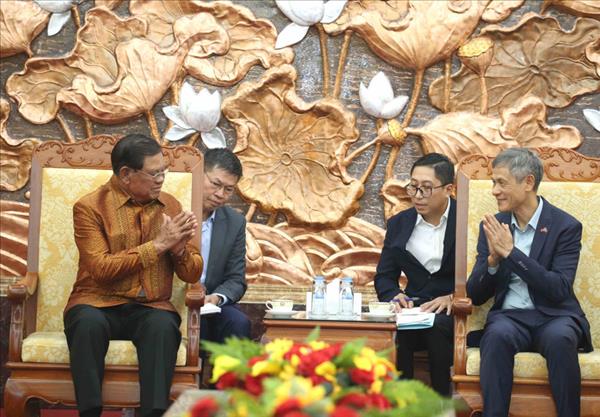

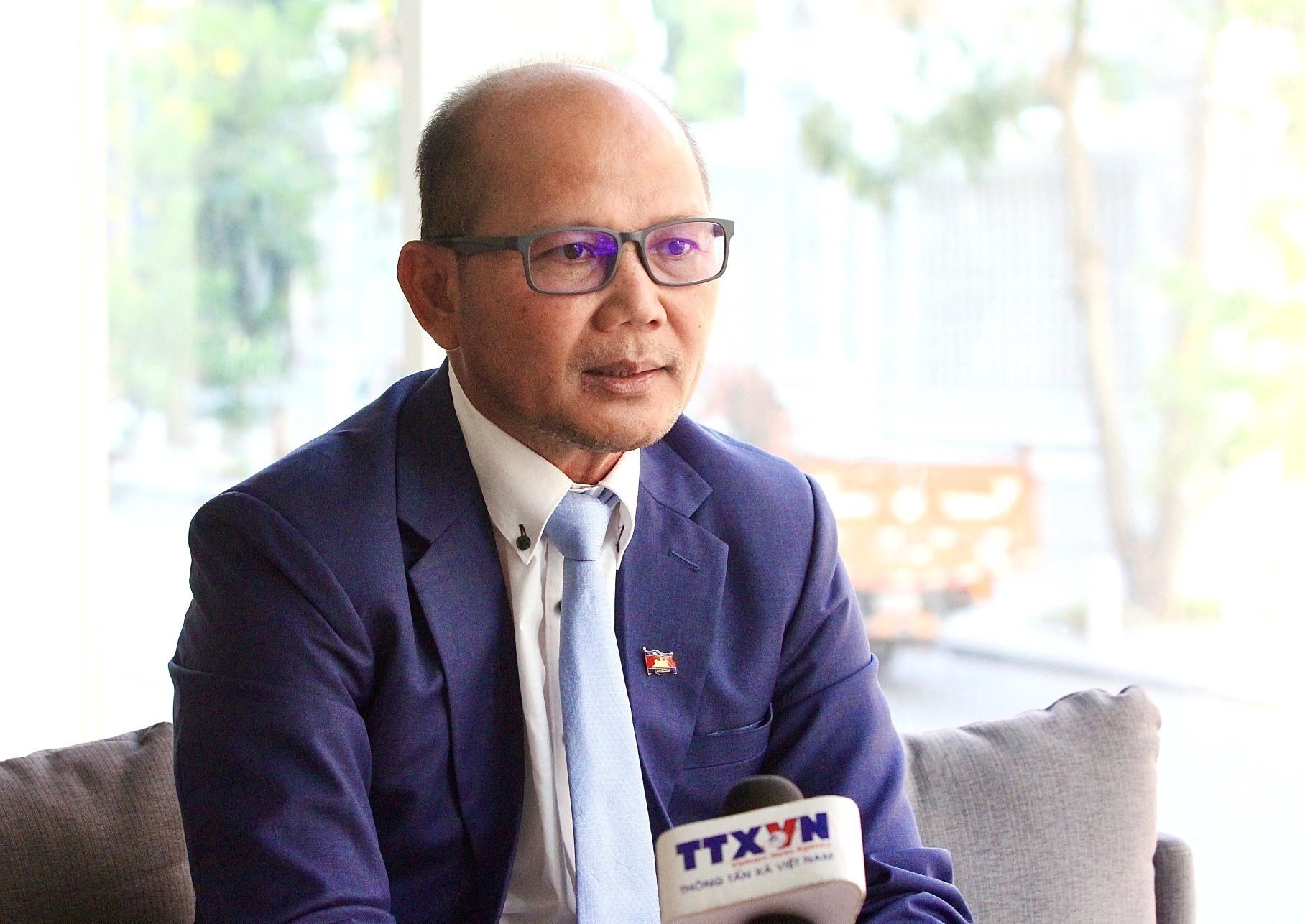
Uch Leang, Acting Director of the Department of Asian, African, and Middle-East Studies under the International Relations Institute of Cambodia ((IRIC), at the Royal Academy of Cambodia (RAC), made the assessment in a recent interview with Vietnam News Agency correspondent in Cambodia.
Leang, who is also President of the Cambodia Alumni From Vietnam Association (CAVA), emphasised that the Congress marks the beginning of a new era, describing it as a historic political event for the CPV and a major opportunity for the entire nation.
He said the Congress has been held amid increasingly complex and unpredictable international and regional developments. After four decades of Doi moi (renewal), Vietnam has built a solid political and economic foundation and elevated its position and reputation in the international arena. Against this backdrop, the 14th Congress set a strategic vision and adopted key policy decisions to guide Vietnam confidently into a new era of development.
The draft documents of the 14th Congress drew nearly 14 million public contributions, including over 1,300 from overseas Vietnamese, reflecting strong alignment between the Party’s will and the people’s aspirations in pursuing Vietnam’s model of socialist democracy.
Leang said that Vietnam’s socialist-oriented market economy model has enabled rapid and sustainable economic growth while ensuring social equity, providing citizens with a decent standard of living, and strengthening the nation’s resilience, all while remaining committed to fair, democratic, and civilized development.
Through this development model, Vietnam has portrayed itself as a country truly belonging to its people, with state power exercised on their behalf through representative institutions and guaranteed by the Constitution, he said, adding that under the leadership of the CPV, the country remains committed to a people-centred democracy, ensuring citizens’ power as well as their rights and developmental interests.
In this spirit, the documents presented at the 14th Congress designate “environmental protection” alongside socio-economic development as a central task, while foreign affairs and international integration are placed on par with defence and security, becoming key and ongoing priorities, he said.
According to the Cambodian expert, this perspective also emphasises that the political system is key, the economic system is central, and other institutions are highly important. Consequently, the three strategic breakthroughs from the previous term have been restructured to align with contemporary development trends, highlighting the need to improve institutions for rapid and sustainable development, cultivate high-quality human resources linked to science and technology, and invest in comprehensive infrastructure development, especially in digital infrastructure, energy, and green urban areas.
To illustrate his assessment of Vietnam’s development direction and prospects, Leang cited statistics showing that in recent years, Vietnam has been one of Asia’s fastest-growing economies, with growth rates of 5.05% in 2023 and 7.09% in 2024. In 2025, the Vietnamese economy accelerated sharply, achieving a GDP growth of 8.02%.
Leang noted that with timely policies driving economic momentum in 2026, aiming for double-digit growth, foreign media analyses project Vietnam could become ASEAN’s second-largest economy after Indonesia in 2026–2027 if growth continues at its current pace.
From this perspective, the expert observed that Vietnam’s four-decade socio-economic development has relied heavily on political leadership, particularly the strategic planning, policies, and national development directions set by the CPV./.