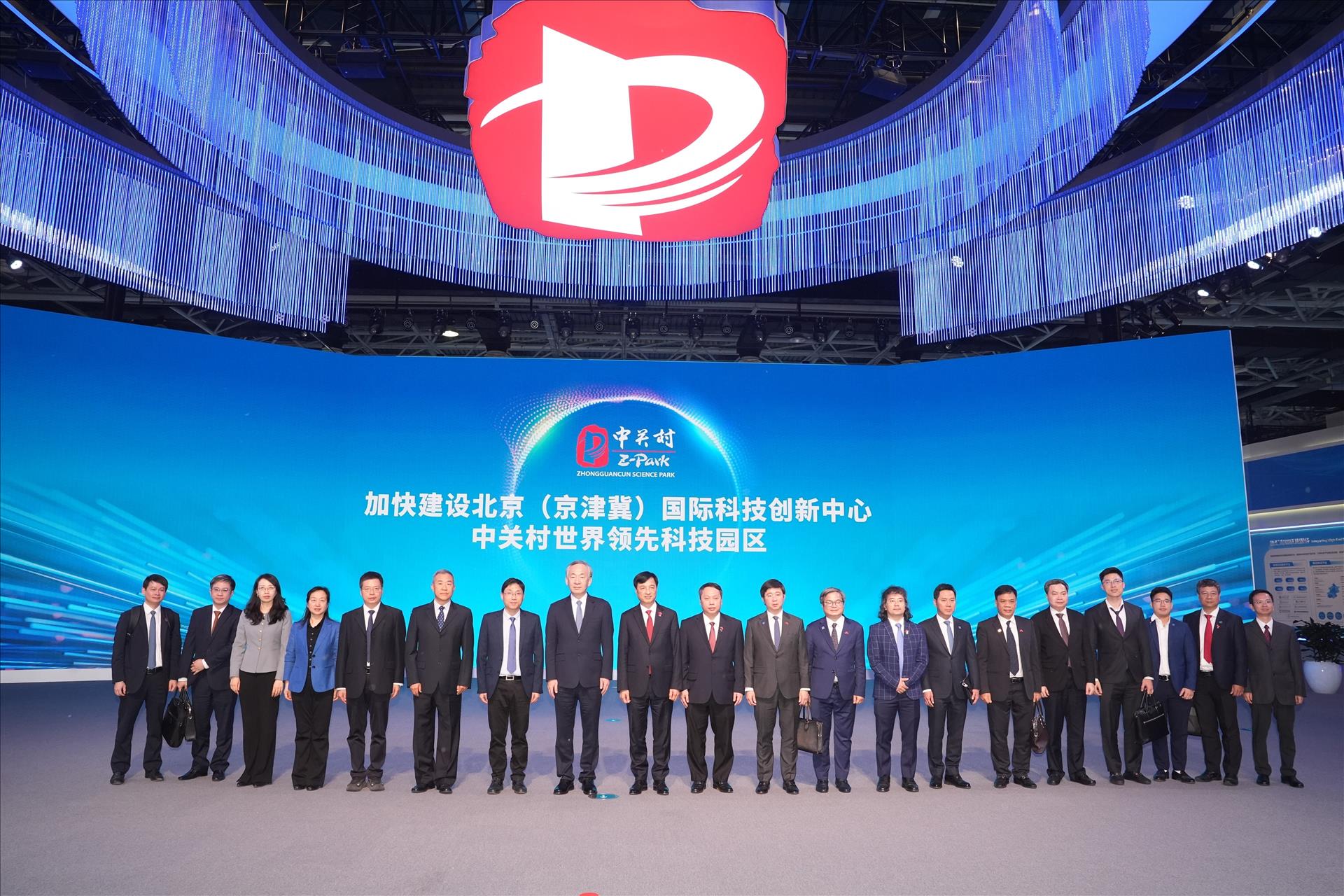
Politburo member and Chairman of the Party Central Committee’s Organisation Commission Nguyen Duy Ngoc on April 15 paid a working visit to Zhongguancun Science Park in Beijing while accompanying General Secretary of the Communist Party of Vietnam (CPV) Central Committee and State President To Lam, his spouse, and a high-level Vietnamese delegation on a state visit to China.
Ngoc, who also serves as Standing Deputy Head of the Central Steering Committee for the Development of Science, Technology, Innovation and Digital Transformation, toured the park’s exhibition area and was briefed on the formation and development of Zhongguancun, along with Beijing’s achievements in science, technology and innovation.
At a working session with the park’s management board, Ngoc praised Beijing and Zhongguancun for their progress in development of science, technology, innovation and digital transformation, noting that many of their experiences and models could serve as practical references for Vietnam in refining institutions, policies and implementation mechanisms.
He stressed that Vietnam is accelerating the implementation of the Politburo’s Resolution No. 57-NQ/TW, which identifies science, technology, innovation and digital transformation as key drivers for rapid and sustainable development. In that spirit, he expressed his hope that Beijing, Zhongguancun and relevant Chinese agencies will step up exchanges, share experience and promote cooperation with Vietnamese agencies and localities, including Hanoi. Priority areas include smart cities, artificial intelligence, robotics, semiconductors, elderly care, medical technology, and high-quality human resources training.
For his part, Vice Mayor of Beijing Jin Wei welcomed Ngoc and the Vietnamese delegation and outlined the city’s development orientations in science, technology and innovation.
Jin noted that, as a megacity, Beijing is addressing multiple governance challenges, including environmental protection, transport, urban management, and improving residents’ quality of life. He said the city has consistently placed science, technology and innovation at the core of its development strategy.
Beijing is home to more than 30,000 nationally recognised high-tech enterprises and has developed several large-scale industrial clusters. The city also has more than 400 key robotics enterprises and strong advantages in education, research, and high-quality human resources, with numerous leading universities and research institutes.
The Chinese official highlighted that Beijing has focused on creating a favourable environment for enterprises to raise practical issues, enabling authorities to promptly adjust policies and support mechanisms, thereby fostering a dynamic innovation ecosystem with close linkages among the State, schools, and businesses.
Jin expressed his belief that, based on the sound bilateral relationship, ministries, sectors, localities, and businesses of both sides will continue to expand substantive exchanges and cooperation in the coming time.
At the session, Zhongguancun representatives also introduced its organisational model, governance mechanisms, and methods for coordinating the innovation ecosystem, particularly cooperation among state agencies, enterprises, research institutes, and universities in implementing key science and technology tasks.
Zhongguancun, China’s first national innovation demonstration zone, is regarded as a typical model for developing a large-scale innovation ecosystem with the participation from the State, schools, and enterprises. Experiences shared at the working session are expected to provide useful references for Vietnam in developing high-tech parks and innovation zones, and in promoting enterprise engagement in addressing major national technological challenges./.