Vietnam has taken a significant step toward mastering space technology with the successful development of advanced composite materials for satellite applications, contributing to its long-term goal of building autonomous and reliable remote sensing capabilities.
As Vietnam seeks to enhance its capacity to develop, operate and utilise Earth observation satellites and satellite constellations, materials science has emerged as a critical enabler. A growing trend in the sector is the replacement of traditional aluminium alloys with carbon fibre-reinforced polymer (CFRP) composites. These materials are significantly lighter while maintaining high strength and stiffness, and they allow a flexible design tailored to specific technical requirements. They are ideal for making protective enclosures for delicate satellite electronics that endure intense vibrations during launch.
However, a key limitation is the epoxy resin used to bind composite layers, which tends to be brittle and prone to cracking under dynamic loads. Addressing this challenge, Dr To Anh Duc and his research team at the Vietnam National Space Centre under the Vietnam Academy of Science and Technology have completed a project to develop and test CFRP materials enhanced with carbon nanomaterials (CNMs) for satellite component enclosures. The research was conducted from January 2024 to December 2025.
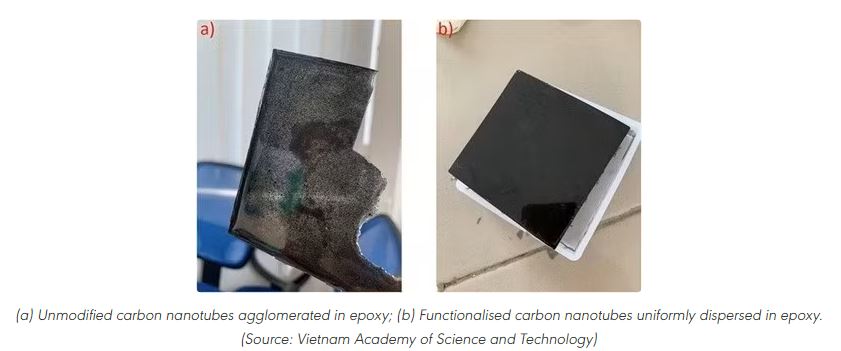
Rather than redesigning the entire material system, the team focused on improving the epoxy resin by incorporating carbon nanotubes - ultra-strong materials that, if not properly treated, tend to agglomerate and reduce performance. By chemically modifying the nanotubes with functional groups, the researchers achieved uniform dispersion within the resin. This microscopic adjustment significantly improved structural stability, enabling more even stress distribution and reducing the risk of cracking.
Building on this foundation, the team developed a complete production process, from nano-dispersion and reinforced resin fabrication to integration with carbon fibres. They successfully manufactured a prototype satellite component enclosure and conducted vibration tests simulating launch conditions.
The results demonstrated clear improvements. When untreated nanotubes were used, material properties showed little enhancement due to clustering. In contrast, treated nanotubes, particularly at an optimal concentration of around 0.2%, achieved an effective balance between strength and flexibility, enhancing both load-bearing capacity and deformation tolerance.
The resulting enclosure weighs approximately 65 grams - about 70% of the weight of an aluminium equivalent - while maintaining required stiffness and structural integrity. Vibration testing showed minimal deviation within internationally accepted limits, confirming the material’s reliability for potential real-world applications.
On a mass-equivalent basis, the composite material outperforms aluminium in load-bearing efficiency and stiffness, especially under primary vibration directions. This highlights a key advantage for modern satellite design, where weight reduction and performance optimisation are critical.
According to Dr Le Xuan Huy, Vice Director General of the Vietnam National Space Centre, such applied research plays an essential role in building technological capacity. He emphasised that self-reliance in the space sector is achieved incrementally, through mastering individual components and processes.
While further testing and validation are required before full deployment, the research marks a promising step forward. It provides valuable data, experience, and human resources development, supporting Vietnam’s broader ambition to achieve greater autonomy in space technology./.