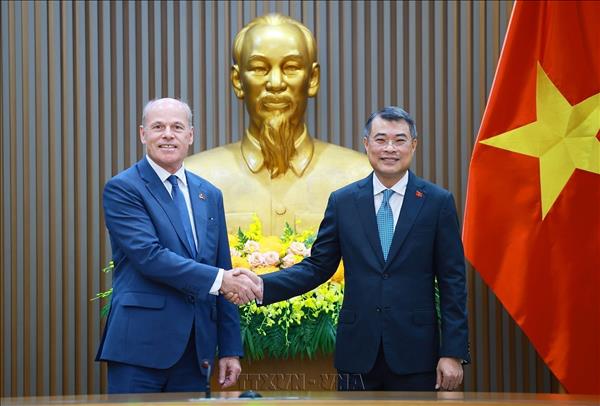
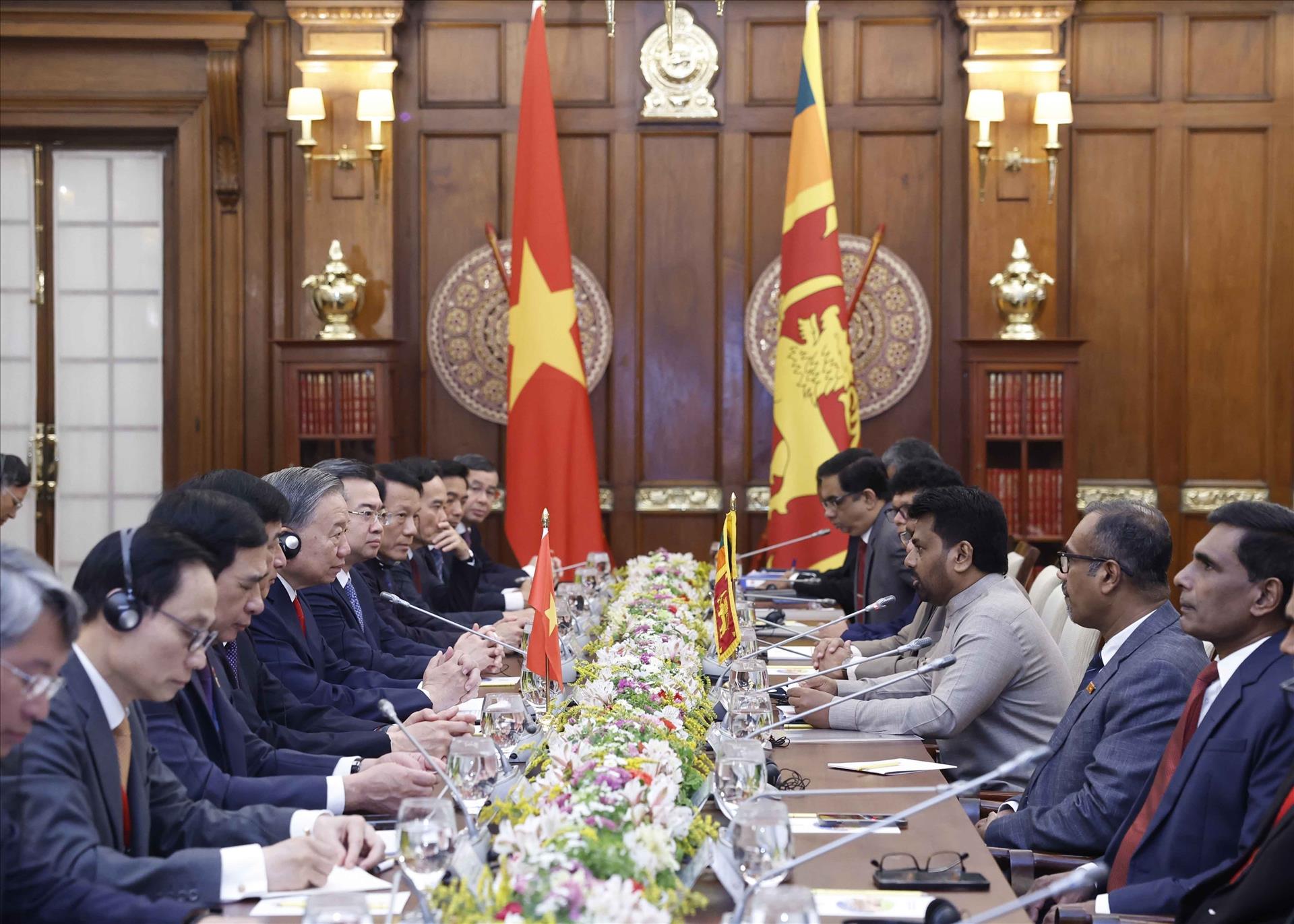
General Secretary of the Communist Party of Vietnam (CPV) Central Committee and State President To Lam held talks with Sri Lankan President Anura Kumara Dissanayake at the Presidential Secretariat in Colombo. Photo: VNA
President Dissanayake welcomed General Secretary and President Lam and the high-ranking Vietnamese delegation, describing the visit as an important milestone in the history of bilateral relations. He also congratulated General Secretary Lam on being elected by the 16th National Assembly as State President, with overwhelming support.
Emphasising the longstanding and profound nature of the bilateral ties, which, he said, go beyond ordinary relations, the President noted that the leaders and people of Sri Lanka have always maintained sincere friendship and affection toward Vietnam and late President Ho Chi Minh under all circumstances. He also expressed his admiration for Vietnam as a development model in the region and globally, while praising the CPV for its leadership in guiding the country’s development achievements.
The top Vietnamese leader congratulated Sri Lanka on its positive achievements in stabilising the macro-economy, restructuring debt, and recovering from the 2020–2024 crisis period. He particularly praised the country’s effective implementation of its economic reform programme and the “Clean Sri Lanka 2026” initiative.
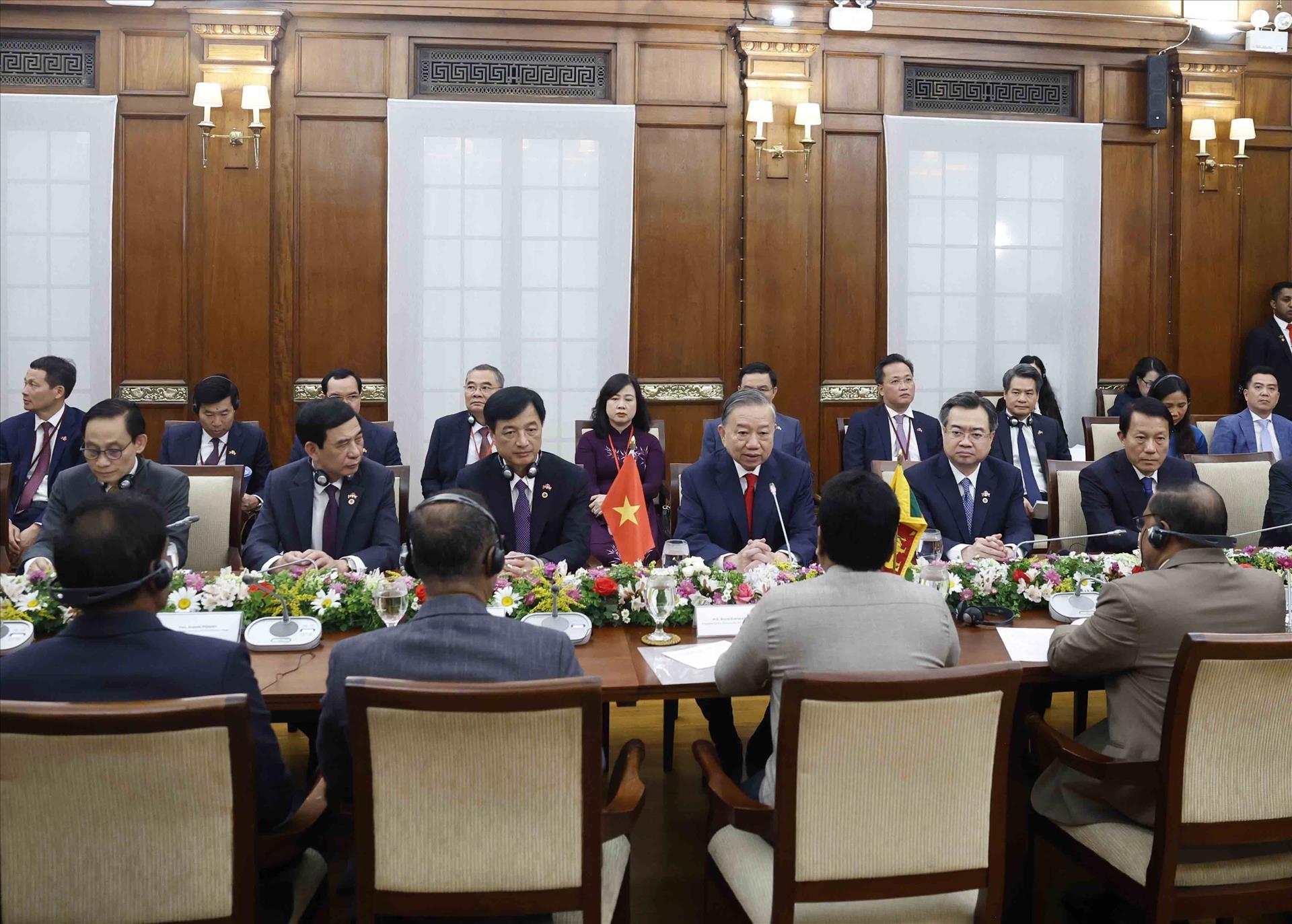
General Secretary of the Communist Party of Vietnam (CPV) Central Committee and State President To Lam held talks with Sri Lankan President Anura Kumara Dissanayake at the Presidential Secretariat in Colombo. Photo: VNA
General Secretary and President Lam expressed his confidence that under President Dissanayake’s leadership, Sri Lanka will enter a path of stable and sustainable growth, successfully achieve its development objectives, and realise its “Vision 2048” goal of becoming a developed country by the centenary of independence.
The two leaders briefed each other on the situation in their respective countries and expressed satisfaction with the traditional friendship and multifaceted cooperation that the two nations have nurtured for more than half a century, founded on political trust, steadfast support, shared Buddhist cultural values, and their active membership in the Non-Aligned Movement.
Noting that the bilateral relations are currently at their most positive stage of development, the two leaders exchanged views on major orientations to further deepen the ties in line with the considerable potential of both countries, thereby elevating bilateral cooperation for the benefit of their people and for peace, stability, and development in the region and the world.
The two sides agreed to further strengthen political trust and comprehensively advance traditional friendship and multifaceted collaboration; expanding high-level and all-level exchanges and contacts; maintain regular bilateral cooperation mechanisms across various sectors; strengthen ties between the two ruling parties; and enhance exchanges on theoretical issues, foreign policy, and regional and international matters of mutual concern.
They also agreed to promote more substantive and effective defence and security cooperation, particularly in United Nations peacekeeping training, information sharing, and defence technology transfer, while pledging to further strengthen cooperation in maritime security and cybersecurity.
Emphasising the strong potential for trade and investment cooperation, the two leaders agreed to implement groundbreaking measures aimed at achieving the bilateral trade target of 1 billion USD in the near future. General Secretary and State President Lam affirmed that Vietnam stands ready to supply the Sri Lankan market with products in which Vietnam has strengths and Sri Lanka has demand, including food and foodstuffs and agricultural machinery.
For his part, President Dissanayake affirmed that the Sri Lankan Government will create favourable conditions and offer incentives for Vietnamese enterprises investing and operating in Sri Lanka, and promote cooperation in high-tech agriculture, climate change adaptation, and green transition.
The two leaders also agreed to strengthen collaboration in agriculture, agricultural supply chain connectivity, post-harvest preservation technologies, fisheries, science and technology, and digital transformation. They pledged to share experiences in developing key export products and implement mutually beneficial research and technology transfer projects, with the aim of developing symbolic cooperation projects.
Both sides also agreed to make cooperation in culture, education, connectivity, and people-to-people exchanges an important pillar of the bilateral relations. In this regard, the two countries will expand tourism cooperation, particularly in spiritual tourism, launch direct flights, and promote partnerships between universities and research institutes.
President Dissanayake also proposed Vietnam establish branch campuses of several major Vietnamese universities in Sri Lanka.
Responding to President Dissanayake’s remarks on the affection and respect that the Sri Lankan people reserve for President Ho Chi Minh, General Secretary and President Lam said that cultural cooperation should be further promoted. He proposed Sri Lanka support activities honouring the late President, as well as efforts to promote Vietnamese culture and language in the country. He emphasised that both sides should demonstrate strong determination in promptly implementing the agreements reached during the visit.
Regarding regional and international issues of mutual concern, the two leaders stressed that amid increasingly complex global and regional developments, Vietnam and Sri Lanka should maintain close coordination at multilateral forums, particularly at the United Nations, the Non-Aligned Movement, and the Global South Forum.
Both sides reaffirmed the importance of maintaining peace, stability, security, and freedom of navigation, while underscoring the need to peacefully settle disputes on the basis of respect for and compliance with international law, especially the 1982 United Nations Convention on the Law of the Sea (UNCLOS)./.
The two leaders briefed each other on the situation in their respective countries and expressed satisfaction with the traditional friendship and multifaceted cooperation that the two nations have nurtured for more than half a century, founded on political trust, steadfast support, shared Buddhist cultural values, and their active membership in the Non-Aligned Movement.
Noting that the bilateral relations are currently at their most positive stage of development, the two leaders exchanged views on major orientations to further deepen the ties in line with the considerable potential of both countries, thereby elevating bilateral cooperation for the benefit of their people and for peace, stability, and development in the region and the world.
The two sides agreed to further strengthen political trust and comprehensively advance traditional friendship and multifaceted collaboration; expanding high-level and all-level exchanges and contacts; maintain regular bilateral cooperation mechanisms across various sectors; strengthen ties between the two ruling parties; and enhance exchanges on theoretical issues, foreign policy, and regional and international matters of mutual concern.
They also agreed to promote more substantive and effective defence and security cooperation, particularly in United Nations peacekeeping training, information sharing, and defence technology transfer, while pledging to further strengthen cooperation in maritime security and cybersecurity.
Emphasising the strong potential for trade and investment cooperation, the two leaders agreed to implement groundbreaking measures aimed at achieving the bilateral trade target of 1 billion USD in the near future. General Secretary and State President Lam affirmed that Vietnam stands ready to supply the Sri Lankan market with products in which Vietnam has strengths and Sri Lanka has demand, including food and foodstuffs and agricultural machinery.
For his part, President Dissanayake affirmed that the Sri Lankan Government will create favourable conditions and offer incentives for Vietnamese enterprises investing and operating in Sri Lanka, and promote cooperation in high-tech agriculture, climate change adaptation, and green transition.
The two leaders also agreed to strengthen collaboration in agriculture, agricultural supply chain connectivity, post-harvest preservation technologies, fisheries, science and technology, and digital transformation. They pledged to share experiences in developing key export products and implement mutually beneficial research and technology transfer projects, with the aim of developing symbolic cooperation projects.
Both sides also agreed to make cooperation in culture, education, connectivity, and people-to-people exchanges an important pillar of the bilateral relations. In this regard, the two countries will expand tourism cooperation, particularly in spiritual tourism, launch direct flights, and promote partnerships between universities and research institutes.
President Dissanayake also proposed Vietnam establish branch campuses of several major Vietnamese universities in Sri Lanka.
Responding to President Dissanayake’s remarks on the affection and respect that the Sri Lankan people reserve for President Ho Chi Minh, General Secretary and President Lam said that cultural cooperation should be further promoted. He proposed Sri Lanka support activities honouring the late President, as well as efforts to promote Vietnamese culture and language in the country. He emphasised that both sides should demonstrate strong determination in promptly implementing the agreements reached during the visit.
Regarding regional and international issues of mutual concern, the two leaders stressed that amid increasingly complex global and regional developments, Vietnam and Sri Lanka should maintain close coordination at multilateral forums, particularly at the United Nations, the Non-Aligned Movement, and the Global South Forum.
Both sides reaffirmed the importance of maintaining peace, stability, security, and freedom of navigation, while underscoring the need to peacefully settle disputes on the basis of respect for and compliance with international law, especially the 1982 United Nations Convention on the Law of the Sea (UNCLOS)./.