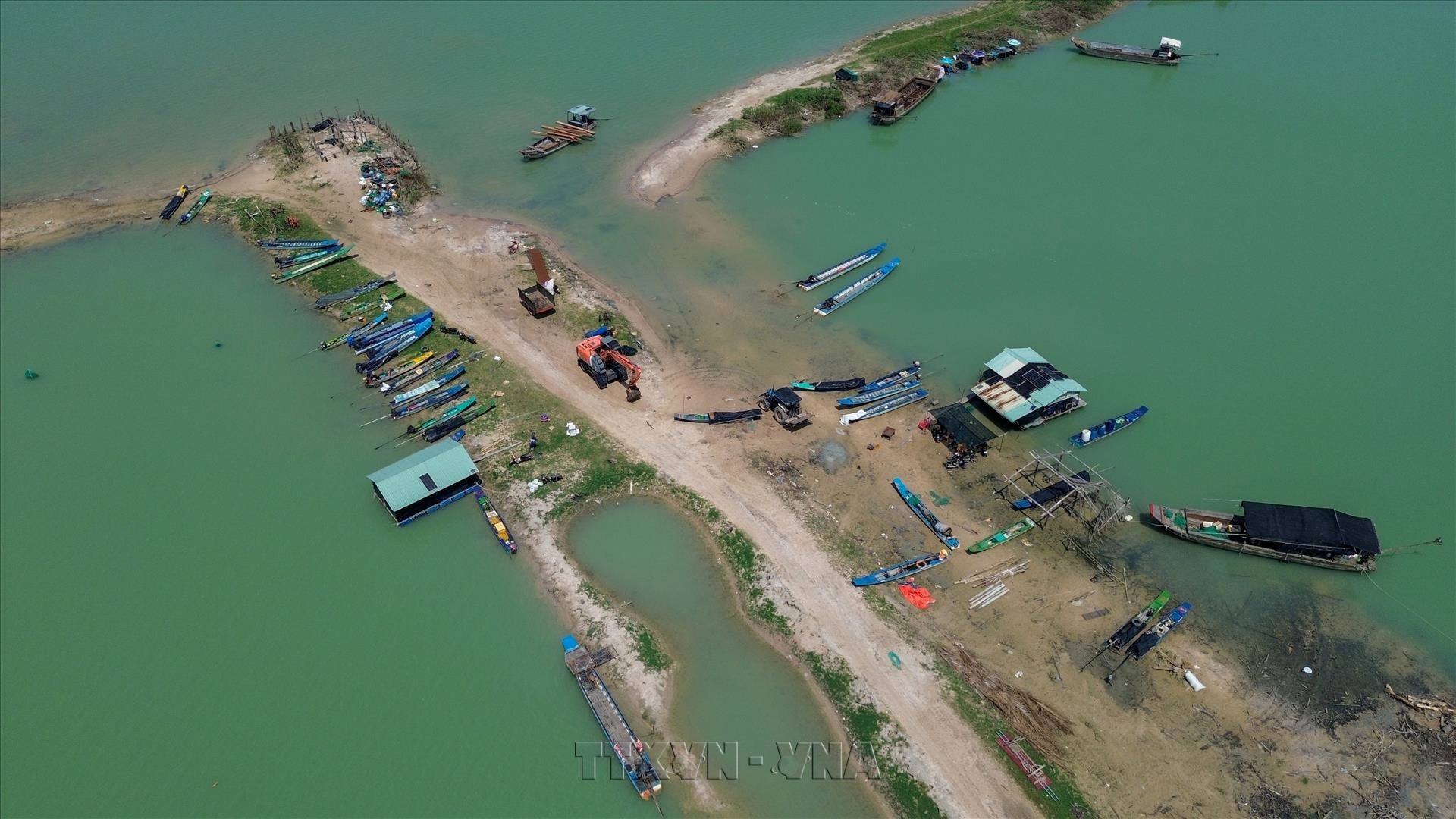
Dau Tieng Reservoir not only ensures water security but also offers strong potential for ecotourism and the development of green industries. Photo: Giang Phuong/VNA
Vital role and potential of “turquoise gem”
As Southeast Asia's largest artificial irrigation reservoir, Dau Tieng covers about 270 sq.km and has a designed storage capacity of 1.58 billion cubic metres. It spans Tay Ninh province, Ho Chi Minh City and Dong Nai province, with a system comprising the main dam, auxiliary dams, regulating sluices, spillways, about 150km of canals and more than 300 irrigation facilities.
For decades, the reservoir has played a vital role in ensuring water security by providing direct irrigation for nearly 117,000 hectares of farmland while supplying water for additional agricultural areas, domestic use and industrial production.
It also helps prevent saltwater intrusion, ensures irrigation for about 28,800 hectares of farmland along the Sai Gon River and 32,317 hectares along the Vam Co Dong River, mitigates flooding, improves the downstream environment and enhances water quality. In addition, it generates electricity by utilising environmental discharge flows and water released through intake sluices, with a combined installed capacity of 20.5 MW.
Beyond its irrigation functions, Dau Tieng has become known as the "green lung" of the region thanks to its expansive water surface, peninsulas, islands and diverse ecosystems. These natural advantages provide favourable conditions for developing eco-tourism, ecological agriculture, sustainable aquaculture and other nature-based services.
On clear days, the vast turquoise lake stretches to the horizon, reflecting surrounding forests and scattered islands. Its peaceful setting and fresh air have made it a popular destination for boating, camping, fishing and watching sunrise and sunset.
When connected with the Ba Den Mountain national tourist site and nearby historical and cultural attractions, the reservoir is expected to become part of a diversified tourism network that encourages visitors to stay longer and spend more.
One of the reservoir’s most distinctive attractions is the sight of herds of cattle grazing on semi-submerged grasslands that emerge as water levels recede during the dry season. Set against lush green fields and the vast expanse of water, the landscape has become a favourite destination for photographers, nature lovers and outdoor enthusiasts, with many describing it as one of Dau Tieng Reservoir's unique seasonal highlights.
Doan Thi Nhu Huong, a visitor from Ho Chi Minh City, said she was impressed by the reservoir's immense size, clean air and largely untouched landscape, adding that it offers ideal conditions for camping, boating and sightseeing and promises to become a tourist magnet if developed in harmony with environmental conservation.
Similarly, Nguyen Thanh Danh from Dong Nai province said Dau Tieng’s well-preserved ecosystem and tranquil scenery give it a distinctive appeal. He stressed that development should always go hand in hand with environmental protection to maintain its natural beauty for future generations.
Coordinated actions to optimise advantages
Tran Quang Hung, General Director of Southern Irrigation Exploitation One Member Co. Ltd., noted the reservoir still holds considerable untapped potential for eco-tourism, aquaculture, semi-submerged forest, responsible mineral exploitation, and renewable energy projects such as floating solar power.
To maximise opportunities, the company will work with relevant agencies to review and digitise maps of the reservoir's protected zones, increase boundary markers and improve land management.
It will also coordinate with local authorities to incorporate land within the reservoir area into local land-use plans while ensuring a balance between infrastructure protection and the legitimate interests of residents in the lake’s semi-submerged areas and protection corridors, Hung went on.
Meanwhile, Tay Ninh authorities will continue working with management units to strengthen safety monitoring, protect reservoir corridors, control resource exploitation, prevent water pollution, conserve upstream forests and biodiversity, monitor water quality and raise public awareness of environmental protection, ensuring Dau Tieng Reservoir develops sustainably while maintaining its vital role in regional water security and economic growth./.