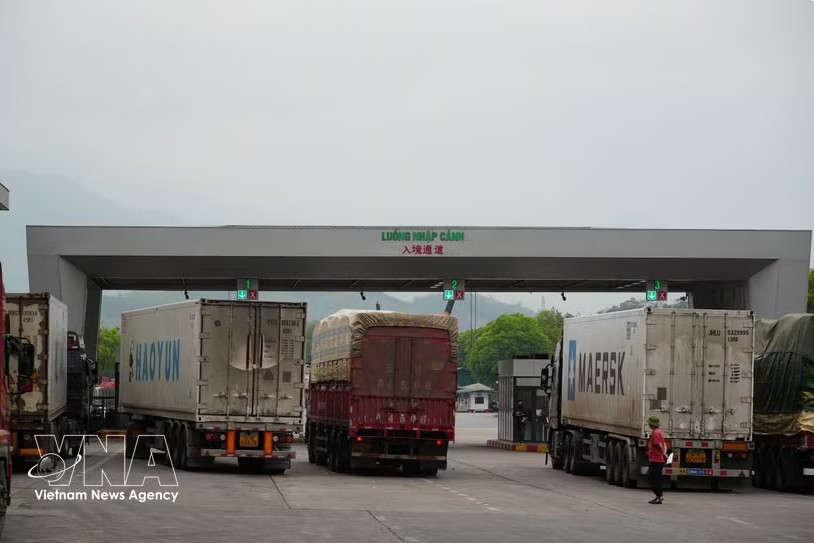
Trucks carrying imports enter Vietnam through Lao Cai International Border Gate. Photo: VNA
In recent years, Cao Bang province has proactively implemented synchronous measures to promote its border gate economy. Despite global and regional uncertainties and challenges to international trade, the northern province recorded strong results in 2025, maintaining growth momentum and contributing significantly to socio-economic development.
Total foreign trade turnover through Cao Bang’s border gates reached 1.63 billion USD, up 84% year-on-year and exceeding the provincial target by 81%. State budget revenue from imports and exports approximated 2.26 trillion VND (85 million USD), surging 144% compared to 2024 and equivalent to 327% of the assigned target. These figures highlight the growing importance of the border gate economy in the province’s fiscal structure.
The results reflect strong political determination by the provincial Party Committee and authorities in effectively leveraging border advantages.
Identifying the border gate economy as a leading growth pillar, Cao Bang has issued a development programme for the 2025–2030 period, outlining clear tasks and objectives.
A key solution is the development of a digital border gate platform to automate the management of vehicles and goods, reduce manual procedures, and ensure data connectivity among relevant agencies. The roadmap includes the preparation phase through March 2026, pilot implementation at Ta Lung and Tra Linh border gates in April and May, and full-scale operation across the province from June 1. The platform is expected to significantly improve management efficiency and operational transparency.
Experience from Cao Bang shows that geographical advantages can only be fully translated into development gains when combined with new thinking, modern technology, and advanced governance methods.
Meanwhile, Lao Cai province is also accelerating efforts to develop its border gate economy. With a borderline of about 182 km, it aims to turn its border gate economic zone into a key growth engine by adopting a smart border gate model, viewing this as a breakthrough measure for improving management efficiency, reducing logistics expenses, and enhancing customs clearance capacity.
The province is implementing a project at the clearance points of Kim Thanh Bridge and Ban Vuoc under the Lao Cai International Border Gate. The project focuses on modernising management, inspection, and supervision through advanced technology and automated transport systems, with the goal of cutting logistics costs and facilitating trade.
By 2030, Lao Cai targets import – export turnover of around 9 billion USD, a doubling of cargo throughput at these two clearance points, and a 20–30% reduction in logistics costs.
Central to the project is the development of a smart border gate model based on synchronised data connectivity between Vietnam and China, along with the use of unmanned vehicles for cargo transport under bilateral agreements. The model integrates advanced technologies such as artificial intelligence, the Internet of Things, big data, 5G networks, and satellite positioning systems.
Linking smart border gate development with cross-border e-commerce is opening a new direction in line with digital economy trends. Provincial leaders consider this model an inevitable step in modernising border trade and implementing the Party’s policy of building a more efficient and competitive border gate economy./.