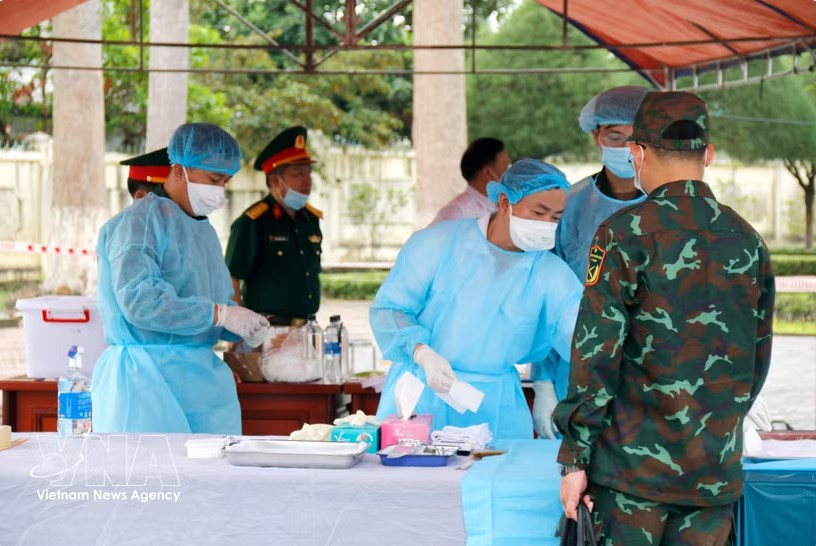
Authorities in central Lam Dong province on June 4 launched a pilot programme to collect biological samples, digitise records and transfer remains of unidentified fallen soldiers for DNA analysis, part of the nationwide “500-day campaign” aimed at accelerating the search for, recovery and identification of martyrs’ remains.
The activity, carried out at the Duc Linh commune Martyrs’ Cemetery, marks an important step in applying scientific and technological advances to help identify fallen soldiers while responding to the long-standing aspirations of their families and relatives.
The cemetery was selected as the province’s pilot site for sample collection, handover procedures and the digitisation of information related to martyrs’ remains. A total of 55 samples will be collected, preserved, sealed and transferred in accordance with regulations.
Dinh Van Tuan, Vice Chairman of the provincial People’s Committee and head of the provincial steering committee for the search, recovery and identification of martyrs’ remains, said the collection and preservation of samples from martyrs' remains serves as a practical test of the entire process, from preparation and grave opening to sample collection, preservation, handover, storage of remains and temporary restoration of graves.
The results will provide a basis for a comprehensive assessment of the procedures, helping authorities identify strengths and shortcomings, draw lessons from implementation and refine future plans to ensure that the work is conducted in a scientific, rigorous and effective manner.
Lam Dong is currently home to 12 martyrs’ cemeteries, 11 of which contain unidentified graves requiring sample collection. Authorities estimate that samples will need to be collected from 4,845 unidentified graves across the province. The largest numbers are located at the Binh Thuan Martyrs’ Cemetery with 3,436 graves, and the Lam Dong Martyrs’ Cemetery with 777 graves.
Given the scale of the task, Tuan said the campaign will require strong coordination, careful planning and sustained commitment to achieve meaningful results.
According to the provincial steering committee, the standardisation of sample collection procedures and the digitisation of information will gradually help build a comprehensive and reliable database, providing a crucial foundation for DNA analysis and comparison.
The initiative is viewed as a breakthrough effort that leverages advances in science and technology to identify fallen soldiers whose identities have remained unknown for decades.
On June 3, representatives from 11 communes and wards housing martyrs’ cemeteries across the province attended a training programme on sample collection, handover procedures and data digitisation in preparation for the campaign./.