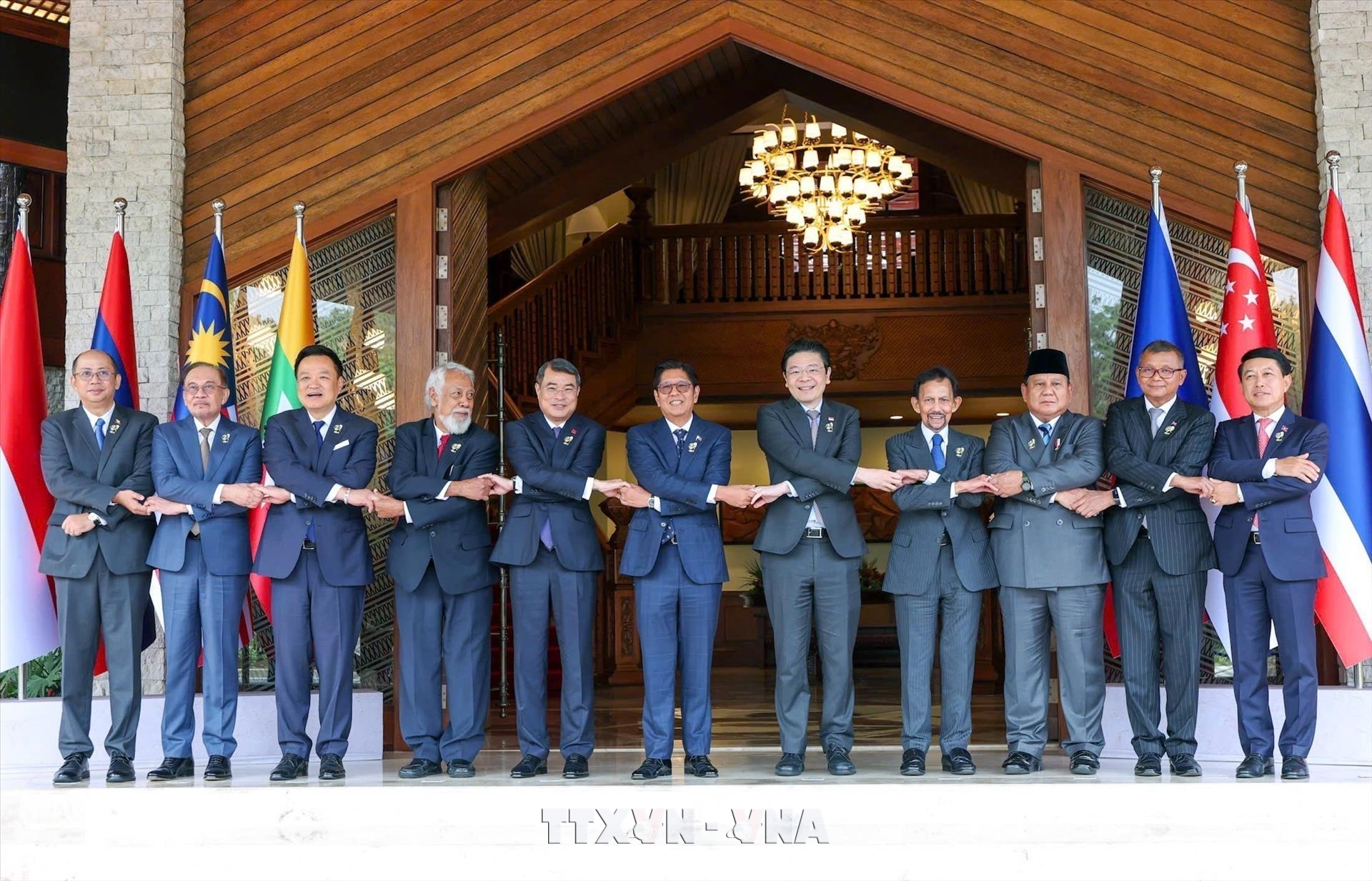
Prime Minister Le Minh Hung and other heads of delegation attend the retreat session of the 49th ASEAN Summit. Photo: VNA
Sharing his insights into the significance of the trip, the Thai scholar expressed his admiration for Vietnam’s neutral foreign policy - a stance that fosters friendship with all nations and demonstrates a genuine readiness to expand comprehensive cooperation globally. He noted that this approach aligns perfectly with ASEAN’s own objective of strengthening broad, friendly ties with countries across every region of the world.
Songkrit emphasised that the Vietnamese Prime Minister's participation in the Manila Summit directly reinforces ASEAN’s commitment to such a neutral foreign policy, which is highly beneficial for the bloc, especially given the current multipolar geopolitical landscape.
"I am confident that such unity in maintaining a neutral foreign policy will empower ASEAN to effectively navigate and overcome any challenges or obstacles it may face," he said.
Regarding Vietnam’s role in ASEAN Community-building, Songkrit observed that the country’s continuous socio-economic progress highlights its remarkable potential across various sectors. He pointed out that notable advancements, such as the development of economic infrastructure, the growth of industrial and agricultural capabilities, the enhancement of production and service technologies, and the international recognition of its capital and financial markets, all attest to the success of Vietnam’s efforts to elevate the quality of its human resources.
Building on these milestones, the scholar stated his firm belief that Vietnam possesses great potential to extend these achievements through close cooperation with fellow ASEAN member states, all with the shared goal of improving the quality of life and well-being for the citizens of ASEAN.
Commenting on bilateral and regional cooperation prospects following the Manila Summit, Songkrit noted that ASEAN is built upon three pillars of constructive cooperation: political-security, economic (trade and investment), and socio-cultural. Consequently, he suggested that Vietnam and Thailand should prioritise all three areas.
Specifically, in the political-security sphere, both nations must engage with sincerity to foster stable and sustainable security. Regarding the economy (trade and investment), they should take concerted measures to transition from competitors into genuine partners, such as collaborating on production to ensure food security. In the socio-cultural domain, the focus should be on deepening mutual understanding among their peoples, as well as fostering close exchanges in arts, cultural traditions, and festivals.
Concluding his remarks, Songkrit emphasised that such bilateral efforts could serve as a significant model, with the potential to eventually extend to other ASEAN member states./.