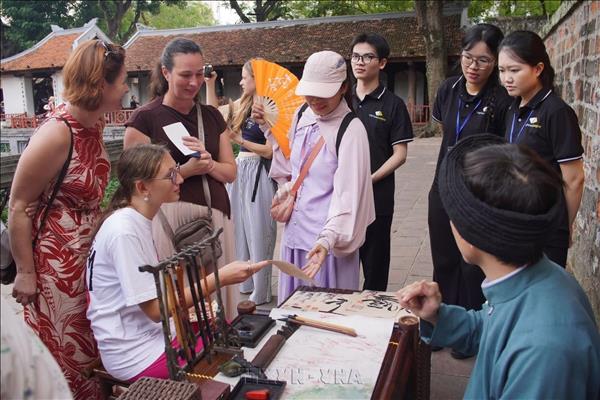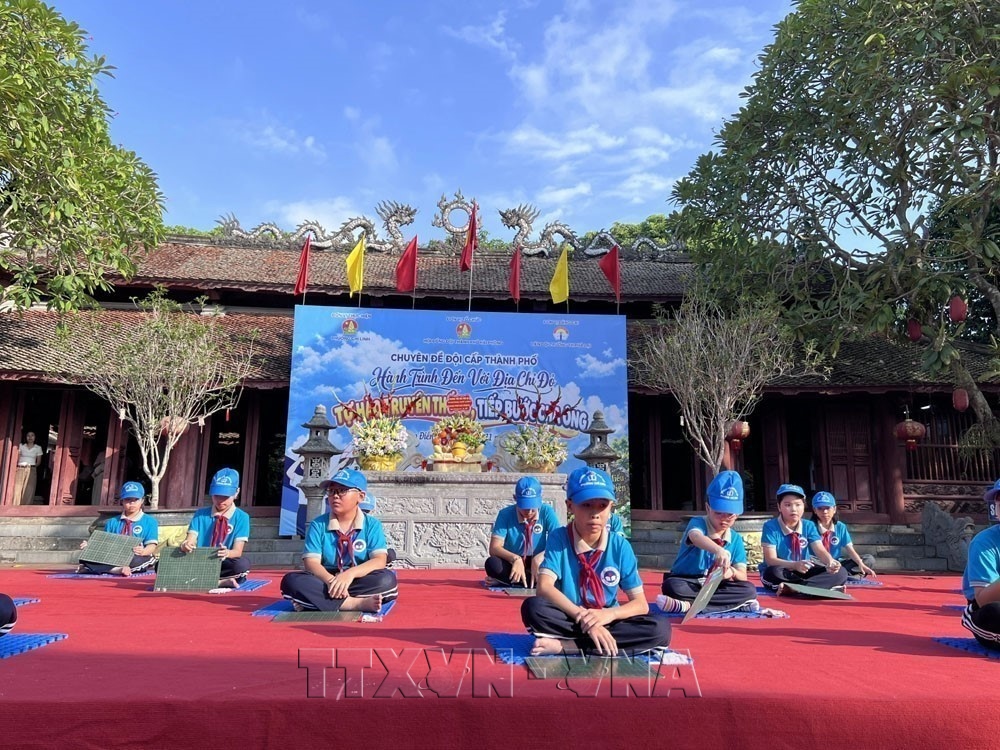
To make the heritage more accessible, local authorities and cultural agencies are also applying digital technology and working with schools to develop educational programmes. Photo: VNA
The special national relic, located in Mao Dien commune, embodies the historical and cultural values of the former region of Hai Duong. Hai Phong authorities are working to promote these values, turning the heritage site into an important resource for the nothern city’s development.
A symbol of academic tradition
Mao Dien Temple represents the tradition of valuing education and Confucian scholarship in the former Hai Duong region and Vietnam as a whole.
The temple was first built in the 15th century under the Early Le Dynasty in Vinh Lai commune, Duong An district. Around the same period, the Hai Duong regional examination centre was established in Mao Dien. Its former grounds are now known as Trang Field.
Historical records show that the examination centre initially served the region before becoming a national examination venue under the Mac Dynasty. During this period, it hosted four metropolitan examinations. Under the Tay Son Dynasty (1788–1802), the temple was relocated from Vinh Lai to Mao Dien and combined with the examination centre, forming an important centre of education and culture.
Over the centuries, the site has undergone several restoration and renovation projects. It was recognised as a national historical and cultural relic in 1992, followed by further restoration between 2002 and 2016. In 2017, it was designated a special national relic and, in December 2024, recognised as a provincial-level tourist area.
The temple worships Confucius and eight distinguished Vietnamese scholars and historical figures, namely renowned teacher Chu Van An; Mac Dinh Chi, who earned the highest academic title in both Vietnam and China; doctoral laureate Pham Su Menh; physician and Zen master Tue Tinh; national hero and great man of culture Nguyen Trai; scholar Nguyen Binh Khiem; mathematician Vu Huu; and Nguyen Thi Due, a female doctoral laureate.
Today, the temple serves as a destination for educational activities and the promotion of academic excellence, attracting tens of thousands of visitors who come to explore its history and pay tribute to national scholars.
Its annual festival is held twice a year, with the main spring celebration taking place on the 18th day of the second lunar month. The event honours distinguished predecessors and promotes the traditions of learning and respect for teachers.
Turning heritage into an educational resource
Hai Duong province, now part of Hai Phong city, has made efforts to preserve and promote the temple's values through activities that educate younger generations about national history and the importance of education.
Le Thi Thoa, deputy head of the Cam Giang relic management division under the Con Son–Kiep Bac Relic Management Board of Hai Phong's Department of Culture, Sports and Tourism, said preservation work covers the temple's architectural structures, cultural spaces, stone steles, Han-Nom script documents and artefacts related to the history of Confucian education and examinations.
The work also includes making surveys, preparing scientific records, conducting research and digitising historical materials to ensure their long-term preservation.
The management board has organised various activities, including the temple festival, incense-offering ceremonies, spring calligraphy activities and ceremonies honouring outstanding students and academic achievers.
To make the heritage more accessible, local authorities and cultural agencies are also applying digital technology and working with schools to develop educational programmes, Thoa added./.