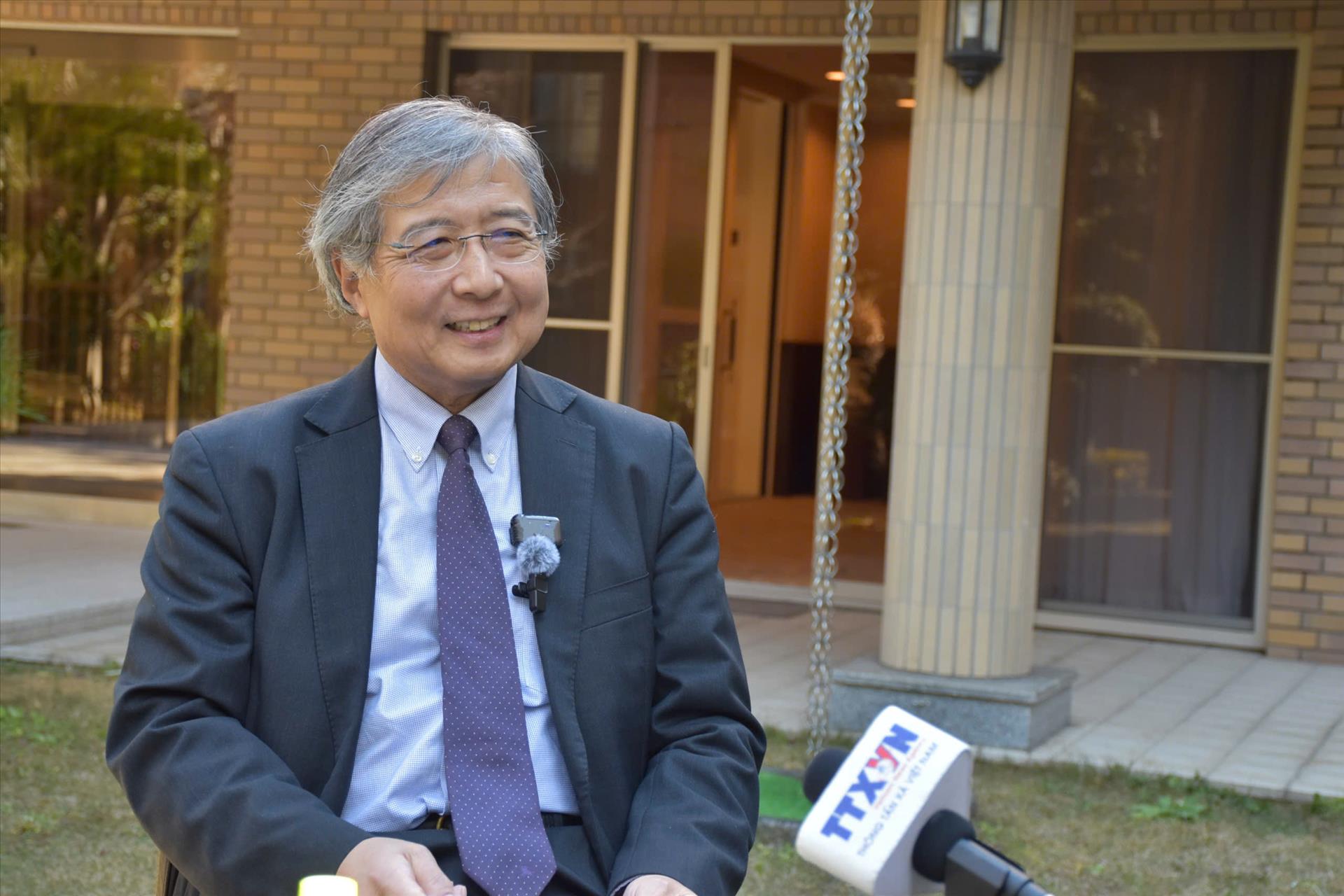
Professor Toshiro Nishizawa of the University of Tokyo has highlighted the increasingly prominent role of Vietnam’s National Assembly (NA) and local authorities in promoting socio-economic development, as well as the importance of parliamentary cooperation to general relations between Vietnam and Japan.
Reporter: How do you assess the performance of Vietnam’s 15th National Assembly during the 2021–2026 term?
Professor Toshiro Nishizawa: Although the 15th National Assembly faced various disruptions in the aftermath of the pandemic, I understand that, in the latter half of the term, it pursued institutional reforms and administrative efficiency with considerable determination.
Many media outlets and Vietnam watchers have evaluated its performance positively, often describing the Assembly as having “advanced the modernization of state governance.”
I understand that in 2025 the Assembly passed 89 laws and 91 resolutions—more than 40 percent of all laws and resolutions adopted during the entire 15th term. Among these, what particularly caught my attention was the resolution adopted on June 16 to amend and supplement several articles of the 2013 Constitution. This constitutional amendment enabled the implementation of a large-scale reorganization of local administrative structures.
The traditional 63 administrative units have been consolidated into 34, and the administrative hierarchy has shifted from a three‑tier system to a two‑tier system (from “province/centrally governed city – district – grassroots level” to “province/centrally governed city – grassroots level”). Like the restructuring and rationalization of ministries and central agencies in March last year, this represents a very bold administrative reform.
Another aspect I found especially interesting was the first‑ever use of the electronic identification system (VNeID), introduced during the pandemic in 2021, to collect and aggregate public opinions on draft resolutions. I interpret this as being aligned with the broader national policy of promoting science and technology, innovation, and digital transformation. Given the growing criticism in Japan regarding the slow digitalization of the National Diet, Vietnam’s experience is likely to attract considerable interest.
Reporter: What is the significance of holding the upcoming National Assembly and People’s Councils elections two months earlier than usual as Vietnam enters a new stage of development?
Professor Toshiro Nishizawa: I understand that elections traditionally held in May were moved to March, with the National Assembly scheduled to convene on April 6.
At the 14th National Congress of the Communist Party held this January, Vietnam set ambitious goals: to become an upper‑middle‑income country by 2030 and a developed country by 2045. The Congress also emphasized accelerating administrative reform, anti‑corruption efforts, and digitalization; continuing a multi‑polar foreign policy; and prioritizing reforms in education, healthcare, and climate change response.
These are all highly ambitious objectives. I sense a strong desire to ensure a good start by appointing key government positions in the National Assembly as early as possible in the first year of implementing the Congress resolutions.
The early elections are also meaningful for the implementation of the 2026 socio‑economic development plan, which aims for economic growth exceeding 10 percent.
Furthermore, for Vietnam—which has been advancing a multi‑polar diplomatic strategy—the early elections are necessary to respond to an increasingly uncertain international environment, including conflicts in the Middle East.
In all these areas, I am keen to observe how much progress can be achieved successfully.
Reporter: From your perspective, how can parliamentary cooperation between Vietnam and Japan be further strengthened in the coming years?
Professor Toshiro Nishizawa: In August last year, a delegation of members of the House of Representatives, led by Ms. Yuko Obuchi, Chair of the Japan–Vietnam Parliamentary Friendship Alliance, visited Vietnam.
Their program included courtesy calls on General Secretary To Lam and National Assembly Chairman Tran Thanh Man, a meeting with Mr. Lê Minh Hưng, Chair of the Vietnam–Japan Parliamentary Friendship Association, as well as exchanges with representatives of five provinces and cities in the Mekong Delta at the Can Tho Investment Seminar.
Parliamentary cooperation between Vietnam and Japan is a meaningful component of the broader bilateral relationship. To promote such cooperation, it may be effective for both sides to identify priority areas of shared interest and focus their dialogue accordingly. By moving beyond generalities and engaging in substantive discussions on specific issues, I expect the cooperative relationship to deepen. However, there is such an English saying that “the devil is in the details.” Mutual trust building, dialogue with patience, and increasing the frequency of exchanges are also important. Let’s believe that “God is in the details” instead.
In addition, expanding parliamentary cooperation both vertically and horizontally will be essential for achieving tangible results. Vertical expansion would involve extending cooperation to local assemblies. Horizontal expansion entails extending parliamentary exchanges beyond the realm of politics to include industry, public administration, academia, and, more broadly, engagement with ordinary citizens. This is cooperation aimed at jointly shaping the future—that is, “co‑creation.”
More generally, expanding people-to-people exchanges reinforce Vietnam’s image as a dynamic yet peaceful and respectful nation, committed to cooperation and mutual understanding and respect among people.
Reporter: In a rapidly changing global environment, how can Vietnam enhance parliamentary diplomacy to better support its national development and international engagement?
Professor Toshiro Nishizawa: According to the information platform Vietnam.vn, last year, the National Assembly Chairman, Vice Chairpersons, and members of the Standing Committee participated in numerous diplomatic activities. A highlight was the Chairman’s reception of many visiting delegations at the level of parliamentary speakers from other countries. In a rapidly changing international environment, Vietnam’s role in maintaining its multi‑polar diplomatic approach is becoming increasingly important.
How should parliamentary diplomacy be strengthened?
What I mentioned regarding Vietnam–Japan parliamentary cooperation also applies more broadly to parliamentary diplomacy: identifying priority areas of shared interest, focusing discussions, and moving beyond general statements to concrete issues. Mutual trust, patience, and increasing the frequency of exchanges are important.
It is important for Vietnam to proactively promote the spirit of the “Comprehensive Strategic Partnership (CSP) for Peace and Prosperity in Asia and the World” on a global scale—that is, in its relations with a wide range of countries. Such efforts are expected to encourage partner nations to adopt constructive attitudes and behaviors. Parliamentary diplomacy, I believe, can make a significant contribution to these endeavors./