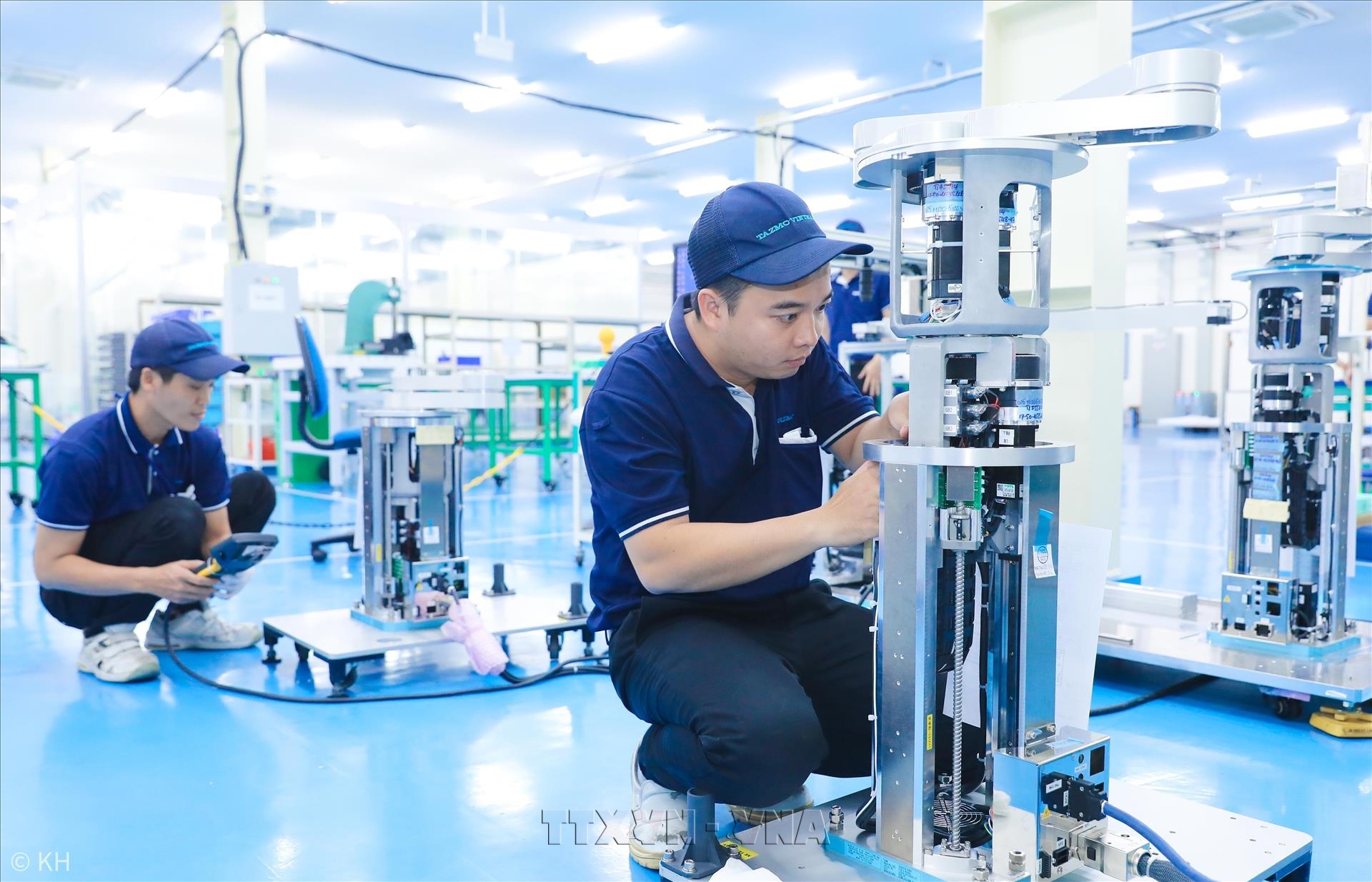
The Japanese-invested TAZMO Vietnam in Long Hau Industrial Park, Tay Ninh province, produces approximately 70,000 devices annually. Photo: VNA
Anh said Japan's semiconductor strategy centres on four priorities – strengthening economic security and supply chain resilience; building capabilities in next-generation technologies such as advanced logic, memory, 3D integration, chiplets and advanced packaging; combining semiconductors with artificial intelligence; and leveraging the country's strengths in materials, manufacturing equipment, testing and reliability while retraining its workforce.
Japan is aware that no country can single-handedly manage the entire semiconductor supply chain, so cooperation with partners like the US, Europe, and Asian countries including Vietnam forms a crucial part of Japan's strategy, he said.
Regarding the five joint semiconductor research projects linking leading universities in Vietnam and Japan, Anh said their greatest value lies in shifting Vietnam from learning semiconductor theory to training talent through practical research. He noted that semiconductor engineers must gain hands-on experience through solving technological problems, operating advanced equipment, working under strict research standards and taking responsibility for the quality of research outcomes.
The projects cover fundamental areas linked with important development directions of the semiconductor industry, including 3D integrated circuits based on CFET structures, high-mobility materials and transistors, materials for sensors and renewable energy, secure AI-on-chip systems using RISC-V architecture, and wide-bandgap materials for power electronics. Running for about 42 months, they include dedicated components to develop young researchers, contributing to Vietnam's goal of training around 250 doctoral-level semiconductor specialists.
The projects allow Vietnamese doctoral students and young scientists to participate throughout the research process, from identifying scientific problems and designing experiments to fabrication, testing, data analysis, international publication and intellectual property development. More importantly, they also access research organising methodology of Japan's leading laboratories in terms of quality management, data recording, laboratory safety and university – industry collaboration, which are skills hard to be fully obtained through theory learning.
Training human resources through joint research projects will help considerably reduce the time needed for gaining experience, the expert said.
Anh added that the programme also promotes joint doctoral supervision, long-term researcher exchanges, shared facilities and joint research groups. However, he stressed that Vietnam must also strengthen its capacity to receive and build on the programme's outcomes. Besides, it is necessary to boost investment and devising favourable financing mechanisms for key domestic institutions and laboratories to be equipped with appropriate facilities, standardised processes, operating standards and data management systems matching those of their Japanese partners, so that returning researchers can continue their work, establish research teams, train future generations, and have stable funding sources to work.
If implemented effectively, the projects will help establish core research teams, joint laboratories and a long-term Vietnam–Japan research network, strengthening Vietnam's independent research capability, technology absorption and participation in the global semiconductor value chain. Their greatest value, he said, lies in developing a generation of experts capable of leading research, training talent and creating technologies suited to Vietnam's development needs.
Commenting on FPT's first commercial chip exports to Japan and its agreement with Restar to distribute 10 million FPT-designed chips across the Asia-Pacific region between 2026 and 2028, Anh described the achievement as an important milestone showing Vietnamese firms are moving beyond providing manpower and design services to developing their own branded semiconductor products accepted by international markets.
He noted that the first shipment, comprising power management chips for multifunction printers, successfully met Japan's stringent requirements for electrical performance, reliability, and supply chain standards. The achievement also demonstrates Vietnam's ability to target promising market segments such as power management chips, controller chips, IoT devices and products based on mature manufacturing technologies.
The expert cautioned, however, that the agreement concerns distribution across the Asia-Pacific region rather than Japan alone. While it reflects Vietnamese firms' growing capabilities in chip design, commercialisation and compliance with international standards, sustainable competitiveness will depend on developing a broader product portfolio, expanding the customer base, generating recurring revenue, ensuring reliable supply and strengthening intellectual property./.