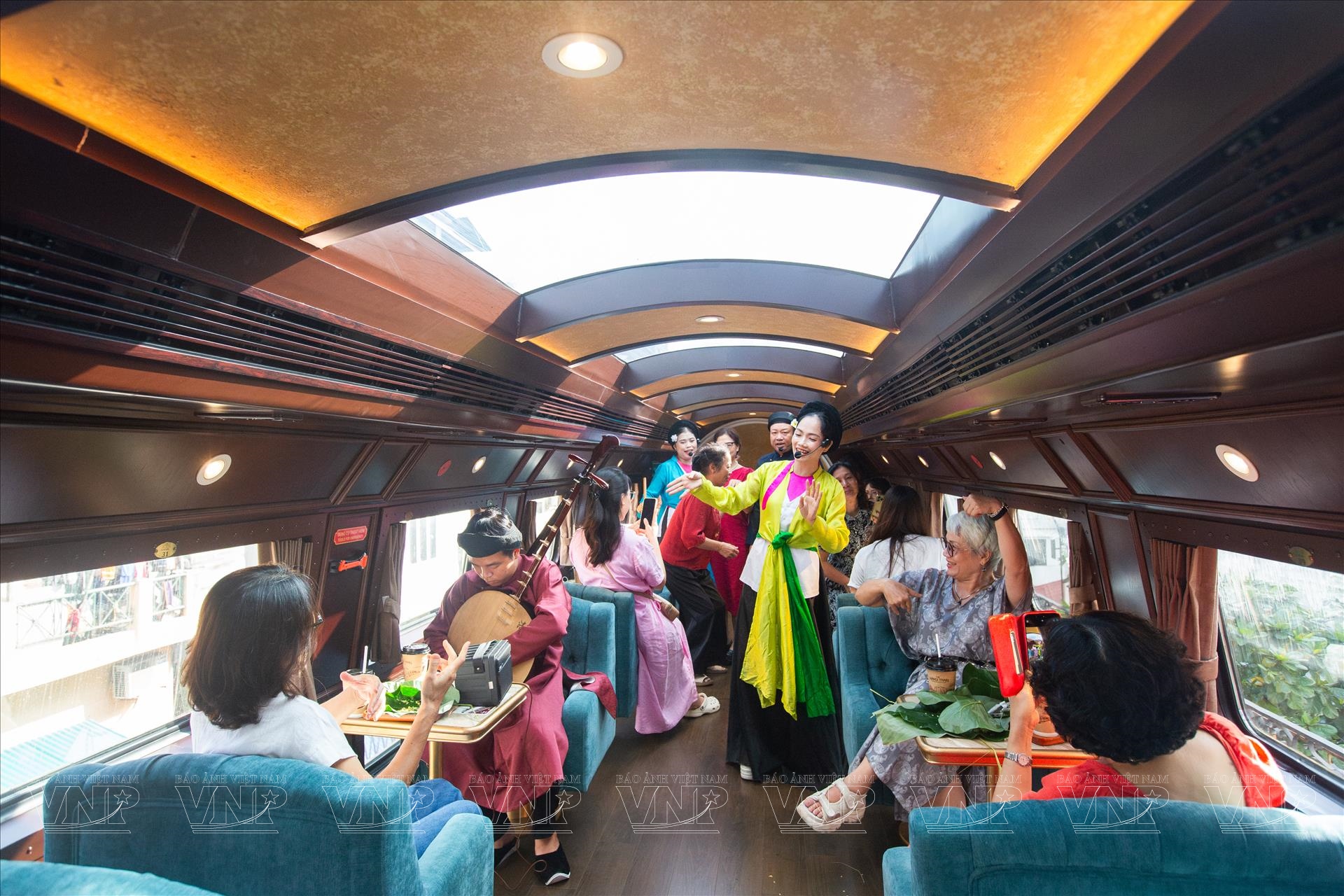
The Hanoi Train takes visitors on a sightseeing and cultural experience journey along the route from Hanoi to Tu Son. Photo: Khanh Long/VNP
Local identity on board
On a weekend morning, the “5 Cua O” (Hanoi Five Gates) heritage train pulled out of Hanoi Railway Station to the strains of “xam tau dien” - a traditional folk music echoing through a community carriage. Outside the window, the bustle of the Old Quarter gradually receded and the iron span of the historic Long Bien Bridge slid into view.
Unlike a standard commuter run, the onboard atmosphere is a cultural immersion. Passengers travelling from the capital to Bac Ninh move through recreated heritage spaces, with “xam” folk performances, stories of old Hanoi and the warmth of the service crew. Less than a year after launch, the train has drawn roughly 70,000 passengers.
The “Hoa Phuong Do” (Flamboyant Flower) train on the Hanoi–Hai Phong route stands out with a modern, polished design. Inspired by the port city’s signature red flower, its 20 newly built carriages wear a striking blue, white and red livery. Indochine-style VIP compartments blend Asian aesthetics with contemporary touches, while drinks and regional cuisine accompany views of the northern countryside before arrival in the bustling coastal city.
On the central coast, the “Central Heritage Connection” train from Hue to Da Nang offers something starker. The line clings to the Hai Van Pass, with Lang Co Bay glittering on one side and mist-shrouded mountains rearing on the other. It is widely seen as one of Vietnam’s most beautiful coastal rail stretches.
Artists from Hue and Da Nang perform folk tunes and Hue chamber songs on board, as local dishes are prepared and served, telling the region’s story through its flavours.
Further north, the Hanoi–Lao Cai route, which feeds the hill station of Sapa, stands out for long-distance comfort. Tourist sleepers, such as Chapa Express, Sapaly Express, Victoria Express and Livitrans, offer wood-panelled cabins, soft beds and a cosy, highland-inspired atmosphere.
From novelty to mainstay
Green tourism expert Phung Quang Thang said the emergence of heritage trains signals that rail tourism is catching up with global demand for low-carbon, experience-rich travel. With proper investment, he argued, the model could become a signature Vietnamese tourism product.
Despite early traction, the segment still has room to become more polished. Experts suggested that route-specific photo books, special publications, postcards, poetry collections and souvenirs could enrich the emotional pull of a trip, turning a train ride into a lasting memory.
On a weekend morning, the “5 Cua O” (Hanoi Five Gates) heritage train pulled out of Hanoi Railway Station to the strains of “xam tau dien” - a traditional folk music echoing through a community carriage. Outside the window, the bustle of the Old Quarter gradually receded and the iron span of the historic Long Bien Bridge slid into view.
Unlike a standard commuter run, the onboard atmosphere is a cultural immersion. Passengers travelling from the capital to Bac Ninh move through recreated heritage spaces, with “xam” folk performances, stories of old Hanoi and the warmth of the service crew. Less than a year after launch, the train has drawn roughly 70,000 passengers.
The “Hoa Phuong Do” (Flamboyant Flower) train on the Hanoi–Hai Phong route stands out with a modern, polished design. Inspired by the port city’s signature red flower, its 20 newly built carriages wear a striking blue, white and red livery. Indochine-style VIP compartments blend Asian aesthetics with contemporary touches, while drinks and regional cuisine accompany views of the northern countryside before arrival in the bustling coastal city.
On the central coast, the “Central Heritage Connection” train from Hue to Da Nang offers something starker. The line clings to the Hai Van Pass, with Lang Co Bay glittering on one side and mist-shrouded mountains rearing on the other. It is widely seen as one of Vietnam’s most beautiful coastal rail stretches.
Artists from Hue and Da Nang perform folk tunes and Hue chamber songs on board, as local dishes are prepared and served, telling the region’s story through its flavours.
Further north, the Hanoi–Lao Cai route, which feeds the hill station of Sapa, stands out for long-distance comfort. Tourist sleepers, such as Chapa Express, Sapaly Express, Victoria Express and Livitrans, offer wood-panelled cabins, soft beds and a cosy, highland-inspired atmosphere.
From novelty to mainstay
Green tourism expert Phung Quang Thang said the emergence of heritage trains signals that rail tourism is catching up with global demand for low-carbon, experience-rich travel. With proper investment, he argued, the model could become a signature Vietnamese tourism product.
Despite early traction, the segment still has room to become more polished. Experts suggested that route-specific photo books, special publications, postcards, poetry collections and souvenirs could enrich the emotional pull of a trip, turning a train ride into a lasting memory.
Another idea is linking artists directly to the rail experience. Literary, musical, visual arts and photo works have already been created on board, with meaningful interaction unfolding between artists and passengers en route.
Hoang Gia Khanh, Director General of Vietnam Railways, said heritage trains tell the country’s story in a modern experiential language, which projects a nation reforming and integrating while still holding onto its cultural identity. If done well, each journey can carry Vietnam’s image, culture and people a little further across the global tourism map./.