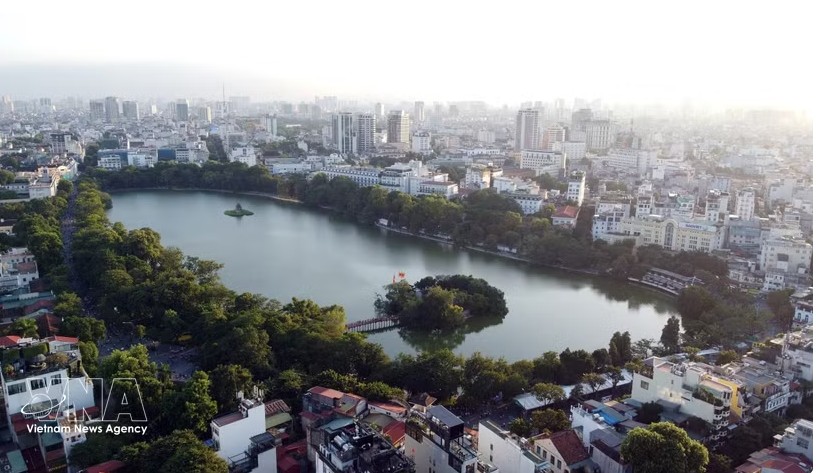
A view of the Hoan Kiem lake area, downtown Hanoi. Photo: VNA
Under Decision No. 2512/QD-UBND, signed on May 13, 2026 by Chairman of the municipal People’s Committee Vu Dai Thang, the master plan covers Hanoi’s entire administrative boundaries, with 126 commune-level administrative units (comprising 51 wards and 75 communes).
The planning area spans approximately 3,359.84 square kilometres. Hanoi borders Thai Nguyen and Phu Tho provinces to the north; Ninh Binh and Phu Tho to the south and south-west; Bac Ninh and Hung Yen to the east; and Phu Tho again to the west and north-west.
The plan outlines a development model based on a “multi-layered, multi-polar and multi-centre” urban structure, with the Red River positioned as the city’s principal ecological and cultural landscape axis.
Hanoi is expected to pursue a “compact and green” development approach, while accelerating digital transformation, green transition, circular economy initiatives and climate adaptation.
Under the approved roadmap, the capital’s population is projected to reach between 14–15 million by 2035, rising to 15–16 million by 2045 and 17–19 million by 2065, with the long-term figure capped at no more than 20 million.
Urban land designated for construction is set to account for approximately 55–60% of Hanoi’s total natural area by 2065, while the remaining land will be reserved for green corridors, forests and ecological spaces.
By 2035, Hanoi aims to become a green, smart and modern city, as well as an important regional centre for finance, commerce and innovation. Its gross regional domestic product (GRDP) is expected to reach approximately 200 billion USD, with per capita GRDP exceeding 18,800 USD.
By 2045, the capital aspires to become one of the Asia-Pacific’s leading innovation hubs, before evolving into a global city with life quality and happiness among the world’s highest by 2065.
One of the plan’s most notable features is its emphasis on developing cultural industries and tourism into key economic sectors. Hanoi aims for cultural industries to contribute around 10% of GRDP by 2035, 12% by 2045 and 15–20% by 2065.
The city also intends to strengthen its identity as a “creative city” while promoting the cultural heritage of Thang Long – Hanoi as a pillar of Vietnam’s national soft power.
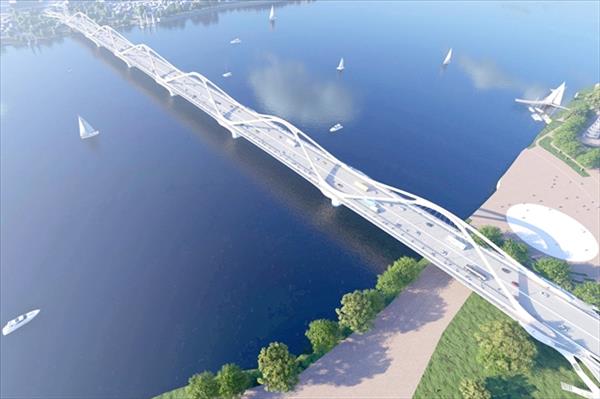
In terms of transport and infrastructure, Hanoi plans to fundamentally resolve chronic traffic congestion hotspots by 2030, and strongly develop river-based transport routes, additional river crossings and the urban railway network in order to reduce pressure on inner areas and expand urban development space. It also looks to expand underground urban space through transit-oriented development (TOD) models integrated with public transport systems.
Environmental objectives feature prominently within the master plan, particularly the ambition to revive local rivers. Authorities aim to progressively address pollution affecting rivers, including To Lich, Nhue, Day, Tich and Cau Bay. Studies are also planned for the construction of regulating dams to support integrated river basin management. The city further intends to expand reservoirs, retention lakes and underground water storage systems to improve flood prevention and enable water reuse.
The master plan additionally identifies strategic breakthroughs in institutional reform, science and technology, digital transformation and spatial development. The Hoa Lac Hi-Tech Park is expected to become Hanoi’s core research, development and innovation hub. The capital also plans to build a digital government system and smart urban governance model based on big data and artificial intelligence.
Looking beyond 2085, Hanoi envisions itself as a model “sustainable mega-city” and a highly influential centre in the global cities' network where trade, knowledge and innovation flows across the Asia-Pacific converge./.