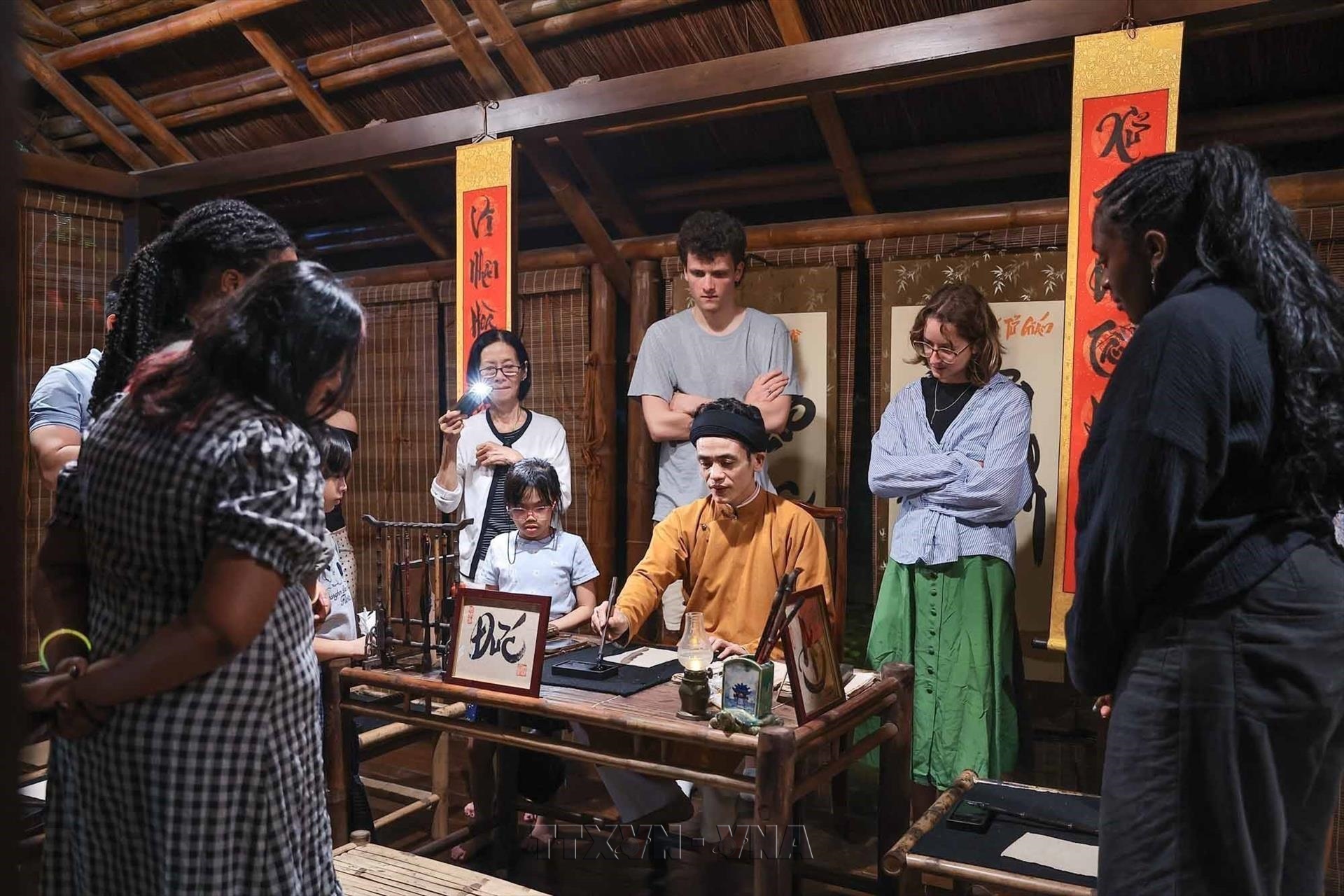
Tourists enjoy the experience of Vietnamese calligraphy at Van Mieu - Quoc Tu Giam (The Temple of Literature)'s night tour. Photo: VNA
In the longer term, the capital seeks to establish itself as a regional and international destination for cultural and heritage tourism, creativity, events and high-quality tourism services.
These goals are set out in Action Programme No. 20-CTr/TU, issued by the Hanoi Party Committee to implement the Politburo’s Resolution No. 26-NQ/TW on developing tourism into a spearhead economic sector in the new era.
The municipal People’s Committee subsequently issued Plan No. 406/KH-UBND on October 19, outlining implementation measures for the 2026-2030 period.
Under the plan, Hanoi targets welcoming and serving between 47 million and 50.5 million tourist arrivals by 2030, including 13-15 million international visitors and 34-35.5 million domestic travellers. Tourism revenue is expected to reach 295-340 trillion VND (11.43 billion-13.17 billion USD), with the sector’s overall contribution accounting for around 7.5-8% of the city’s gross regional domestic product (GRDP).
To support this growth, the capital plans to add at least 10,000 high-end accommodation rooms in the four- and five-star categories. It also aims to have three sites recognised as national tourist areas and at least three craft villages or ancient villages developed into high-quality destinations capable of competing regionally and internationally.
Nguyen Tien Dat, Vice Chairman of the Hanoi Tourism Association, said the capital is working towards a larger, higher-quality and more closely connected tourism ecosystem.
However, targets for visitor numbers, revenue and accommodation capacity are only the starting point, he noted. Sustainable growth would also require better tourism planning, distinctive products, consistent service quality and a competitive destination brand.
Turning heritage into distinctive experiences
With its rich cultural heritage, distinctive urban architecture, renowned cuisine, traditional craft villages and network of ecological destinations, Hanoi has strong potential to develop diverse tourism products.
Experts, however, believe these advantages must be transformed into meaningful visitor experiences to strengthen the capital's competitiveness and meet changing tourist demand.
Associate Professor and Doctor Duong Van Sau from the Faculty of Tourism at the Hanoi University of Culture said the capital should make greater use of its cultural assets, including Hoan Kiem Lake, the Old Quarter, the Imperial Citadel of Thang Long and the Temple of Literature.
Rather than relying mainly on conventional sightseeing tours, Hanoi should connect heritage sites with art performances, traditional craft experiences, cuisine, creative design and interactive activities involving local communities, he said.
Pham Hai Quynh, Director of the Asian Tourism Development Institute, said the capital should also step up the development of event, night-time and culinary tourism, alongside products linked to cultural industries.
International music festivals and street art programmes could enrich urban cultural life while making Hanoi more attractive to visitors, he said. He also called for stronger links between Hanoi and neighbouring localities to create connected itineraries combining urban heritage, craft villages, ecological tourism, resort stays and rural experiences.
Tran Trung Hieu, Deputy Director of the Hanoi Department of Culture, Sports and Tourism, said the city's tourism sector is working with localities to review and reorganise tourism spaces in a sustainable manner, with cultural values serving as a foundation.
The city is also promoting the application of technology to improve service quality and enhance the appeal of tourist destinations./.