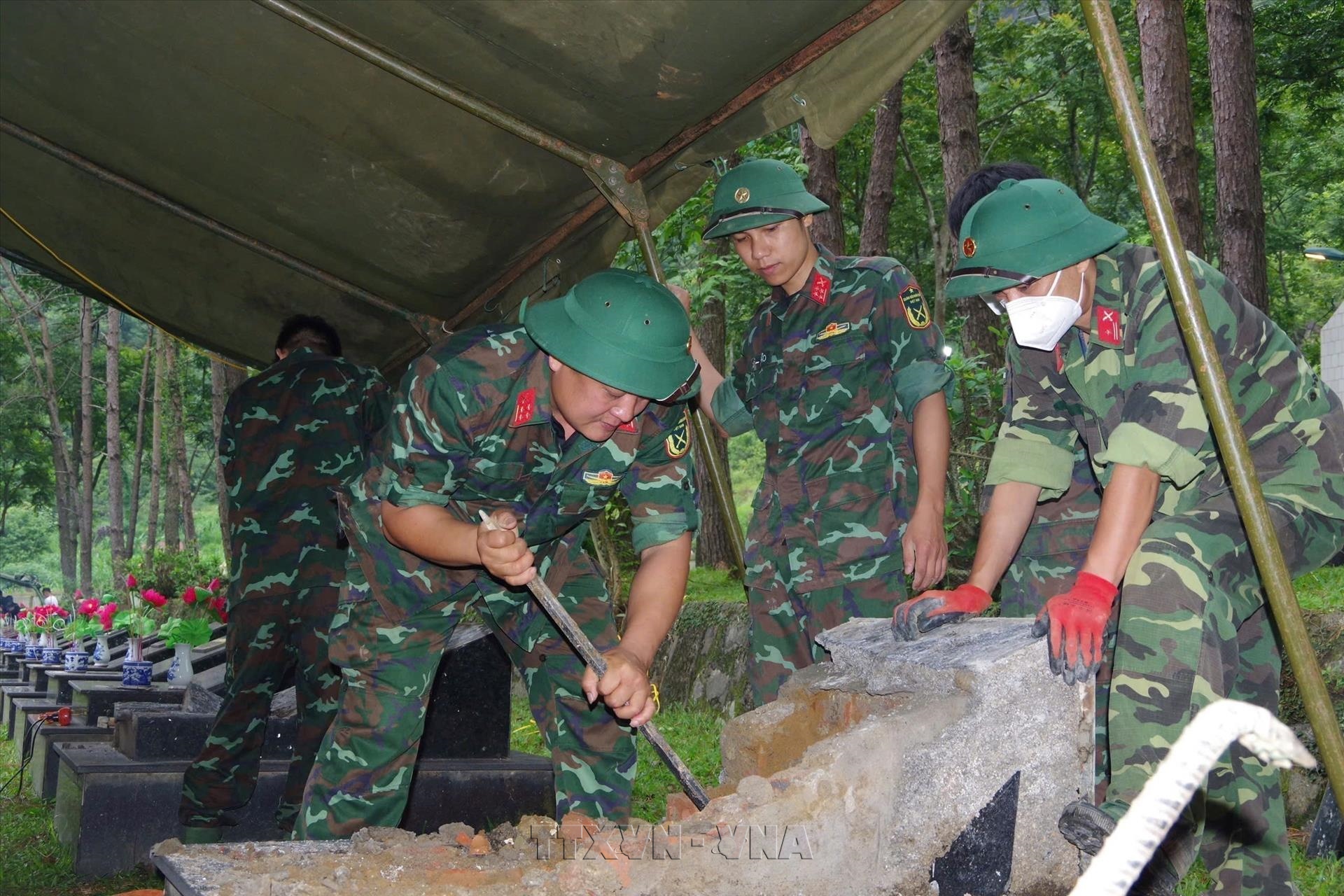
Authorities in the northern province of Cao Bang have begun collecting DNA samples. Photo: VNA
At the DNA Analysis Centre under the Institute of Biology of the Vietnam Academy of Science and Technology (VAST), every unidentified set of remains begins a painstaking journey. Carefully cleaned, processed and analysed under strict laboratory conditions, bone samples are examined in the hope of returning a fallen soldier to his family.
The painstaking work extends beyond meticulous sample processing and the development of a DNA database.
Inside a transparent plastic box no larger than a hand are a few bone fragments discoloured by time. Instead of a name, the label bears only a coded identification number. From these scant remains, specialists at the centre begin a process that can take days or even months, hoping to restore the identity of an unknown fallen soldier and return him to his family.
Tran Manh Ha, who has worked at the centre since 2006 when the unit was still a small research group, said after remains are received from recovery sites, they are cleaned and have quality assessed. Suitable bone fragments are then cut and ground into fine powder under sterile conditions in a specialised fume hood to minimise the risk of contamination.
DNA extraction is the most critical stage of the process. Some remains, however, have deteriorated so severely after decades underground that they no longer contain enough DNA for analysis, he noted.
"Whenever that happens, we all feel disappointed," Ha said, noting that every unsuccessful test means another family must continue waiting for answers. He stressed that proper collection and preservation of remains at excavation sites are crucial to improving identification success rates.
Despite the challenges, Ha said the humanitarian value of the work has kept him and his colleagues committed for nearly two decades.
Dr. Tran Trung Thanh, Director of the DNA Analysis Centre, said every successful identification represents not only a scientific achievement but also a tribute to those who sacrificed for the nation.
He explained that DNA in decades-old remains is often severely degraded by soil conditions, temperature, humidity and microorganisms, while many samples contain only tiny DNA fragments or substances that interfere with analysis. Because each sample is preserved differently, scientists must carefully select the most appropriate extraction and sequencing methods to ensure exact and reliable results.
The quality of a sample also depends heavily on how it is collected at the recovery site. If the appropriate bone is not selected or the sample is improperly preserved or transported, the DNA may continue to degrade, reducing the likelihood of successful analysis, Thanh added.
Another challenge lies in collecting DNA from relatives as many direct family members of fallen soldiers have passed away over time, leaving only more distant relatives for comparison, making kinship analysis considerably more complex.
To improve success rates, the centre has adopted the next-generation sequencing using single nucleotide polymorphism (NGS-SNP) technology for difficult samples, while continuously refining DNA extraction techniques, expanding the collection of relatives' samples and updating its DNA database.
Dr. Phi Quyet Tien, Director of the Institute of Biology, said that a pilot project at the Tra Linh Martyrs' Cemetery in the northern mountainous province of Cao Bang in 2025 demonstrated the technology's potential. Fifty-four out of 58 exhumed remains, or 93%, yielded usable SNP data despite severe degradation – a result that would have been virtually impossible to achieve using the mitochondrial DNA analysis method previously employed.
By comparing the data with DNA samples from relatives of 14 fallen soldiers, scientists successfully identified two of them in the first pilot phase, he noted.
Similar DNA sampling has since been carried out at the Giong Rieng Martyrs' Cemetery in the Mekong Delta province of An Giang, where 964 graves remain unidentified.
Tien said that building a comprehensive national DNA database is just as important as advancing technology. Between 2019 and 2021, more than 4,000 analysed remains had to be stored because there were insufficient DNA samples from relatives for comparison.
The expert noted that collecting DNA samples from the relatives of fallen soldiers nationwide and building a concentrated genetic database are as strategically important as mastering DNA identification technology.
With the NGS-SNP technology, kinship analysis can now extend beyond immediate family members to relatives as distant as the fourth or fifth generation, significantly increasing the chances of identification.
The VAST’s Institute of Biotechnology stands ready to work with the Ministry of Public Security, the Ministry of National Defence and local authorities to standardise SNP data for inclusion in the national DNA database, ensuring interoperability and enabling long-term storage, retrieval and comparison, Tien said.
According to Tien, one of the most important lessons from the 500-day campaign to recover and identify the remains of fallen soldiers is that no single institution, regardless of how advanced its technology may be, can accomplish this mission alone.
The painstaking work extends beyond meticulous sample processing and the development of a DNA database.
Inside a transparent plastic box no larger than a hand are a few bone fragments discoloured by time. Instead of a name, the label bears only a coded identification number. From these scant remains, specialists at the centre begin a process that can take days or even months, hoping to restore the identity of an unknown fallen soldier and return him to his family.
Tran Manh Ha, who has worked at the centre since 2006 when the unit was still a small research group, said after remains are received from recovery sites, they are cleaned and have quality assessed. Suitable bone fragments are then cut and ground into fine powder under sterile conditions in a specialised fume hood to minimise the risk of contamination.
DNA extraction is the most critical stage of the process. Some remains, however, have deteriorated so severely after decades underground that they no longer contain enough DNA for analysis, he noted.
"Whenever that happens, we all feel disappointed," Ha said, noting that every unsuccessful test means another family must continue waiting for answers. He stressed that proper collection and preservation of remains at excavation sites are crucial to improving identification success rates.
Despite the challenges, Ha said the humanitarian value of the work has kept him and his colleagues committed for nearly two decades.
Dr. Tran Trung Thanh, Director of the DNA Analysis Centre, said every successful identification represents not only a scientific achievement but also a tribute to those who sacrificed for the nation.
He explained that DNA in decades-old remains is often severely degraded by soil conditions, temperature, humidity and microorganisms, while many samples contain only tiny DNA fragments or substances that interfere with analysis. Because each sample is preserved differently, scientists must carefully select the most appropriate extraction and sequencing methods to ensure exact and reliable results.
The quality of a sample also depends heavily on how it is collected at the recovery site. If the appropriate bone is not selected or the sample is improperly preserved or transported, the DNA may continue to degrade, reducing the likelihood of successful analysis, Thanh added.
Another challenge lies in collecting DNA from relatives as many direct family members of fallen soldiers have passed away over time, leaving only more distant relatives for comparison, making kinship analysis considerably more complex.
To improve success rates, the centre has adopted the next-generation sequencing using single nucleotide polymorphism (NGS-SNP) technology for difficult samples, while continuously refining DNA extraction techniques, expanding the collection of relatives' samples and updating its DNA database.
Dr. Phi Quyet Tien, Director of the Institute of Biology, said that a pilot project at the Tra Linh Martyrs' Cemetery in the northern mountainous province of Cao Bang in 2025 demonstrated the technology's potential. Fifty-four out of 58 exhumed remains, or 93%, yielded usable SNP data despite severe degradation – a result that would have been virtually impossible to achieve using the mitochondrial DNA analysis method previously employed.
By comparing the data with DNA samples from relatives of 14 fallen soldiers, scientists successfully identified two of them in the first pilot phase, he noted.
Similar DNA sampling has since been carried out at the Giong Rieng Martyrs' Cemetery in the Mekong Delta province of An Giang, where 964 graves remain unidentified.
Tien said that building a comprehensive national DNA database is just as important as advancing technology. Between 2019 and 2021, more than 4,000 analysed remains had to be stored because there were insufficient DNA samples from relatives for comparison.
The expert noted that collecting DNA samples from the relatives of fallen soldiers nationwide and building a concentrated genetic database are as strategically important as mastering DNA identification technology.
With the NGS-SNP technology, kinship analysis can now extend beyond immediate family members to relatives as distant as the fourth or fifth generation, significantly increasing the chances of identification.
The VAST’s Institute of Biotechnology stands ready to work with the Ministry of Public Security, the Ministry of National Defence and local authorities to standardise SNP data for inclusion in the national DNA database, ensuring interoperability and enabling long-term storage, retrieval and comparison, Tien said.
According to Tien, one of the most important lessons from the 500-day campaign to recover and identify the remains of fallen soldiers is that no single institution, regardless of how advanced its technology may be, can accomplish this mission alone.
Coordination among the Ministry of National Defence, the Ministry of Public Security, the Ministry of Home Affairs, the Ministry of Health, the VAST, and local authorities has established an integrated workflow covering every stage—from site surveys, the recovery of remains and field sample collection to secure sample transport under a strict chain of custody, laboratory analysis at the DNA Analysis Centre, and comparison with relatives' DNA profiles and martyrs' records.
This coordinated mechanism has significantly shortened the time from collecting samples to obtaining results while ensuring transparency and full traceability throughout the entire process—an essential requirement in a field where any error could directly affect the dignity of the fallen and the trust of their families, he said.
As Vietnam prepares to mark the 79th anniversary of War Invalids and Martyrs' Day (July 27, 1947–2026), DNA analyst Ha and his colleagues at the DNA Analysis Centre continue to work quietly in the laboratory, examining the remains of unidentified fallen soldiers. Their mission of remembrance carries on, while each day in the laboratory brings renewed hope to families still waiting to learn the identities of their loved ones who gave their lives for the nation./.