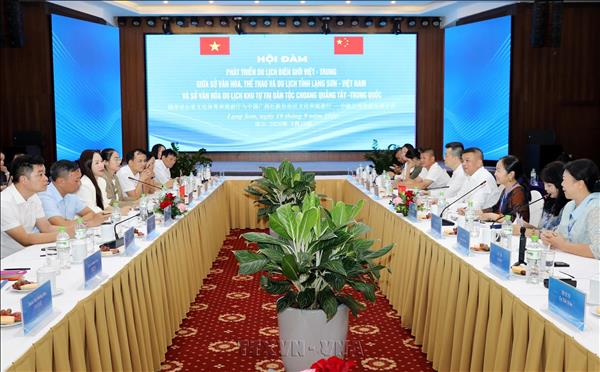
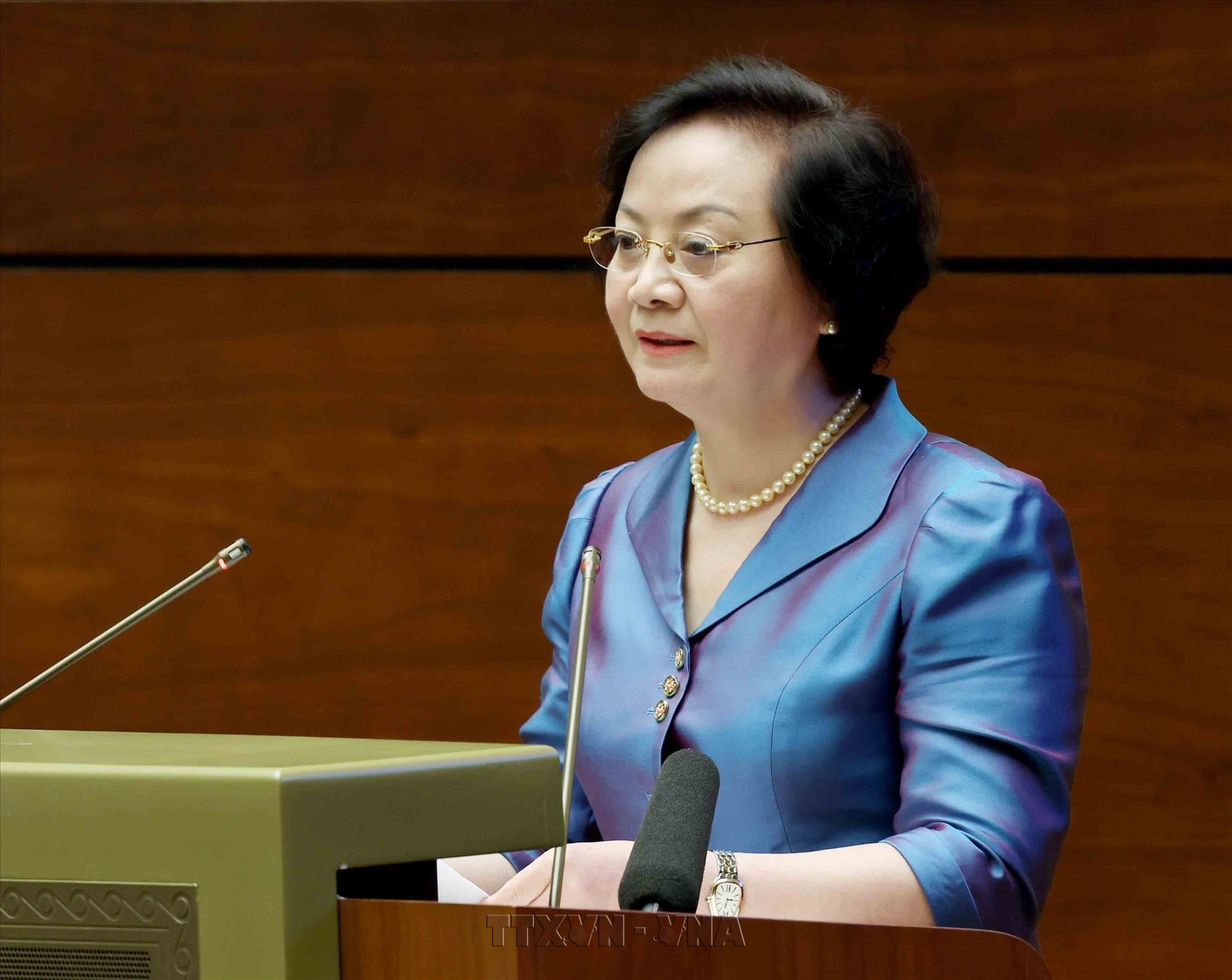
Deputy Prime Minister Pham Thi Thanh Tra speaks at the conference reviewing one year of operation of the overall organisational model of the political system and the three-tier admistration model. Photo: VNA
According to the Deputy PM, the model has opened up a new development space and strategic vision for national development in the new era, while bringing important changes in awareness, leadership methods, governance approaches, operational mechanisms and implementation capacity. It has also strengthened the close relationship between Party leadership, State management, the core role of the Vietnam Fatherland Front and socio-political organisations, and the people’s right to mastery, thereby reinforcing public trust and inspiring aspirations for national development throughout the political system and society.
Tra noted that despite significant progress, substantial tasks remain to ensure that the state administrative system becomes leaner, more effective and more efficient, contributing to the successful implementation of the Resolution of the 14th National Party Congress and other strategic resolutions of the Politburo.
She said the Government will focus on three core priorities, with institutional improvement and stronger implementation capacity identified as the most fundamental task. Over the past year, institutional reform combined with administrative procedure reform has been treated as a key breakthrough, helping create favourable conditions for the administrative system to operate smoothly and better serve citizens and businesses.
To date, the Government has completed approximately 1,300 legal normative documents, while nearly 40% of administrative procedures and business conditions have been simplified or reduced. The proportion of administrative procedures handled by the Government, ministries and central agencies has fallen to 27.4%, meeting and even exceeding targets set by the Party Central Committee.
In the coming period, the Government will continue synchronising institutional reforms with stronger administrative simplification efforts so that institutions become a driving force, resource and competitive advantage for national development. The Deputy PM said these efforts will help foster innovation, unlock productive forces and create a transparent, fair and stable business environment that strengthens confidence among citizens and enterprises.
She added that the Government plans to amend and supplement 49 laws by 2027 and address 21 operational issues related to the two-tier local administration model.
Tra said the most significant challenge is no longer the lack of policies or institutions, but rather limitations in awareness and execution, particularly among some local leaders and grassroots administrations. She stressed the need to shift from assigning tasks to assigning measurable results, from collective responsibility to greater accountability of individual leaders, and from traditional supervision methods to data-based monitoring and performance evaluation.
Public satisfaction, she said, should become a key indicator for assessing the quality and effectiveness of local administrations.
The official also underlined the importance of continuing governance reform through stronger decentralisation and delegation of authority, combined with digital transformation and the development of digital government and digital administration.
She said further efforts will focus on improving mechanisms that link decentralisation with the allocation of resources, data, implementation tools and power-control measures. Under the principle of “localities decide, localities implement and localities take responsibility,” the Government will concentrate on macroeconomic management, institutional development, strategic planning, major resource coordination and national risk management, while empowering local administrations to act more proactively.
Tra also stressed the need to improve the quality and effectiveness of commune-level administrations, which she described as the foundation of the two-tier local administration model. Local authorities were urged to review development spaces following administrative restructuring, address fragmented urban and economic zones, and continue reorganising commune-level administrative units that fail to meet prescribed standards.
At present, 705 commune-level administrative units have yet to meet the required standards, which is expected to be handled in 2026, he said, adding that the Government will work with the Party Central Committee’s Organisation Commission and local authorities to develop criteria for specialised divisions at the commune level, further streamline administrative structures, promote autonomy in public service units and build a contingent of capable grassroots officials.
The Deputy PM further said that the one-year review will provide an opportunity to further improve and innovate the operation of the three-tier political system, address remaining bottlenecks and enhance overall performance. She voiced her belief that the model will continue to create a strong foundation and momentum for Vietnam’s rapid and sustainable development in the years ahead./.