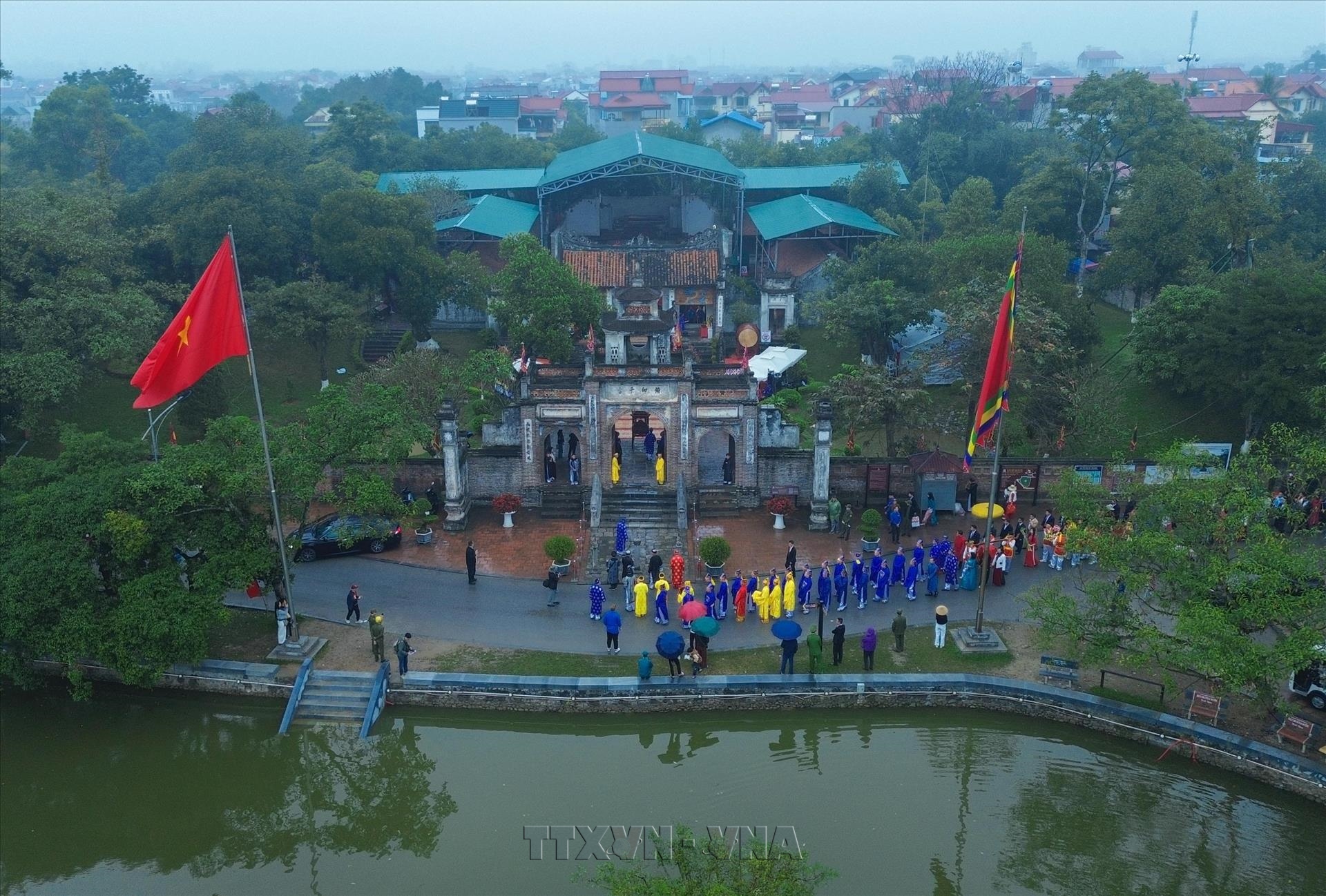
Co Loa Special National Relic Site in Dong Anh Commune, Hanoi. Photo: VNA
The Thang Long-Hanoi Heritage Conservation Centre, in collaboration with the Vietnam Association of Historical Sciences, recently organised a seminar to identify and clarify the scientific arguments regarding the outstanding universal values of the site.
It was a step closer to finalising the dossier to be submitted to UNESCO for consideration for inclusion on the Tentative List for World Heritage nomination.
Special relic
Co Loa played an important role in the history of national founding and defence. Not only was it the capital of the Au Lac State under King An Duong Vuong (circa the 3rd century BC) and during the era of Ngo Quyen (10th century), but Co Loa also served as a political, military and cultural centre linked to various stages of the nation's historical development.
The citadel was a system of large-scale fortifications, unique construction techniques and interconnected network of moats. It was also home to preserved spaces for habitation, spiritual practice and community life that have endured for over two millennia.
These elements make Co Loa stand as a distinctive heritage site reflecting the formation of the early state and the Hong (Red) River civilisation in Vietnam. These values are not only significant to the nation's history but also serve as a vital foundation for ongoing research and comparative studies with similar heritage sites across the region and the world.
At the seminar, Vice Chairwoman of the Hanoi People’s Committee Vu Thu Ha said research, preservation and promotion of the values of the Co Loa Relic Site were not only requirements of heritage conservation but also tasks closely linked to the city’s development strategy in the new era.
“Preparing the UNESCO dossier is to not only honour the values of a historical and cultural heritage but also affirm its historical depth, cultural identity and stature of Thang Long-Hanoi within the course of human civilisation," said Ha.
"It creates momentum to leverage cultural resources for the city's rapid and sustainable development and to realise the vision for Hanoi's growth."
According to Nguyen Thanh Quang, Director of the Thang Long-Hanoi Heritage Conservation Centre, scholars' records and researches in the past century showed that Co Loa was not merely a military stronghold, a capital city, and an ancient settlement, but rather a large-scale organised space of power, defined by the close interrelationship between fortifications, the water system, human habitation, production activities and the natural environment.
“Co Loa is vital physical evidence of the early states' formation based on the Dong Son Culture, reflecting a convergence of metallurgical expertise, wet-rice agriculture, waterway transportation, military technology, and social organisation," said Quang.
"Consequently, the significance of Co Loa extends beyond Vietnamese history; it also helps elucidate a crucial phase in the formation and development of early states across Southeast Asia."
Outstanding universal values
Co Loa relic complex encompasses archaeological sites, fortifications and historical and architectural monuments within Dong Anh commune, with a designated conservation area of approximately 860ha.
The area features traditional village spaces, along with numerous festivals and customs that the community has continuously maintained to this day.
According to Associate Professor Dr Vu Van Quan from the University of Social Sciences and Humanities, Co Loa's outstanding universal values were demonstrated by its system of ramparts, ancient water network and series of archaeological sites of multiple periods associated with habitation and metallurgy, alongside the continuous existence of traditional village spaces and community culture.
The site meets the criteria of the World Heritage Convention as a potential cultural heritage site possessing Outstanding Universal Value.
Quan said: “The system of three concentric ramparts, networks of moats, natural waterways and functional zones, reveals a clearly organised political and military structure.
"In this citadel, power was decentralised and safeguarded through large-scale planning and construction measures.”
Professor Nguyen Quang Ngoc added that Co Loa was a prime embodiment of the exceptional development achieved by the Au Lac State under King An Duong Vuong, particularly regarding creative ingenuity, advancements in construction techniques and state-of-the-art military strategy.
“Co Loa Citadel represents a new stage of development for the Au Lac State, social authority and stratification," said Ngoc.
"It stands as the pinnacle of Dong Son Culture and the Red River civilisation, the first and most brilliant civilisation in Southeast Asia. The citadel meets all the criteria to be recognised as a World Cultural Heritage site.”
Dr Nguyen Van Son, Chairman of the Hanoi Historical Association, revealed that during his cooperation with many foreign experts and scholars from prestigious American institutions, Co Loa received very high praise.
“They said Co Loa was a citadel of immense scale and ancient history, arguably unrivaled in Asia. According to them, this site is fully deserving of World Heritage status, provided a comprehensive dossier is prepared for UNESCO’s consideration," Son said./.