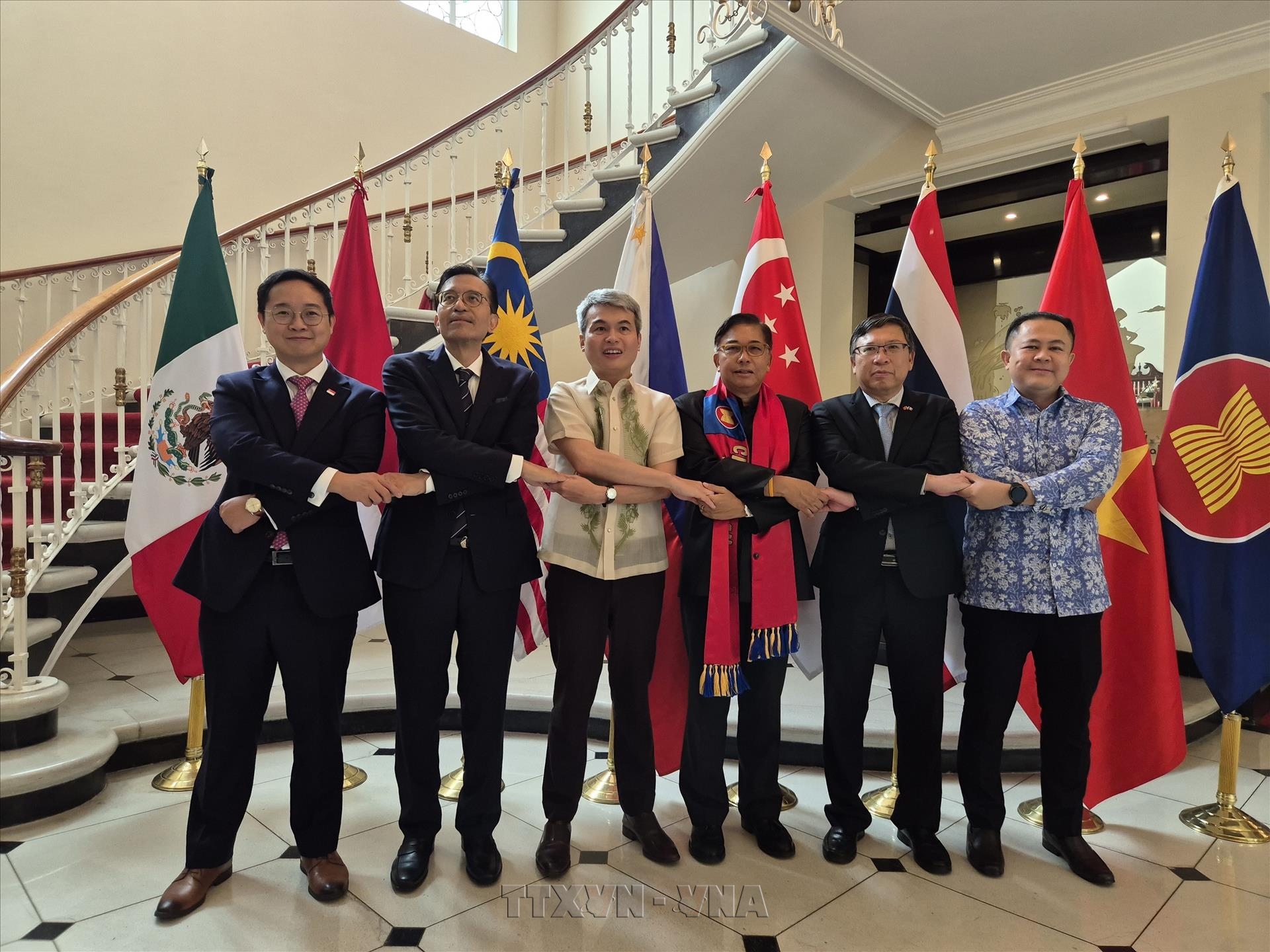
The ceremony was attended by representatives of the Mexican Ministry of Foreign Affairs, the diplomatic corps and international friends.
Thai Ambassador to Mexico Rooge Thammongkol, rotating Chair of the ASEAN Committee in Mexico City (ACMC) for July-December, said ASEAN has grown into one of the world’s most successful regional organisations and plays a central role in promoting peace, stability and cooperation in the Asia-Pacific region.
Built on the three pillars of the Political-Security Community, Economic Community and Socio-Cultural Community, ASEAN continues to uphold solidarity and adaptability while maintaining balanced relations with its partners, thereby steadily strengthening its international standing, he said.
He also highlighted the ACMC’s role in promoting ASEAN’s image in Mexico over the past 14 years. He praised the contributions of the Vietnamese, Malaysian and Philippine embassies in organising activities across Mexican states and cities to foster economic, trade, investment and tourism cooperation, as well as people-to-people exchanges.
Fernando Gonzalez Saiffe, Director General for Asia-Pacific at the Mexican Ministry of Foreign Affairs, described ASEAN as a model of multilateralism and regional cooperation at a time when the world is facing numerous challenges.
He said the Mexican Government is accelerating internal procedures to complete its accession to the Treaty of Amity and Cooperation in Southeast Asia (TAC) in 2026, viewing the move as an important foundation for ushering ASEAN-Mexico relations into a new stage of development.
The event also featured the handover of the rotating ACMC chairmanship from Philippine Ambassador Arvin R. De Leon to Thai Ambassador Rooge Thammongkol.
During its chairmanship in the first half of 2026, the Philippine Embassy worked closely with other ASEAN missions to organise diplomatic activities and strengthen engagement with Mexican authorities, businesses and academics, helping promote the ASEAN Community and deepen cooperation between the regional bloc and Mexico.
Founded on August 8, 1967, with five founding members, ASEAN now comprises 11 member states with a combined population of around 700 million and a gross domestic product exceeding 4 trillion USD, making it the world’s fifth-largest economy.
Over nearly six decades, ASEAN has continued to affirm its role as a driving force for regional integration and maintain its centrality in the evolving regional architecture, contributing to peace, stability, cooperation and development in the Asia-Pacific and beyond./.