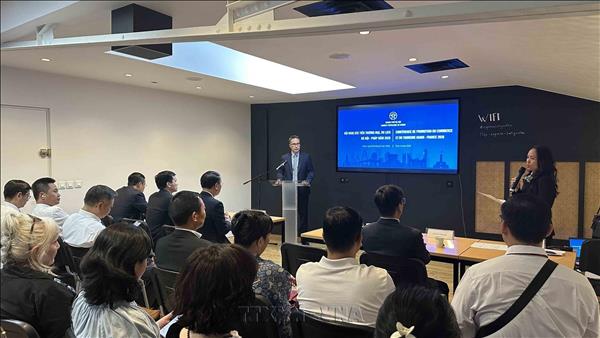

Ngo Cong Thuc, Vice Chairman of the An Giang Provincial People's Committee, delivers remarks at the event. Photo: Van Si/VNA.
Stepping up law enforcement
Vice Chairman of the provincial People's Committee Ngo Cong Thuc stressed that all individuals and organisations found deliberately violating fishing regulations would face strict legal action, regardless of the identity of the vessel owner or the size of the fishing boat. Officials and state agencies found to have covered up violations, facilitated illegal activities, or neglected their responsibilities in combating IUU fishing would also be dealt with severely.
The province has adopted stringent penalties to put an end to illicit profits derived from illegal fishing activities.
Between January and July, the provincial sub-department of fisheries and fisheries surveillance conducted 160 inspections, detected 53 violating vessels, and imposed fines totalling nearly 3 billion VND (114,233 USD).
An Giang has also taken a particularly strict stance on violations involving vessel monitoring systems (VMS). Authorities recorded 149 violations involving 78 fishing vessels that failed to report their positions, resulting in fines of more than 4.7 billion VND. Meanwhile, the provincial Border Guard Command imposed administrative fines totalling 1.75 billion VND on five cases involving 12 individuals.
For other IUU-related offences, the sub-department carried out patrols and inspections, issued administrative penalties exceeding 2.3 billion VND, and transferred six fishing vessels that were ineligible for fishing operations to local authorities for continued management and supervision. It also verified additional violations and imposed administrative fines of more than 1.6 billion VND.
Digitising fisheries management
An Giang has embraced digital technology to strengthen the management of its fishing fleet, which comprises 10,911 vessels.
By the end of June 2026, 100% of active fishing vessels (3,542 out of 3,551) had been equipped with VMS devices. For those that had yet to install the equipment because they were laid up or awaiting auction, local authorities assigned officials to closely monitor them using geolocation imagery and Google Maps.
In addition to VMS, the province has fully deployed the electronic Catch Documentation and Traceability (eCDT) system. Since July 2024, all fishing vessels entering and leaving ports there have been required to submit declarations through the system, enhancing transparency and accuracy.
Training has also been prioritised, with numerous courses organised for thousands of fishermen, vessel owners and fisheries officials on using the electronic logbook (eLogbook) and eCDT software. These efforts are intended to improve seafood traceability and strengthen IUU fishing prevention. The application of digital technology not only enhances state management but also protects the legitimate interests of law-abiding fishermen.
Le Huu Toan, Director of the provincial Department of Agriculture and Environment, said the province had also tightened control over so-called “three no's” fishing vessels – those without registration, fishing licences or certificates of technical safety. Relevant agencies have coordinated with local authorities to survey and classify them by length for more effective management.
The province has also identified and arranged 23 concentrated anchorage areas where fishing vessels that are not eligible for fishing operations can be safely moored under the supervision of local authorities.
Alongside the continued implementation of comprehensive anti-IUU fishing measures, An Giang has proposed that the Government promptly introduce policies to support fishermen in switching livelihoods and decommissioning nearshore fishing vessels in order to conserve natural fisheries resources.
Its campaign against IUU fishing is not only aimed at securing the removal of the "yellow card" but also at driving a comprehensive transformation of the fisheries sector towards greater transparency, modernisation and sustainability. With coordinated measures and the commitment of both fishermen and authorities, the province is confident it can make a significant contribution to enhancing the global standing of Vietnam's seafood industry./.