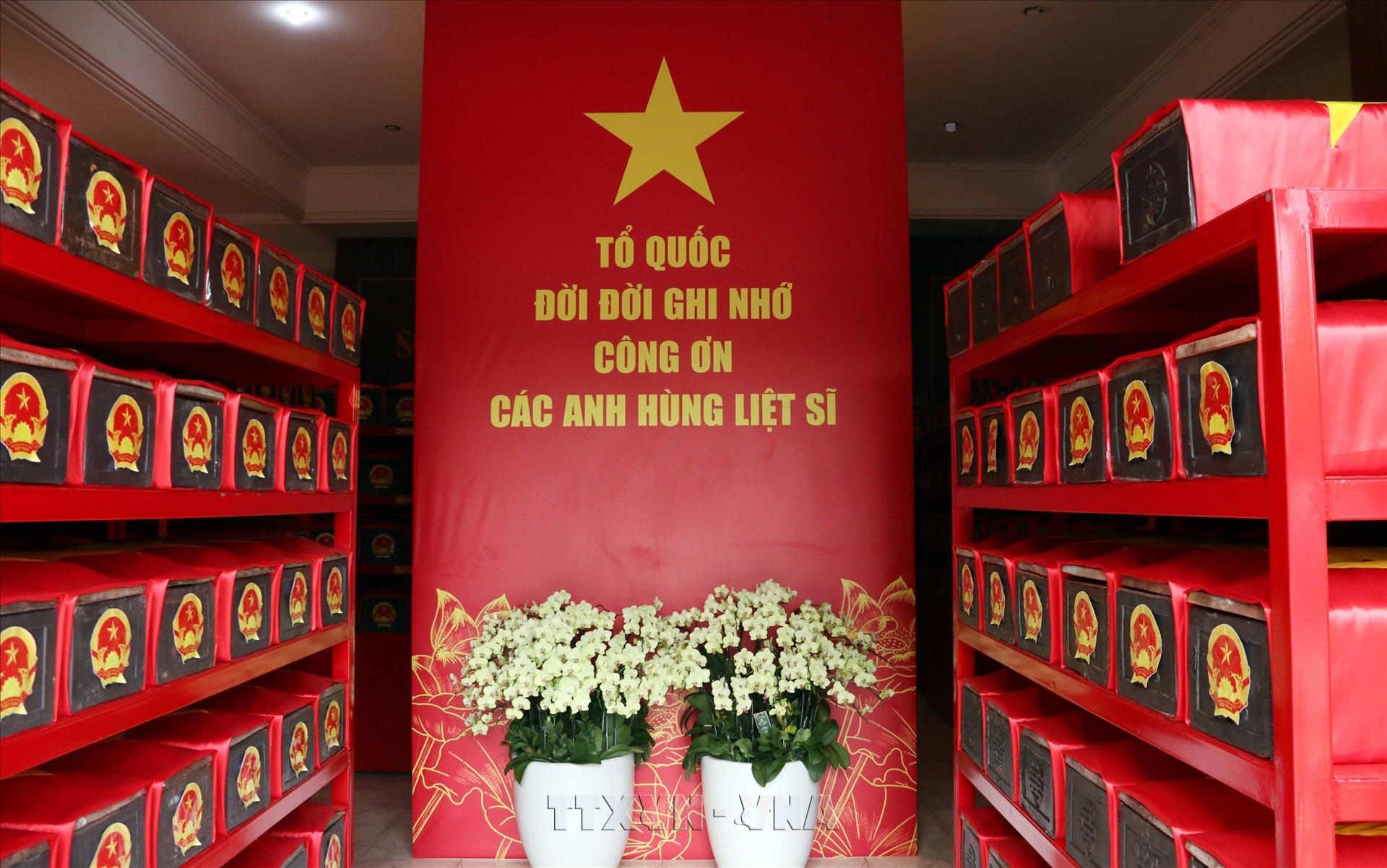
Information provided by local residents in Son La province helped authorities find the remains of two fallen soldiers after four days of searching. At Le Thi Rieng Park in Ho Chi Minh City, 701 sets of remains and 304 sets of personal items have been recovered, while in Ca Mau province, more than 3,000 unidentified graves have been excavated and biological samples collected.
In late September, based on information provided by residents of Cang Kieng village, Chieng Khoong commune, Son La province, authorities launched a search in a family garden where two soldiers believed to have died during the resistance war against French colonial rule were reportedly buried.
After four days of searching, on September 27, the remains of two soldiers were found, including skulls, leg and arm bones, teeth and several personal items, including a piece of shrapnel. Biological samples were also collected for DNA testing.
On October 1, the remains were commemorated and reburied at the Martyrs' Cemetery in Song Ma commune.
At Le Thi Rieng Park in Ho Chi Minh City, search teams continued working despite heavy rain. On October 1, the Martyrs' Remains Collection Team under the city Military Command found another 19 sets of remains, bringing the total recovered at the park to 701, including 668 individual sets and 33 sets from eight mass graves, along with 304 sets of personal items.
Heavy rain caused water to flood excavation pits and turned the soil muddy, making the search and recovery difficult. Personnel used high-capacity pumps to drain water, covered the sites with tarpaulins and continued manual excavation where necessary.
Lieutenant Colonel Le Ngoc Ha, head of the K74 Team, said the work continued regardless of the weather, with teams working through the day and night whenever remains were found.
Ho Chi Minh City has also completed the collection of biological samples at all 18 martyrs' cemeteries, obtaining 9,854 samples, of which 7,104 were suitable for DNA testing. Outside Le Thi Rieng Park, authorities have recovered five additional sets of remains in Thuong Tan commune.
Nguyen Manh Cuong, Vice Chairman of the Ho Chi Minh City People's Committee and head of the city's steering committee on the search, recovery and identification of martyrs' remains, said the city would continue reviewing and supplementing records, lists and maps, while making use of archival sources and meeting historical witnesses, war veterans and local residents.
“As long as there is information, we must verify it; as long as there is a basis for a search, we must continue searching,” he said.
Accelerating DNA testing
The collection of biological samples is also underway in many other localities.
In Ca Mau, as of September 26, authorities had excavated 3,184 of 3,464 unidentified graves at 11 martyrs' cemeteries. The rate of successful biological sample collection reached 73.8%.
At the provincial Martyrs' Cemetery, eight specialist teams have been maintained for excavation and sample collection. Information from each excavated grave is recorded and samples collected in accordance with procedures before being sent to testing facilities. Ca Mau plans to transport the samples to Hanoi on October 5 for handover to DNA testing agencies.
The next crucial step is identifying the remains. At a September 14 meeting chaired by Deputy Prime Minister Pham Thi Thanh Tra, head of the National Steering Committee on the search, recovery and identification of martyrs' remains, the Ministry of Home Affairs reported that agencies had been tasked with completing DNA testing on 18,000 samples as part of the campaign. At the time of reporting, 210 samples had been tested and 10 cases correctly identified.
Testing facilities are handling a large volume of samples. The National Institute of Forensic Medicine has received 16,636 samples, the Military Institute of Forensic Medicine 35,776, and the Institute of Biology 37,610.
However, degraded DNA and limited access to reference samples remain major challenges. Many remains have been buried for decades in hot and humid conditions, while many relatives of fallen soldiers are elderly, in poor health or have died.
New technologies are being tested to address these difficulties.
The campaign also draws on wartime records and information from overseas sources. Data provided by the US organisation Mission POW-MIA indicated a possible mass grave containing the remains of 16 Vietnamese soldiers in Tan Lap hamlet, Ben Cau commune, Tay Ninh province.
At a September 16 workshop, Tay Ninh authorities compared the data with the combat history of the 429th Special Forces Brigade and found grounds to believe that an unexcavated mass grave may exist there. The province continues to call on veterans, former guerrillas, militia members, former combat personnel and local residents to provide information to help verify the case./.