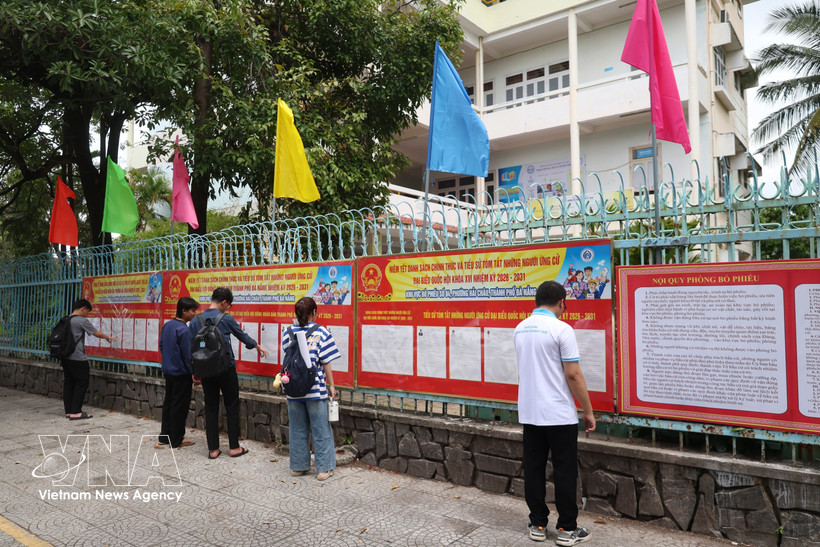
As Vietnam prepares for the election of deputies to the 16th National Assembly (NA) and People’s Councils at all levels for the 2026–2031 term, information campaigns and activities to raise awareness about the occasion are being actively organised at schools and universities nationwide.
Various initiatives aim to enhance the understanding and sense of responsibility among students, helping prepare for what is regarded as a major national event.
Proactively choosing qualified candidates
According to statistics from the education sector in the central coastal city of Da Nang, approximately 151,800 young voters, including students studying at educational institutions across the city, are eligible to vote in the upcoming election. This large and dynamic group of young voters is expected to help spread civic responsibility by participating seriously in the election and selecting capable representatives who reflect the will and aspirations of the people.
Universities in Da Nang have incorporated election awareness into class meetings, youth union activities and youth forums. Through discussions, seminars and legal education sessions, students have gained access to official information, improving their understanding of the political system and the role of elected bodies in the state apparatus. In addition to in-person events, universities are also using social media and digital platforms to share information and attract student engagement.
Le Thi Thu, a student at the University of Science and Technology, under the University of Da Nang, said students had the opportunity to meet several candidates and noted that those standing for election to the NA and People’s Councils in the city possess strong qualifications and professional experience. She said she intends to prioritise candidates with diverse experience and notable achievements when casting her vote.
Meanwhile, Le Tien Sy, a student at the University of Technology and Education, also under the University of Da Nang, said election awareness campaigns not only provide information but also help students better understand their civic duties. Once aware of the meaning of the ballot as well as their rights and obligations as citizens, students are motivated to learn about candidates’ action programmes in order to vote responsibly and in accordance with the law.
Rector Nguyen Le Hung of the University of Technology and Education said the university has implemented guidance from the municipal People’s Committee and the University of Da Nang regarding election preparations, including organising polling stations on campus on March 15.
The university has also provided extensive information to students about the significance of the election and participation procedures. For students from disadvantaged backgrounds or those living far from home, the school has offered support to ensure they are able to take part, aiming for the highest possible voter turnout.
Dang Cong Tai, another student from the University of Science and Technology, said he hopes to remain in the central economic hub after graduation to live and work. He expressed the wish that elected representatives in the next term will pay greater attention to policies supporting graduate employment. Da Nang, he added, should attract more domestic and foreign investment in telecommunications and electronic engineering to create dynamic job opportunities for students.
From an educator’s perspective, many teachers also hope that newly elected representatives will continue to prioritise improving education quality and developing highly skilled human resources for the city, especially as rapid advances in science and technology make investment in higher education and research increasingly important.
Those working in mountainous areas of Da Nang also noted challenges related to policies for contract teachers, particularly low salaries and allowances that do not fully meet living needs.
Ho Thi Vien, a teacher at the Tra Linh semi-boarding secondary school for ethnic minority students, said some mountainous schools face serious teacher shortages while support policies for contract teachers remain limited. She expressed her hope that newly elected representatives will advocate for improved salaries and allowances so teachers can continue working long-term in these areas.
The aspirations expressed by the students and teachers reflect the growing interest of younger generations in the country’s political and social life.
Ready for election day
In the central province of Dak Lak, preparations for the national election day are spreading widely across communities, particularly among young voters.
At the No Trang Long ethnic minority boarding school in Thanh Nhat ward, 63 Grade 12 students who have reached the age of 18 will participate in the election this year. Many have actively sought information about the election, candidates, and the roles of the NA and People’s Councils.
Y Le Zan Eban, a Grade 12 student, said school activities and official media channels helped her better understand the significance of voting. She described feeling both excited and proud to exercise her civic rights for the first time. Although each vote may seem small, she said collective participation contributes to the development of local communities and the nation.
Nguyen Ngoc Tu Huong, Deputy Secretary of the school’s communist youth union, said the school encourages students voting for the first time to research candidates and make informed choices. Students are also encouraged to share election information with their families, particularly in remote areas where access to information may still be limited.
At Tay Nguyen University, Polling Station No. 26 under the election committee of Ea Kao ward will serve 4,491 voters, the majority of whom are students. As young and dynamic voters, they can quickly access information through digital platforms and social media.
Y Cuor B’Krong, Secretary of the university’s youth union, said the union and student association have launched various communication activities on social media platforms, including instructional videos explaining the voting process, polling locations and the rights and responsibilities of voters.
Nguyen Quang Cuong, a second-year economics student, said he feels excited to vote for the first time. He has proactively researched the biographies and action plans of candidates and hopes to select those with both integrity and competence to contribute to national and local development, particularly in education.
According to Dr Le The Phiet, Vice Rector of the university and head of Polling Station No. 26, preparations have largely been completed and most students are ready for election day. With access to information technologies and social media, young voters clearly understand that voting is both a right and a civic responsibility.
With thorough preparation by educational institutions and proactive engagement from young voters, the election day on March 15 is expected to become a genuine democratic event, where each ballot cast by the younger generation contributes to choosing worthy representatives of the people./.