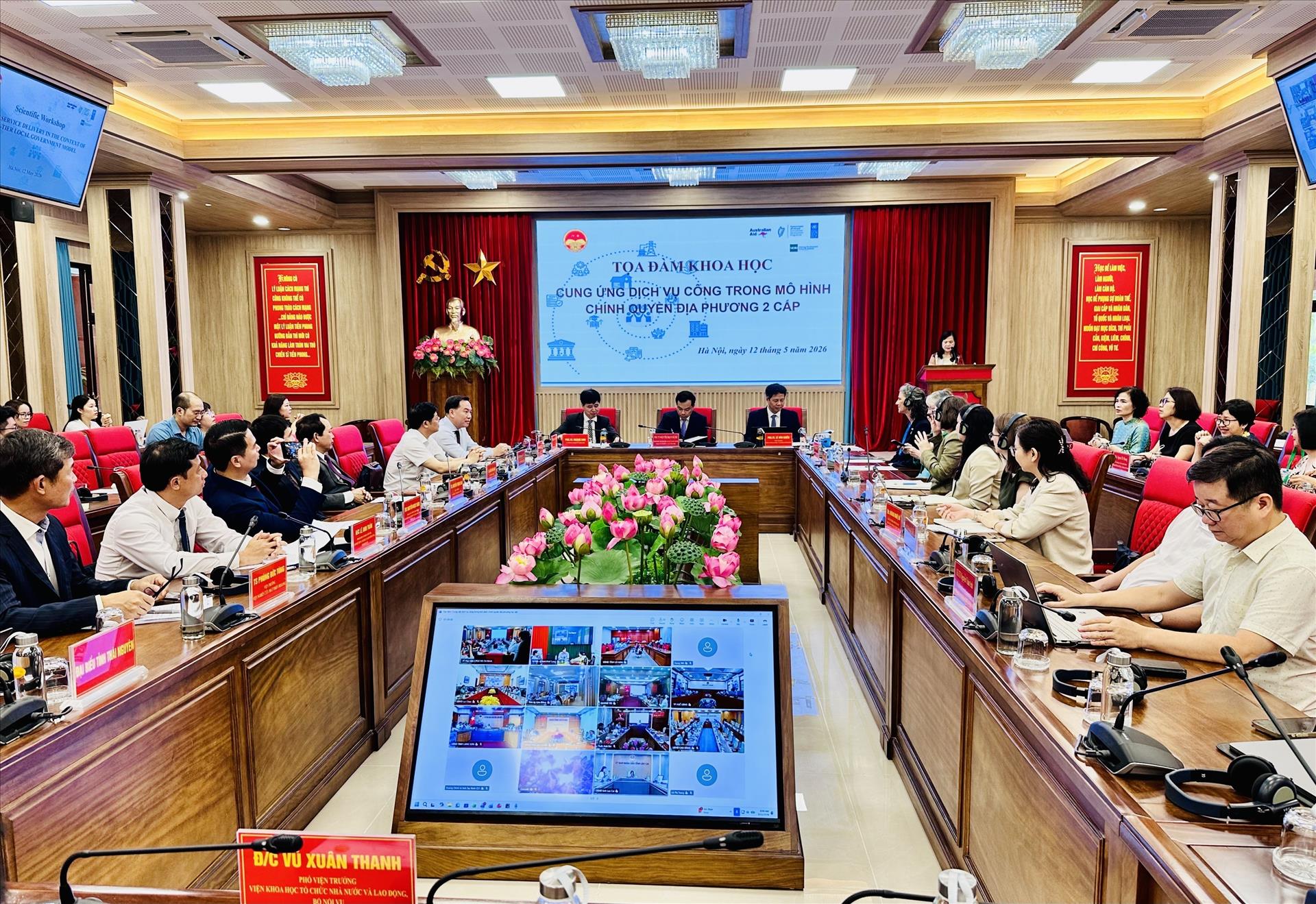
After nearly one year of operation, the two-tier local government model has brought about considerable improvement in public service delivery, heard a seminar held in Hanoi on May 12 by the Ho Chi Minh National Academy of Politics (HCMA) in coordination with the United Nations Development Programme (UNDP) in Vietnam, with support from the Australian and Irish embassies.
Associate Professor and Dr Nguyen Manh Hung, HCMA Vice President and Vice Chairman of the Central Theory Council, described the shift from a three-tier to the two-tier local administration model as a major governance reform in terms of authority allocation, responsibilities, resources and interactions between authorities and citizens.
He noted that the new system has operated relatively stable despite heavy workloads and high reform demands. Many localities have quickly adapted, while people have shown support for streamlined administration and expectations for a more modern, efficient and accountable public sector.
However, Hung acknowledged persistent challenges, including limited resources, human capacity and digital infrastructure, which have hindered public service delivery. In some cases, citizens still have to wait or travel multiple times due to unclear administrative focal points, while grassroots officials face increasingly complex tasks without adequate conditions or skills.
He stressed the need for a shift in governance thinking, from requiring people to follow administrative procedures to designing services around citizens’ actual needs.
At the seminar, international partners shared perspectives on Vietnam’s reform process. UNDP Resident Representative in Vietnam Ramla Khalidi said decentralisation reform requires not only structural changes but also capable grassroots personnel, stable financial resources and secure, people-centred digital systems.
Australian Ambassador Gillian Bird and Irish Ambassador Deirdre Ní Fhallúin highlighted the importance of evidence-based research and public feedback in helping policymakers improve the effectiveness and inclusiveness of public services.
The seminar took place as Vietnam prepares to review one year of officially operating the two-tier local administration model from July 1, 2025.
At the event, researchers from the HCMA and the Mekong Development Research Institute released findings from a nationwide survey of nearly 5,000 people, including 299 persons with disabilities, alongside case studies in the northern provinces of Bac Ninh and Hung Yen.
The report showed broad public support for administrative streamlining and positive assessments of removing district-level administration. Satisfaction with commune-level administrative services reached 4.1 out of 5 points.
However, major bottlenecks remain. Only 21.8% of respondents had used the National Public Service Portal, highlighting a significant digital divide, particularly among persons with disabilities, 93.65% of whom had never accessed the platform. For decentralised procedures such as land-use right certificates, the on-time settlement rate stood at 71.1%, while more than 26% of respondents reported repeated travel to complete procedures.
In healthcare, 34.47% of respondents sought treatment at provincial hospitals, indicating continued pressure on higher-level facilities. Grassroots officials also face “functional overload” due to multi-sector responsibilities and limited staffing.
Based on the findings, participants proposed policy recommendations for the 2026–2031 period, including aligning decentralisation and delegation of power with resource allocation, increasing support for grassroots digitalisation, shifting from payroll management to human resource governance, and reforming salary policies based on job positions to better reflect workloads at the communal level./.