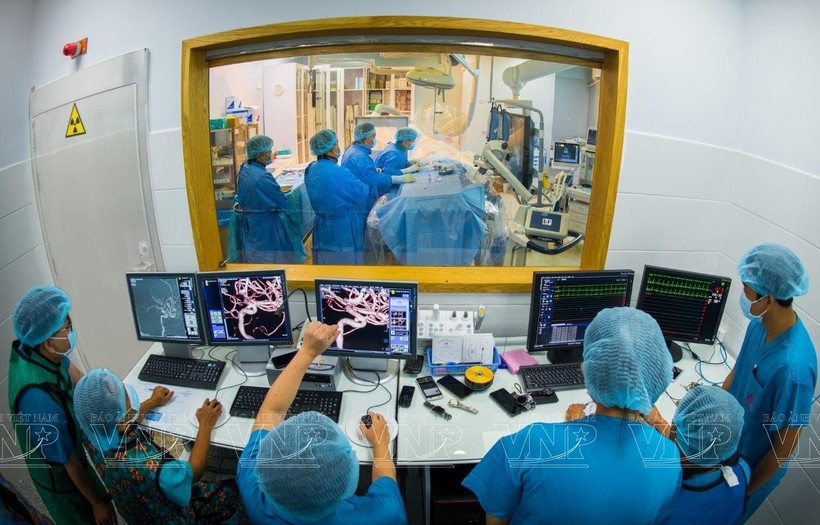
Digital transformation in healthcare is being strongly promoted. Photo: Organising Committee of the 2024 “Technology with Heart” Award, co-hosted by Vietnam News Agency and Viettel
Canada is promoting the development of a precision-medicine platform based on large-scale genomic data and artificial intelligence (AI) to enhance the quality of treatment and improve the efficiency of its public healthcare system. This approach is expected to become a long-term strategic pillar for the country while opening up significant potential for expanded cooperation with Vietnam.
The information was shared at a recent seminar held by the Canada–Vietnam Chamber of Commerce in Montreal, in the context of the Canadian Government’s launch of its 2025 Precision Health Initiative. The initiative seeks to integrate genetic data with health records, environmental factors and lifestyle information, enabling doctors to predict disease risks, select appropriate medications and personalise treatment plans.
Anne Nguyen, Chief AI Officer at the Quebec Innovation Council, noted that AI is creating new opportunities amidst population ageing and rising healthcare demand. Canada is shifting from a traditional mass-medicine model to personalised healthcare, with AI playing a central role.
According to her, the Quebec Innovation Council is tasked with understanding the business ecosystem to advise both provincial and federal governments on AI and foster innovation. Building community-specific genomic datasets will help identify rare diseases in small population groups, which are often overlooked in traditional research. AI accelerates data analysis and the identification of disease causes, thereby enabling more precise treatment strategies.
Brian D. Keane, CEO of DiaGen AI, noted that the biggest challenge is not merely applying AI, but collecting the right datasets. If data is gathered from only one community, the system will overlook other population groups with different genetic, cultural, and behavioural characteristics. This process is extremely costly and requires coordination among multiple organisations and communities.
This need creates opportunities for Canada to expand cooperation with other countries, including Vietnam which is accelerating digital health transformation, electronic medical records, and the use of data in healthcare, thus making it a promising partner in precision medicine.
According to Anne Nguyen, the key point of connection between the two countries lies in professional capacity. Vietnam has a rapidly developing technology foundation and is striving to strengthen its position within the digital healthcare ecosystem. The two countries have significant opportunities for cooperation in training, development, AI applications, and genomic analysis. Canada has strong experience in compiling and analysing genomic data, while Vietnam has a large population with diverse genetic structures. This complementarity can help Vietnam narrow its technological gap and enhance its capacity to treat rare diseases — an area many countries are prioritising for development, she added./.
Anne Nguyen, Chief AI Officer at the Quebec Innovation Council, noted that AI is creating new opportunities amidst population ageing and rising healthcare demand. Canada is shifting from a traditional mass-medicine model to personalised healthcare, with AI playing a central role.
According to her, the Quebec Innovation Council is tasked with understanding the business ecosystem to advise both provincial and federal governments on AI and foster innovation. Building community-specific genomic datasets will help identify rare diseases in small population groups, which are often overlooked in traditional research. AI accelerates data analysis and the identification of disease causes, thereby enabling more precise treatment strategies.
Brian D. Keane, CEO of DiaGen AI, noted that the biggest challenge is not merely applying AI, but collecting the right datasets. If data is gathered from only one community, the system will overlook other population groups with different genetic, cultural, and behavioural characteristics. This process is extremely costly and requires coordination among multiple organisations and communities.
This need creates opportunities for Canada to expand cooperation with other countries, including Vietnam which is accelerating digital health transformation, electronic medical records, and the use of data in healthcare, thus making it a promising partner in precision medicine.
According to Anne Nguyen, the key point of connection between the two countries lies in professional capacity. Vietnam has a rapidly developing technology foundation and is striving to strengthen its position within the digital healthcare ecosystem. The two countries have significant opportunities for cooperation in training, development, AI applications, and genomic analysis. Canada has strong experience in compiling and analysing genomic data, while Vietnam has a large population with diverse genetic structures. This complementarity can help Vietnam narrow its technological gap and enhance its capacity to treat rare diseases — an area many countries are prioritising for development, she added./.