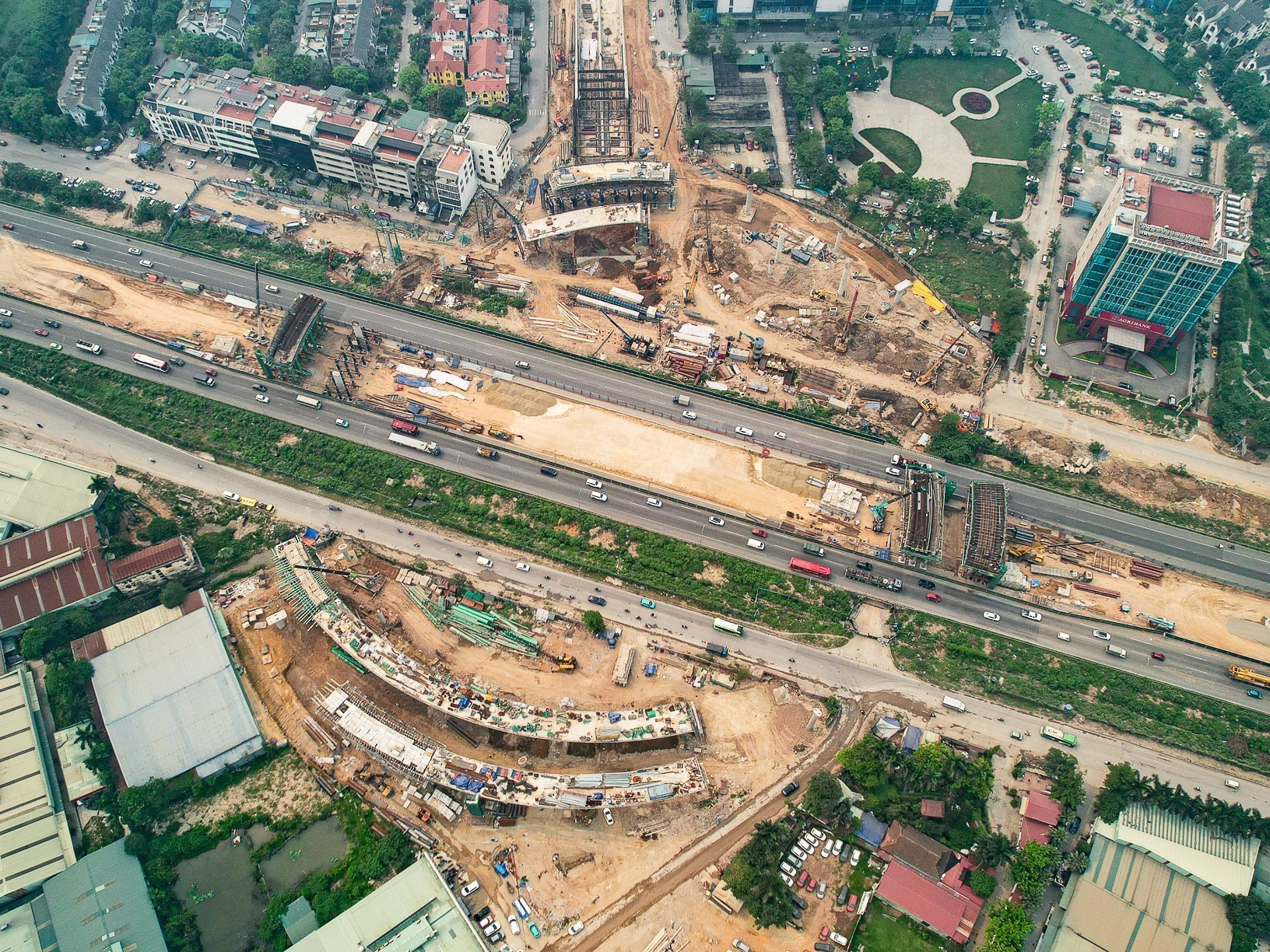
The construction site of the multi-level interchange project between Ring Road 3.5 and Thang Long Boulevard. Photo: VNA
The designation was confirmed in a pre-feasibility report prepared by the Thang Long Project Management Board and the Highway Engineering Consultant Joint Stock Company (HECO).
Under the Action Programme implementing the Resolution of the 14th National Party Congress, Ring Road 5 has been classified as a key infrastructure project for the 2026–30 period.
The National Master Plan for 2021–30, with a vision to 2050, and the Road Network Master Plan for the same period, also identify the route as a project scheduled for investment before 2030.
Authorities said the project is intended to meet rising transport demand in one of the country’s fastest-growing economic regions, while improving links and synchronising transport infrastructure between Hanoi and provinces in the northern key economic zone.
The road is also expected to increase transport capacity and support wider socio-economic development across the region.
According to the consultants’ proposal, the route will begin at Km0, corresponding to Km367+100 on Ho Chi Minh Road in Yen Bai commune in Hanoi, and end at the same point, creating a closed loop.
The planned route will stretch about 340km through seven northern localities: Hanoi (51km), Ninh Binh (36km), Hung Yen (27km), Hai Phong (63km), Bac Ninh (49km), Thai Nguyen (36km), and Phu Tho (78km).
Under the proposal, the main expressway will have six lanes in line with the approved master plan, except for the section through Thai Nguyen from Km248+124 to the CT.07 Expressway, which is planned with four lanes. The road will have a design speed of 100-120kph.
Local authorities are also expected to plan parallel service roads, green belts and pavements alongside the expressway.
The minimum cross-sectional width, including the expressway, parallel roads and green belts, is projected at 120m.
Based on the proposed scale, the preliminary total investment is estimated at 265.5 trillion VND (more than 10 billion USD), including roughly 81.3 trillion VND (more than 3 billion USD) for land clearance and resettlement.
Localities have proposed using a public investment model funded by the central budget to support early and feasible implementation of the project.
According to the report, provincial authorities are facing pressure in balancing budgets as they continue to allocate resources for major centrally backed projects, including land clearance and related infrastructure works.
Units under the Ministry of Construction have asked consultants to further review and update transport demand forecasts, traffic volumes on the main route, at interchanges and on parallel roads to determine the most suitable investment scale.
The ministry also requested additional studies on issues including the transition to green vehicles, climate resilience and flood prevention, as well as toll station and rest area planning to help refine the projected total investment for the route./.