A series of famtrip programmes organised in May reflects the capital city’s more market-oriented approach and efforts to implement the Government’s Resolution 82/NQ-CP on tourism recovery and sustainable development.
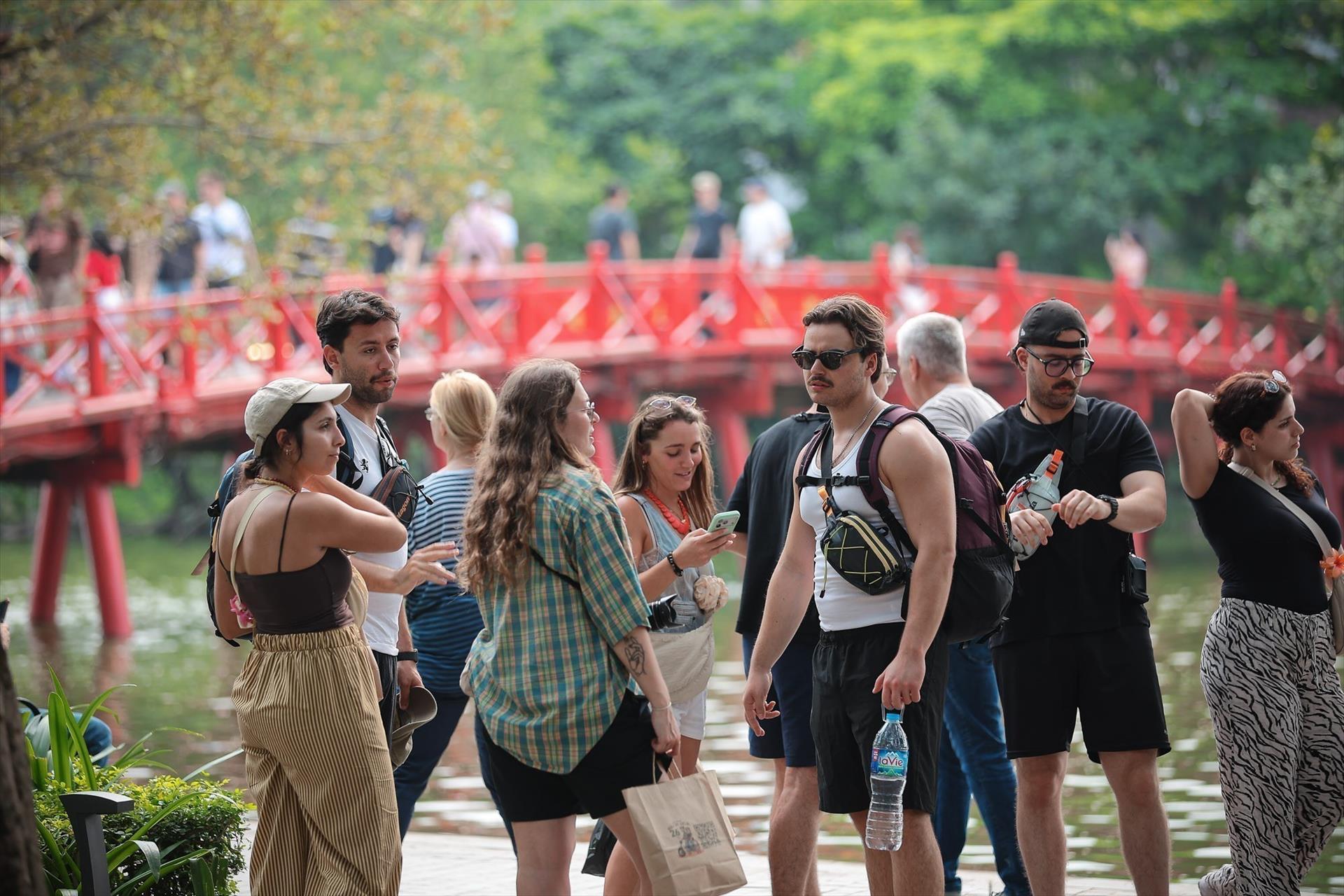
During the month, Hanoi welcomed two international famtrip delegations from Australia and Japan to survey tourism products in the capital and several northern localities. Unlike traditional promotion activities centred on trade fairs and destination branding, the new model allows outbound tour operators to directly experience tourism products, inspect services and connect with local partners at destinations.
The Australian delegation explored tourism routes linking Hanoi, Ninh Binh, Quang Ninh and Yen Tu. Meanwhile, more than 20 Japanese travel executives from Tokyo, Osaka, Kansai, Hyogo and Fukuoka joined a survey tour covering Hanoi, Ninh Binh and Ha Long.
Australian businesses experienced Hanoi’s Old Quarter, the Imperial Citadel of Thang Long, the Hanoi Museum, local cuisine and fine dining services, while also exploring wellness and healing tourism products in Yen Tu, Tam Coc’s ripe-rice season landscape and luxury overnight cruises in Ha Long Bay.
The Japanese delegation focused more on cultural experiences, including city tours, cyclo rides in the Old Quarter and the “Train No.6 – Hanoi Street Museum” route, alongside business networking activities.
The itineraries highlighted Hanoi not as a standalone destination but as a regional tourism hub connected with neighbouring provinces. The strategy aims to extend visitors’ length of stay and increase tourism spending through inter-provincial travel experiences.
The approach mirrors broader tourism trends in Southeast Asia, where countries such as Thailand, Singapore and Malaysia are increasingly shifting towards experiential tourism, thematic travel and integrated tourism ecosystems instead of relying solely on natural attractions.
For years, Vietnam has faced the challenge of rising international arrivals without corresponding increases in visitor spending or length of stay. Many destinations still depend on short tours and similar tourism products while lacking attractive night-time services.
To address the issue, Hanoi and northern localities are accelerating the development of regional tourism products linked to heritage, wellness tourism, golf and night-time entertainment to attract high-value travellers from Northeast Asia, particularly China.
China remains Vietnam’s largest source market. In the first quarter of 2026, more than 1.4 million Chinese visitors travelled to Vietnam, accounting for over 20% of total international arrivals. In 2025, the market contributed nearly 5.3 million visitors, or around one quarter of all foreign arrivals.
Industry experts noted that Chinese tourists are increasingly willing to spend more on high-quality resorts, shopping, cuisine and personalised cultural experiences instead of low-cost package tours.
Hanoi is also placing greater emphasis on developing the night-time economy. The municipal People’s Committee recently approved a project on night-time economic development for 2026-2030, with a vision to 2045.
Under the plan, the city will establish six to eight key night-time economic zones and 15-20 streets and entertainment areas operating beyond midnight. At least three areas are expected to meet regional standards for night cultural and tourism experiences.
West Lake, the Old Quarter and the Red River corridor are expected to become centres for festivals, art performances, night cruises and cultural activities designed to encourage visitors to stay longer.
Experts said sustainable tourism growth will require not only attractive destinations but also better infrastructure, convenient transport, professional services, digital transformation and stronger connectivity between aviation, rail and road tourism.
With closer regional cooperation, improved tourism products and more targeted promotion strategies, Hanoi and Vietnam’s tourism sector are expected to gradually shift from growth in visitor numbers to higher-quality and more sustainable development./.