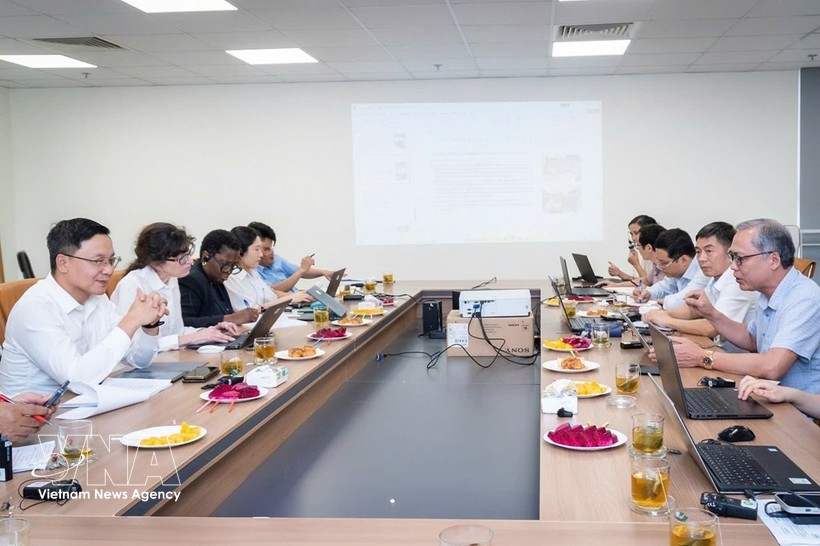
The Department of Climate Change (DCC) under the Ministry of Agriculture and Environment on April 2 held a kick-off meeting for the project “Sustainable Management of Substances Controlled by the Montreal Protocol” (SMS-MP).
Funded by the Multilateral Fund for the Implementation of the Montreal Protocol and implemented through the World Bank (WB) and the United Nations Environment Programme (UNEP), the project aims to help Vietnam meet its international commitments in managing and phasing out controlled substances. It will run from 2026 to 2031 with a total budget of over 13 million USD.
DCC Deputy Director Le Ngoc Tuan said the department serves as the national focal point for implementing the Montreal Protocol and overseeing the management of controlled substances. It has coordinated with international partners and domestic agencies to develop the SMS-MP project.
According to WB representative Mary Ellen Foley, the project will focus on the refrigeration servicing sector, where outcomes will depend heavily on coordination between vocational training institutions and the DCC. A key component involves cooperation with the Vietnam Railway Authority to pilot and convert air-conditioning systems on railway carriages to more climate-friendly alternatives.
The project will also support Department of Vietnam Customs through technical assistance to strengthen the monitoring and control of imports and exports of HCFCs (hydrochlorofluorocarbons) and HFCs (hydrofluorocarbons).
Ha Duc Ngoc, a representative of the Department of Vocational Education and Continuing Education said it will work with relevant partners to select qualified institutions to conduct assessments, issue vocational certificates and organise training activities for technicians in the refrigeration and air-conditioning sector.
At the meeting, participants discussed implementation plans, coordination mechanisms and solutions to ensure progress and effectiveness. The DCC is expected to sign cooperation agreements with relevant partners to roll out project activities in line with the roadmap.
Scheduled for completion by the end of 2031, the project aims to gradually reduce the use of HCFCs and HFCs, eventually maintaining only a minimal level of HCFCs for servicing purposes. It is expected to cut emissions equivalent to 6.1 million tonnes of CO2.
The project targets the phase-out of 97.5% of baseline HCFC consumption by 2030 and a 10% reduction in baseline HFC consumption from 2029, in line with the Montreal Protocol.
Key activities include strengthening the capacity of state management agencies, integrating training materials into vocational education programmes, and training and certifying technicians.
The project will also pilot alternative technologies in sectors such as railway transport, implement awareness-raising activities, enhance control over HCFC and HFC trade, and promote the adoption of climate-friendly technologies, thereby contributing to greenhouse gas emission reductions and improved energy efficiency./.