
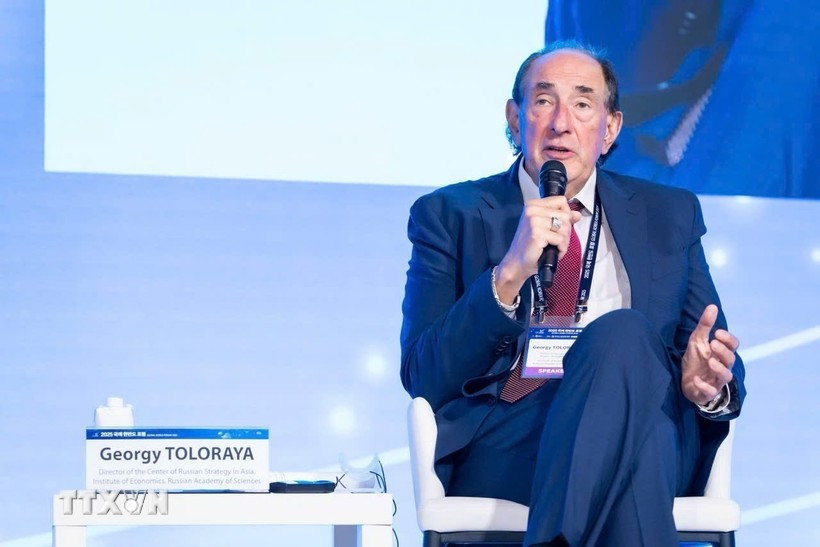
Speaking to a Vietnam News Agency correspondent in Moscow shortly after the Congress concluded, Prof. George Toloraya, Director of the Asian Strategy Centre at the Institute of Economics of the Russian Academy of Sciences, said the Congress marks a qualitative leap in Vietnam’s development trajectory.
He noted that the 14th Party Congress represents a pivotal shift from Vietnam’s role as a “factory of the world” toward its ambition to become a high-tech powerhouse, with development quality reaching a higher level.
According to the scholar, the Congress took place amid complex domestic and international challenges, ranging from natural disasters and epidemics to intensifying strategic competition and disruptions to global supply chains. In this context, Vietnam’s efforts to streamline its organisational apparatus and rearrange administrative boundaries reflect strong political resolve for substantive and far-reaching reform.
Reviewing the Congress documents, Toloraya said Vietnam has clearly charted a transition from extensive growth to intensive growth driven by science – technology, innovation and digital transformation. A modern institution system and high-quality human resources have been identified as core foundations while green and sustainable development, the circular economy and climate change adaptation are treated as essential requirements.
He highlighted Vietnam’s growing institutional maturity, noting that the country now regards institutional reform as the “breakthrough of all breakthroughs” and is proactively addressing the risk of the middle-income trap. Commitments to eliminating the “ask-and-give” mechanism, enhancing transparency and promoting bottom-up governance send a strong signal of Vietnam’s determination to pursue genuine reform to both domestic and foreign investors.
The scholar also pointed to the “dual transformation” orientation, combining the knowledge, digital, green and circular economies, as evidence that Vietnam is moving beyond growth based on low-cost labour toward higher productivity, quality and greater value added. Comprehensive digital transformation, including the development of a digital government, digital economy and digital society, has been identified as a key pillar of this strategy.
The professor stressed the importance of balancing planning and market mechanisms, with the public sector continuing to play a leading role in ensuring macroeconomic stability and setting strategic directions, while the private sector is recognised as one of the most important growth driver that requires a more favourable business environment and stronger competitiveness.
On urban development, he said the creation of new-generation special zones and international financial centres, including in Ho Chi Minh City, underscores Vietnam’s ambition to become a regional services and logistics hub while linking economic growth with the goal of a healthy, disciplined, civilised, safe and developed society.
Regarding foreign policy, the scholar noted that Vietnam continues to pursue a flexible diplomatic approach, but one that is increasingly proactive and assertive in the new era.
From a Russian perspective, he said the outcomes of the Congress open up new opportunities and higher expectations for bilateral cooperation. As Vietnam prioritises digital sovereignty, a strong state and high-tech-driven growth, traditional cooperation models will need to evolve toward technology transfer, localisation and technological self-reliance.
Looking ahead, Toloraya predicted that Vietnam – Russia cooperation will expand to new areas such as technology transfer, digitalisation and green transition, moving beyond traditional political ties toward more substantive and sustainable partnership in the new era./.