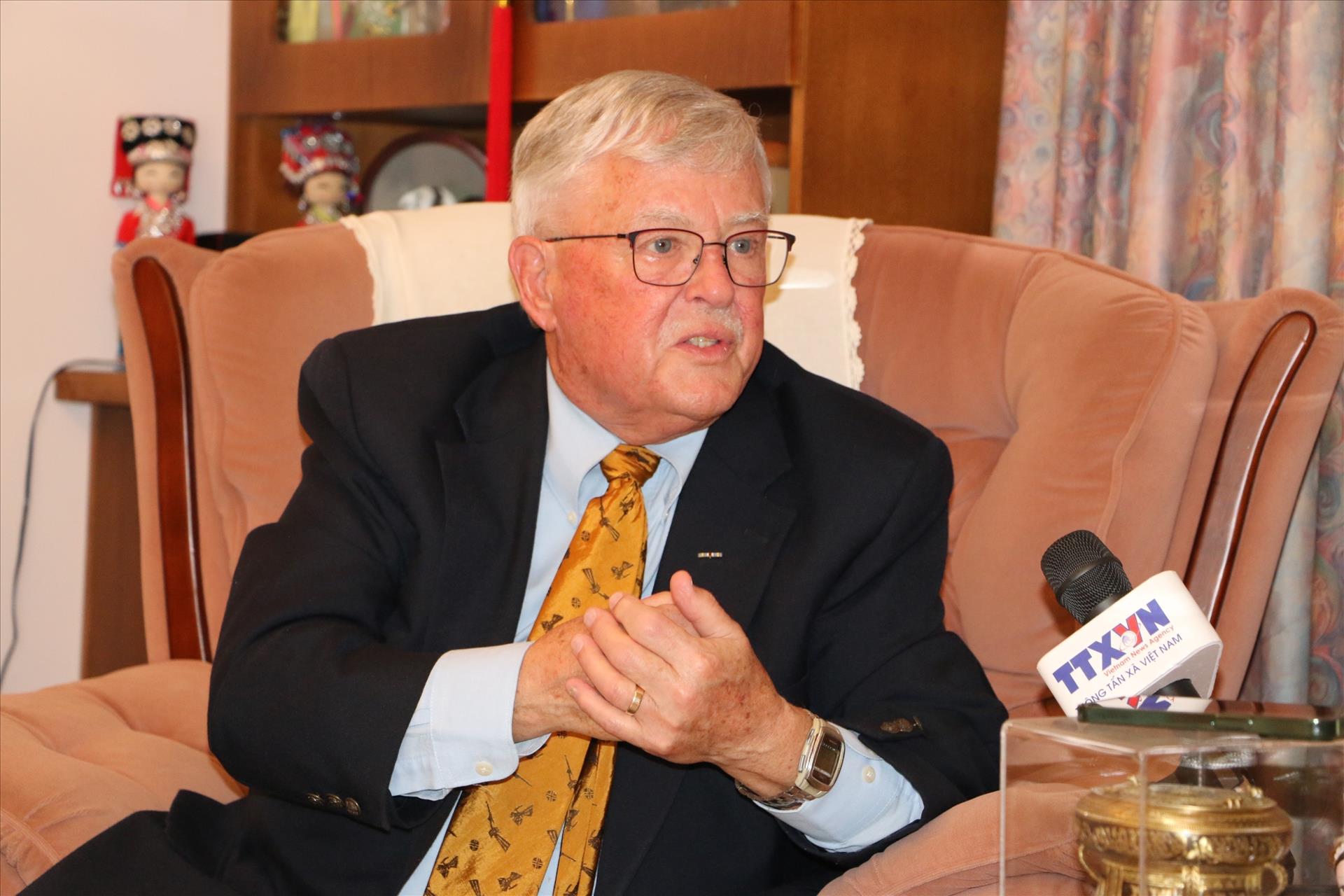
Vietnam’s economic miracle and diplomatic pragmatism is certainly the envy of Southeast Asia, Carl Thayer, Emeritus Professor of Politics at the University of New South Wales’s School of Humanities and Social Sciences told Vietnam News Agency reporters in Sydney.
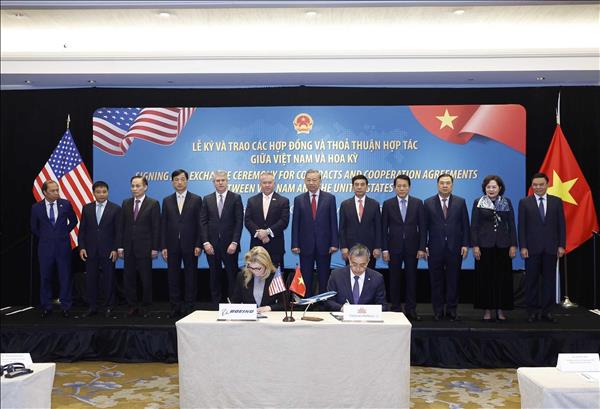
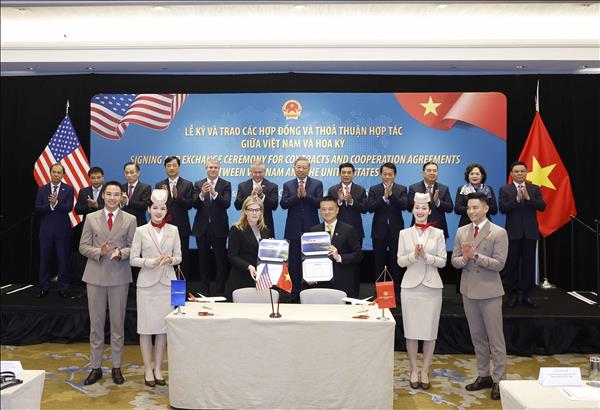
Thayer said Vietnam maintains a Comprehensive Strategic Partnership with both China and the US, as well as those with 12 other important states, and is increasing its leadership role in the Association of Southeast Asian Nations (ASEAN).
He recalled that Prime Minister Pham Minh Chinh closed 2025 at a national conference reflecting on Vietnam’s comprehensive diplomatic strategy, where he urged the delegates to advance this strategy, thereby “further elevating Vietnam’s international standing".
The subsequent Political Report to the 14th National Congress of the Communist Party of Vietnam in January notably stated that: “Strengthening national defence and security, and promoting foreign relations and international integration, are crucial and constant tasks" - a marked upgrading of foreign affairs’ importance to national policymaking.
In terms of the next steps for Vietnam’s diplomacy, he said PM Chinh set out a clear agenda in his speech: steadfastness in strategic direction, flexibility and agility in execution, and a deep understanding of global developments.
Vietnam’s strategic direction can be seen to be guided by the two pillars of national defence - security, more proactive diplomacy and global integration.
Regarding agility in execution, Vietnam’s ability to conduct constructive relations with both the US and China is testament to this. Hanoi also presides over a Comprehensive Strategic Partnership with Japan, a major power, based on a shared commitment to peace, stability, and prosperity in the Indo-Pacific region, he added.
According to him, the Vietnamese Government certainly demonstrates a deep understanding of global developments. In the face of geopolitical tensions, Hanoi has preserved economic growth and restated its commitment to the settlement of disputes via diplomatic means.
As a core member of ASEAN, Vietnam endorses the bloc’s Outlook on the Indo-Pacific (AOIP), which views the Asia-Pacific and Indian Ocean not as distinct, but as a “closely integrated and interconnected region”. Directionally, AOIP underscores the importance of economic development, dialogue and cooperation instead of rivalry, and the importance of the maritime domain.
As a proudly sovereign state with ever-increasing global influence, Vietnam stands firmly behind the principles of a rules-based international order grounded in international law, including freedom of navigation and respect for sovereignty, especially the 1982 United Nations Convention on the Law of the Sea (UNCLOS), he said, adding that Vietnam has improved its maritime and defence capacities to meet security challenges.
Japan has been an important partner here. Via the Official Security Assistance (OSA) programme, the Vietnam Coast Guard has received six Aso-class patrol vessels, complemented by training by the Japan Coast Guard.
Tokyo clearly sees Vietnam as a rising Asian power and has moved to strengthen collaboration and coordination with Hanoi to preserve the rules-based international order and prevent unilateral changes to the regional status quo, he added.
In sum, he said Vietnam’s diplomatic policy has gone from strength to strength over the years. In terms of economic statecraft, Vietnam ranks fourth in the Lowy Institute's Asia Power Index 2025. As the Prime Minister said in his remarks, the diplomatic service has been instructed to continue to elevate Vietnam’s “international mission".
The PM, with the diplomatic service leading on implementation, is intent that Vietnam must contribute “more actively to peace, development and the settlement of global and regional challenges”. This will, in the PM’s words, help to build and safeguard a “fair, equal international order based on international law".
These are worthy objectives for Vietnam as a rising Asian power. Hanoi will undoubtedly continue to work with like-minded partners, in ASEAN and outside the bloc through multinational institutions, to meet them in full, Thayer concluded./.