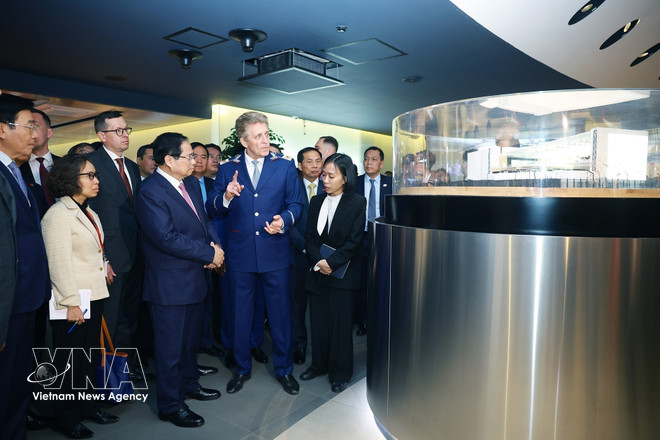
Prime Minister Pham Minh Chinh visited the Virtual Atomic Energy Museum and the Moscow Metro Joint Operations Centre (JOC) of Russia on March 24 (local time) to explore the country’s strengths in nuclear energy and urban rail systems - the two areas where Russia has advantages while Vietnam is prioritising for development.
Located within the Exhibition of Achievements of National Economy complex in Moscow, the museum was built in 2018 and opened to the public in 2023. The facility spans around 25,000 sq.m, with four above-ground floors and three underground basements, and can accommodate up to 2,100 visitors at a time, or 4,500 per day.
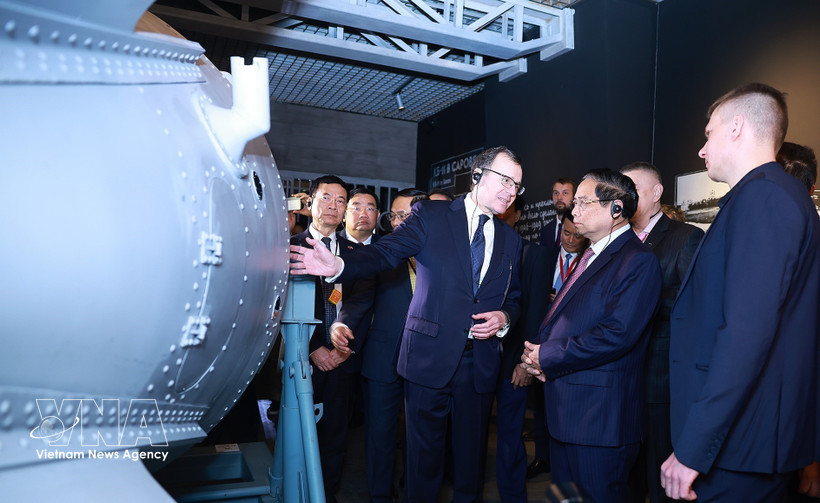
The museum showcases the history and modern achievements of Russia’s nuclear energy industry, hosting exhibitions, lectures and business events to promote knowledge about the sector’s development and future prospects. Designed as both a scientific hub and a public space, it features lecture halls, creative laboratories, reading areas, offices and public amenities.
PM Chinh, who is paying an official visit to Russia from March 22-25, toured exhibitions that highlight early breakthroughs in nuclear science. He also explored potential applications of nuclear technology in energy, medicine, food industry and agriculture.
Expressing his admiration for the achievements of the former Soviet Union and the current Russian Federation in development of nuclear technology, including its scientific and practical foundations, as well as human resources and infrastructure required for the peaceful use of atomic energy, the Vietnamese leader noted that the two countries have already specific cooperation projects in the research and development of nuclear energy for peaceful purposes.
During this visit, Vietnam and Russia also signed an agreement to build a nuclear power plant in Vietnam, contributing to ensuring the Southeast Asian nation's energy security, he noted.
With Vietnam pursuing rapid and sustainable development driven by science, technology and innovation, the PM expressed his hope that the two countries will continue to expand cooperation in the peaceful use of nuclear energy, including research and applications in healthcare, food industry and agriculture.
Visiting the JOC on the same day morning, the Vietnamese leader was briefed on its history and future development orientation, as well as its system of 16 control rooms managing Moscow’s metro lines and centralised operations.
Beyond its efficiency, the metro is renowned for its distinctive architecture. Many stations resemble “underground palaces,” featuring high ceilings, chandeliers, marble finishes and intricate artworks. The system has also integrated modern technologies to enhance passenger experiences, reinforcing its status as both a transport backbone and a cultural landmark of Russia.
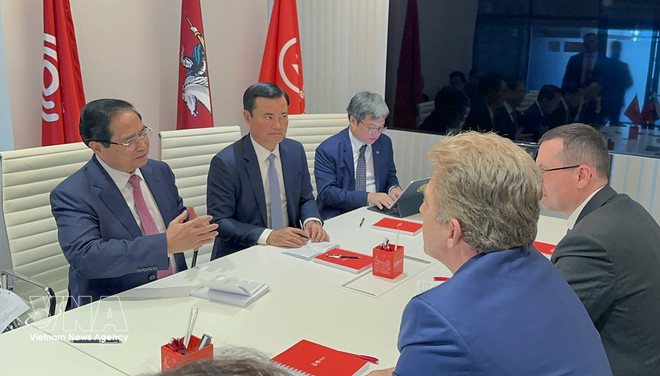
PM Chinh noted that Vietnam is pursuing strategic breakthroughs in infrastructure development, with a forward-looking approach that expands towards the sea, develops underground space, and embraces high-tech frontiers. He highlighted the country’s focus on accelerating urban railway development, especially in Hanoi and Ho Chi Minh City, in line with a modern, green and smart vision.
He said Russia’s experience in developing the metro system in Moscow offers valuable reference for Vietnam, especially in planning routes, determining station locations, designing operational hubs and workshops, and ensuring connectivity with broader transport networks in line with urban development strategies./.