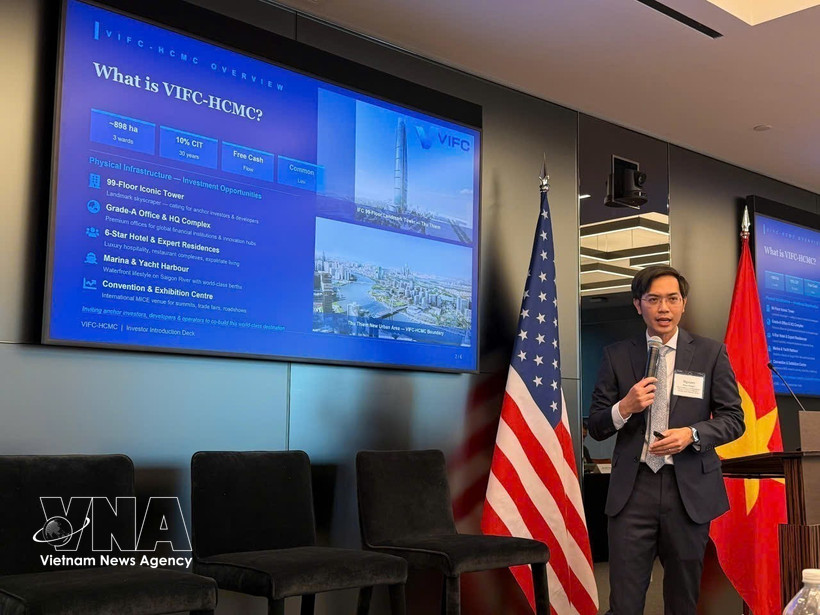
A working visit to the US from March 21 to 30 by Permanent Deputy Prime Minister Nguyen Hoa Binh, who also chairs the executive council of the Vietnam International Financial Centre (VIFC), is viewed as a strategic step to connect the emerging financial hub with global capital flows.
Taking place as the VIFC enters its implementation phase and seeks to attract strategic investors, the trip is expected to enhance the centre’s visibility on the international financial map.
Accompanying the delegation, Associate Professor Dr Nguyen Huu Huan, vice chairman of the VIFC executive council in Ho Chi Minh City, shared that the mission should be understood not merely as diplomatic outreach, but as a large-scale financial investment promotion effort aimed at directly connecting with leading financial institutions, investment funds and exchanges.
Direct engagement with “primary sources of capital” such as global banks, funds and fintech firms will allow Vietnam not only to present its broader economic outlook but also to showcase concrete investment opportunities at the VIFC. Early participation by major institutions, he noted, could generate strong spillover effects and attract additional investors during the centre’s formative stage.
The meetings during this trip will help position the VIFC in Ho Chi Minh City as a next-generation financial hub in the region, with a focus on digitalisation, green finance and emerging models such as tokenisation and fintech. In practical terms, such engagements are expected to yield three outcomes: attracting strategic investors as members or partners, advancing specific projects such as international exchanges or financial data centres, and building market confidence – an essential factor in capital allocation decisions, he said.
Regarding positioning, Huan indicated that the VIFC is not being promoted as a direct competitor to established hubs like Singapore, Hong Kong (China) or Dubai (the UAE), but rather as a specialised centre focusing on niche segments aligned with Vietnam’s comparative advantages. These include aviation finance, maritime finance, and financial technology.
He explained that aviation finance represents a key opportunity, given Vietnam’s rapidly growing aviation market and rising demand for aircraft financing, insurance and fuel hedging services – areas currently dominated by overseas centres.
Similarly, maritime finance is linked to the country’s special advantage in the global logistics chain. Particularly, the Cai Mep – Thi Vai deep-water port complex in Ho Chi Minh City is among the few in the region capable of handling large vessels directly shipping cargo to Europe and the US.
In addition, the VIFC in Ho Chi Minh City is also positioned as an attractive destination for financial and technology corporations seeking to place headquarters or innovation centres. With operating costs estimated at a fraction of those in major financial hubs, combined with a young, abundant and tech-savvy workforce as well as sandbox policies for new financial models, the VIFC here holds potential to become a large-scale “factory of finance” delivering cost-efficient services.
From a broader perspective, Huan noted that global investors are reassessing geopolitical risks and adjusting portfolios accordingly. While capital has not been withdrawn en masse from established centres in the Middle East, there is a growing trend toward diversification. Investors are said to be prioritising locations offering geopolitical neutrality, cost efficiency and regulatory flexibility.
In that context, emerging centres such as the VIFC could serve as complementary destinations in multinational institutions' multi-hub strategies. Rather than replacing established hubs, the VIFC could position itself as an “Asia hedge”, particularly in sectors where Vietnam’s economy provides strong backing such as maritime finance linked to port and logistics chains; aviation finance associated with fleet expansion, airport infrastructure and leasing/hedging services; digital finance, including tokenisation and regulatory sandboxes for new models; alongside an international interbank market integrating traditional banking, digital banking and broader digital financial components.
On the institutional front, he emphasised that legal and regulatory frameworks will be decisive in converting positioning into investor confidence. He cited the National Assembly's Resolution 222/2025/QH15 as a legal foundation, alongside plans to set up specialised courts and an international arbitration mechanism aligned with global standards.
Preferential policies, including tax incentives and streamlined administrative procedures, were also highlighted as competitive advantages. Notably, early investor interest has been reflected in the pledged capital exceeding 9 billion USD within just over two months since the inception of the VIFC in Ho Chi Minh City.
Huan concluded that while building a fully-fledged international financial centre will take time, the VIFC is gradually moving from positioning to building credibility, thereby opening up new opportunities to attract global capital in the years ahead./.