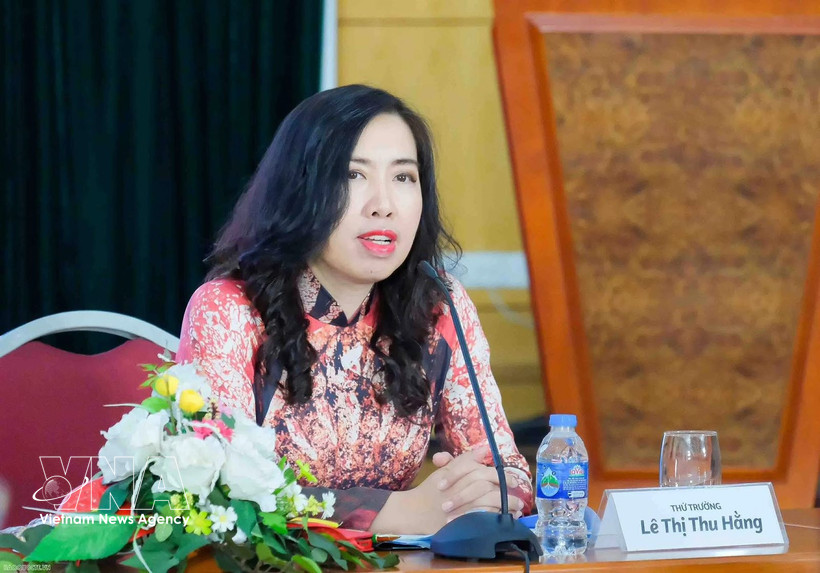
Prime Minister Pham Minh Chinh's official visit to Russia from March 22 - 25 will contribute to advancing the Vietnam–Russia Comprehensive Strategic Partnership in a more substantive, effective and sustainable manner, for the benefit of both countries' people and for peace, cooperation and development in the region and the world, Deputy Minister of Foreign Affairs Le Thi Thu Hang told the media.
Hang said that the trip, to be made at the invitation of Russian Prime Minister Mikhail Mishustin who paid an official visit to Vietnam in January 2025, carries important significance, describing it as a practical step in implementing Vietnam’s foreign policy of independence, self-reliance, peace, cooperation and development, as well as diversification and multilateralisation, as endorsed by the 14th National Party Congress.
The visit will reaffirm the enduring traditional friendship and trusted cooperation between the two countries, while also providing an opportunity to strengthen the bilateral ties both in breadth and depth with a forward-looking vision. It will help create favourable external conditions and mobilise resources for Vietnam’s development in a new era.
During the visit, PM Chinh is expected to hold meetings with high-ranking Russian leaders, visit economic, scientific and educational establishments, and review the implementation of existing cooperation agreements. The two sides are also set to address bottlenecks and identify new drivers for collaboration across traditional areas.
They will discuss major orientations for future cooperation, including launching specific projects aligned with Vietnam’s development priorities, such as new energy, infrastructure and transport connectivity, high technology, biomedicine, healthcare, and high-quality human resource training - the areas in which Russia has considerable strengths and experience, said Hang.
The PM will meet the Vietnamese community in Russia to listen to their aspirations and reaffirm the Party and State’s consistent policy of supporting and protecting overseas Vietnamese’s legitimate rights and interests and promoting the great national unity bloc and national strength.
Regarding measures to further elevate the bilateral ties, the official noted that the Vietnam-Russia relations have continued to develop steadily on the solid foundation of traditional friendship and comprehensive strategic partnership. Political trust has been reinforced through frequent high-level exchanges and effective cooperation mechanisms.
Traditional areas of cooperation, including defence-security, trade, energy, science-technology, and education-training, have been strengthened, while new areas such as innovation, digital transformation, green transition, and advanced technologies are being expanded.
Looking ahead, Hang suggested both sides promote coordinated and comprehensive engagement across the three pillars of Party diplomacy, State diplomacy, and people-to-people exchanges. In addition to strengthening existing areas, greater emphasis should be placed on cultural and educational cooperation, tourism, and youth exchanges.
On education and training, she noted that generations of Vietnamese students trained in Russia have made significant contributions to national development, and that both countries should further expand ties in fields where Russia excels, such as digital technology, quantum technology, biomedicine, and fundamental sciences.
In terms of people-to-people ties, she highlighted the importance of enhancing cultural, artistic and sporting exchanges, as well as organising regular cultural events in both countries. She referred to the Vietnamese Cultural Festival held at Red Square in 2025 to mark the 75th anniversary of diplomatic relations, and noted that 2026 will see a wide range of science and education activities in both countries.
Tourism cooperation has shown strong recovery and should be further facilitated through improved legal frameworks to ease travel between the two nations, Hang added.
The deputy minister also underscored the important role of the Vietnamese community in Russia, numbering around 80,000 people, describing them as a vital bridge in the bilateral relations. She noted that most community members are well-integrated, hardworking, and actively contributing to both societies, with many achieving success as entrepreneurs and professionals.
Vietnam will continue to protect the legitimate rights and interests of its citizens abroad while encouraging their contributions to national development, and at the same time will work with Russia to ensure favourable conditions for the community to live, work and study, she affirmed./.