Since late 2025, many historical sites across Hanoi have boldly renewed their tourism offerings by applying technology and creative approaches to enhance visitor experiences.
These efforts have not only breathed new life into heritage spaces but have also created important momentum for the development of tourism and the capital city’s cultural industries in 2026.
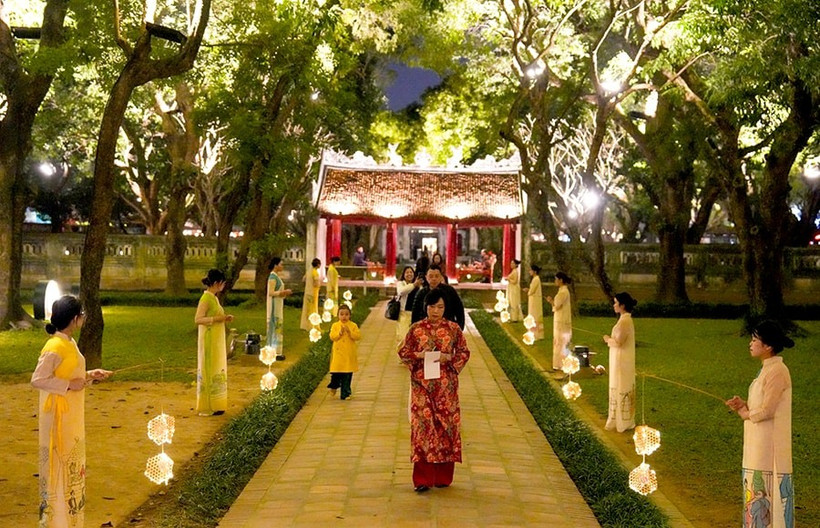
On January 1, 2026, the Centre for Scientific and Cultural Activities at Van Mieu – Quoc Tu Giam (Temple of Literature) officially launched the night tour “Vietnamese Resonance,” an experimental cultural tourism product promising distinctive and engaging experiences for visitors.
Against the illuminated backdrop of the Van Mieu – Quoc Tu Giam complex at night, visitors are guided through a series of cultural spaces, including Khue Van Pavilion, Thien Quang well and the Bai Duong area. The tour also features exhibitions on traditional craft villages, calligraphy displays and concludes with a space dedicated to traditional music.
According to Le Xuan Kieu, Director of the Centre, following the night tour using 3D mapping lighting technology introduced in 2023 and upgraded in 2024, “Vietnamese Resonance” represents a fresh experiment that honours traditional values through a modern approach.
He noted that the programme aims to help visitors perceive Van Mieu – Quoc Tu Giam not only as a symbol of scholarship but also as a place that nurtures and spreads Vietnamese educational philosophy through music and traditional arts.
Beyond the main relic area, Ho Van Lake within the Van Mieu complex has been renovated into a new creative space, emerging as a gathering point for Hanoi’s creative community and visitors. The area now hosts exhibition booths showcasing craft village products and Hanoi’s culinary brands, while evening lighting and non-profit artistic performances have turned it into an attractive experiential destination.
In line with Hanoi’s Resolution No. 09-NQ/TU on cultural industry development, which emphasises leveraging science, technology and innovation to preserve and promote heritage values, many sites have adopted technology to engage the public more effectively.
Notable examples include the “Ngoc Son – The Mysterious Night” tour at Ngoc Son Temple using 3D mapping and performance art, and the Van Mieu night tours that narrate educational traditions through light.
Recently, the Thang Long Imperial Citadel introduced a range of new products combining technology and artistic performance to enhance interaction. Highlights include the “Flag Tower Memories” tour and the “Thang Long Capital” show featuring 3D mapping and digital experiential spaces.
Meanwhile, tourism enterprises are also innovating. The cycling tour “Hanoi Beautiful Sound,” launched in December 2025, integrates public bicycles with GPS-based audio guides, offering visitors a novel way to explore the city.
According to Hanoi Department of Tourism Director Dang Huong Giang, these innovative products not only diversify experiences but also demonstrate the city’s adaptability to modern trends, contributing to improved visitor satisfaction and reinforcing Hanoi’s creative and forward-looking spirit./.