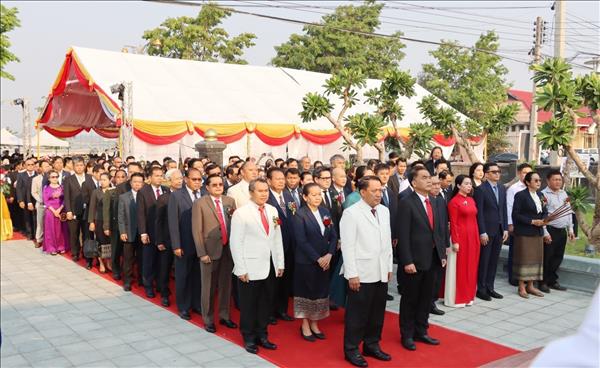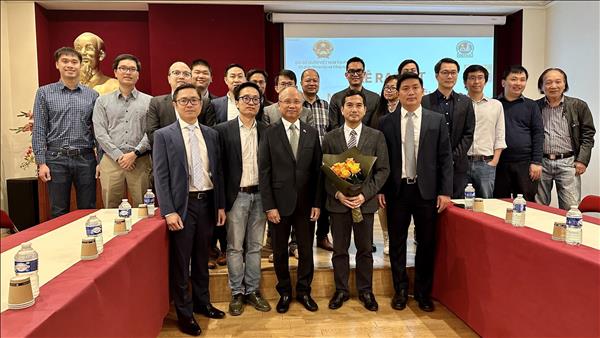

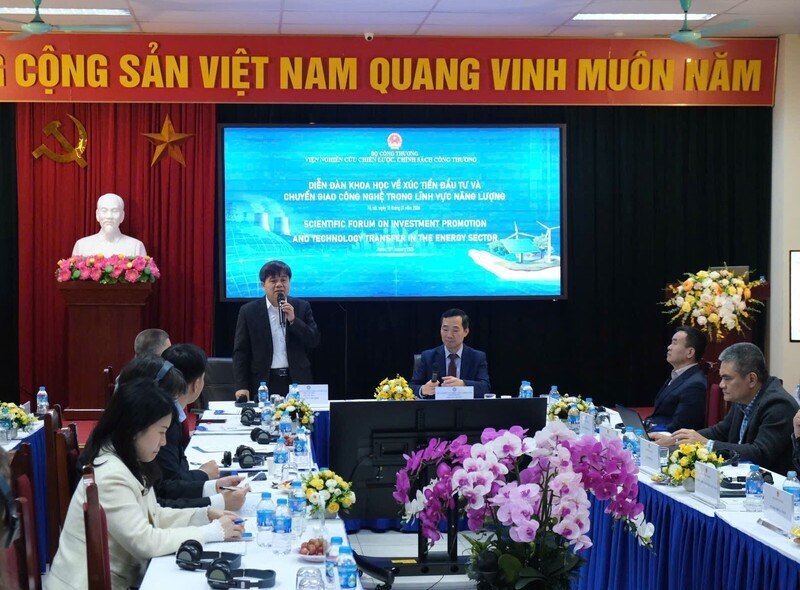
The Vietnam Institute of Strategic and Policy for Industry and Trade under the Ministry of Industry and Trade on January 15 held a scientific forum on investment promotion and technology transfer in the energy sector, focusing on nuclear power, in the context of Vietnam facing challenges in energy security and sustainable development.
The event brought together policymakers, experts and businesses involved in Vietnam’s energy transition.
Addressing the forum, La Hong Ky, a representative of the State Steering Committee Office for National Energy Projects, highlighted the Prime Minister's Decision No. 768/QD-TTg dated April 15, 2025, approving adjustments to the Power Development Plan VIII, adopting an integrated approach that maximises domestic energy resources, develops renewable energy alongside appropriate electricity, coal and gas imports while gradually building nuclear power plants to ensure energy security, environmental protection and sustainable development.
Ky said global nuclear power development is showing positive momentum, particularly with the emergence of small modular reactors (SMRs) with capacities below 300 MW. Compared with large-scale nuclear plants, which often require lengthy construction periods and high upfront investment, SMRs offer faster deployment and lower initial capital costs thanks to factory-based mass production and transportation to installation sites. The first SMRs are expected to enter commercial operation by the end of this decade.
He noted that major technology corporations such as Google, Microsoft and Amazon are increasingly turning to nuclear power to meet the surging electricity demand of data centres serving artificial intelligence development. Meanwhile, the extension of reactor lifespans and the restart of older facilities are further driving the global nuclear industry, expanding technology options suitable for Vietnam’s future financial capacity.
The forum underlined that promoting investment and technology transfer in nuclear power serves multiple objectives, including ensuring energy security, mastering advanced technologies, attracting international capital, training engineers and specialists in nuclear operation and safety management, creating jobs, developing supporting industries, and contributing to sustainable economic growth.
Regarding investment models, the State will continue to play a leading role. State-owned enterprises such as Vietnam Electricity (EVN) and the Vietnam National Industry–Energy Group (Petrovietnam) are expected to be designated as investors of the Ninh Thuan 1 and Ninh Thuan 2 nuclear power plants. The Government will introduce specific financial mechanisms, capital mobilisation arrangements and implementation procedures, while flexible mechanisms are being considered to encourage private enterprises to participate in research and investment in SMR projects.
Under criteria set by the National Assembly, selected nuclear technologies must ensure the highest levels of safety, modernity and investment efficiency.
Currently, the main technologies exported worldwide are Generation III+ reactors, with operating lifespans of 60–80 years and full compliance with post-Fukushima safety requirements. Examples include Russia’s VVER-1200, the United States’ AP1000, the Republic of Korea’s APR-1400 and France’s EPR.
Ky also outlined a four-stage roadmap for nuclear technology transfer, covering operation and maintenance, localisation of the supply chain, mastery of fuel and waste management, and independent design and research into new reactor generations such as SMRs. Participants proposed strengthening technology transfer provisions in Engineering, Procurement and Construction (EPC) and build-operate-transfer (BOT) contracts, establishing a Nuclear Power Research and Development Centre at an early stage, and enhancing cooperation with the International Atomic Energy Agency (IAEA).
Beyond nuclear power, the forum shared the European Union’s experience in energy transition. Experts noted that renewables accounted for about 47% of the EU’s electricity output in 2024, supported by a strong legal framework and effective green finance and just transition mechanisms. They recommended that Vietnam develop a long-term energy transition strategy, improve institutions, diversify energy sources, modernise power infrastructure and strengthen international cooperation./.