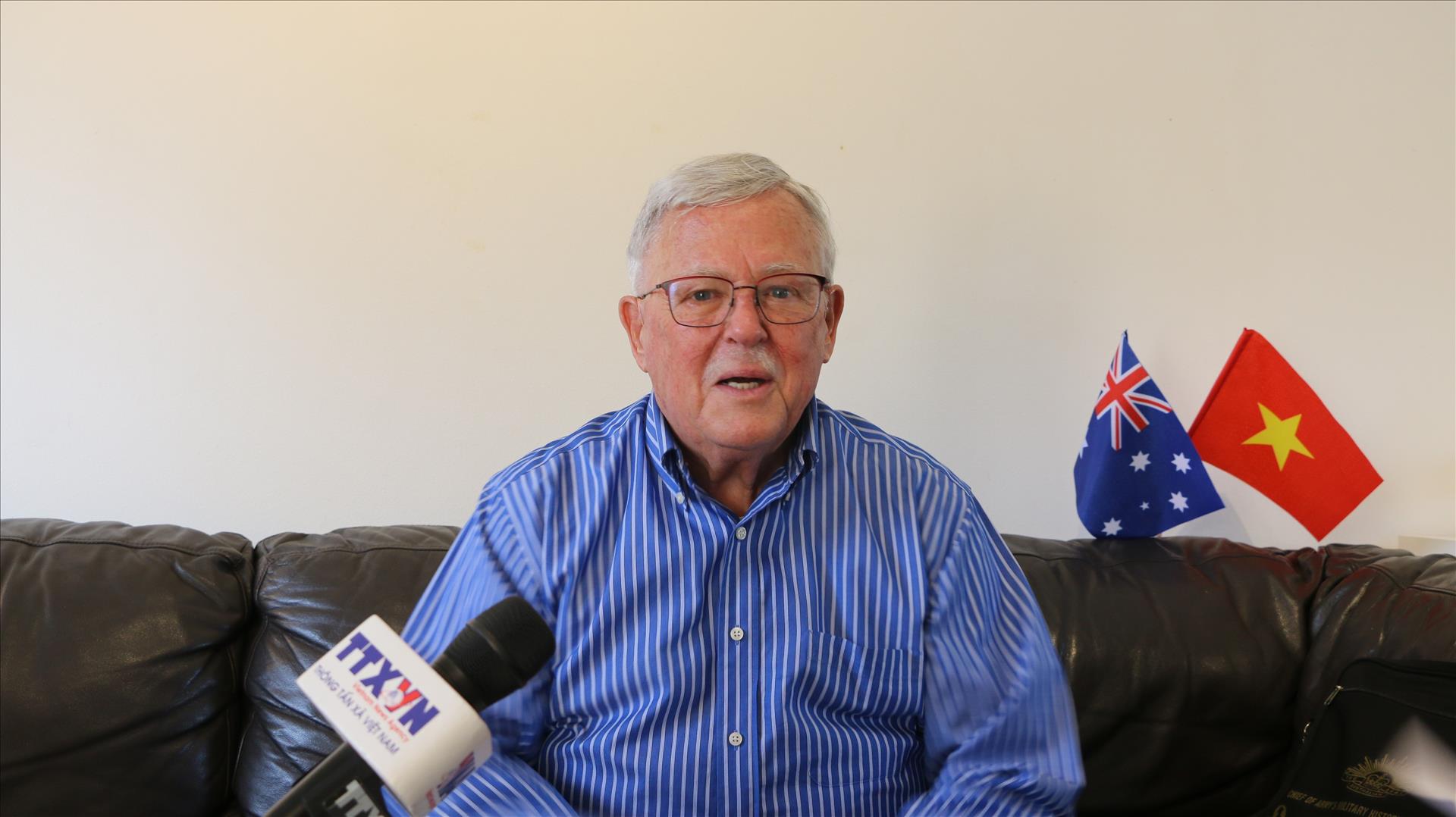
Professor Carl Thayer from the Australian Defence Force Academy at the University of New South Wales has spoken highly of the performance of the 15th National Assembly (NA) and People’s Councils at all levels in Vietnam for the 2021–2026 term, on the threshold of the election of deputies to the 16th legislature and People’s Councils at all levels for the 2026–2031 tenure.
The 15th National Assembly held ten statutory legislative sessions, along with nine extraordinary sessions that mainly addressed personnel issues. The final 10th session witnessed the passage of a record 51 laws during a fast-track session, he said in an interview with the Vietnam News Agency (VNA)'s resident correspondent in Sydney.
During the 15th term, NA deputies raised a number of critical issues with government ministers during question time regarding environmental protection, land administration, and food safety. Deputies were particularly engaged during discussions on amendments to the 2013 Constitution and the Law on the Organisation of Local Administration.
Prof. Thayer described this as a heavy task. However, Vietnam has succeeded in achieving its goals.
In 2025, Vietnam reduced the number of provinces and cities to 34, including 23 newly merged provinces and 11 provinces or cities that remained unchanged. This required restructuring the People’s Councils in the newly merged provinces, he said.
As a researcher on Vietnam, Prof. Thayer observed that in the past, Vietnam used to hold elections for the NA a full year after the national congress of the Communist Party of Vietnam. This schedule was later changed so that elections were held in May or five months after the national congress.
The 14th National Party Congress set forth important development goals for the country in the new era, which need to be urgently implemented by the new Party and Government leadership. Therefore, moving the NA elections forward was a necessary step to elect new Government leaders, including the State President, the Prime Minister, and members of the Cabinet, according to the professor.
Following the streamlining of the political system and the merger of provinces, new People’s Councils will be elected at the same time as the NA. This is a significant move, as the People’s Councils will need to receive direction from the new ministers so they can begin implementation immediately.
According to Prof. Thayer, both the NA and the People’s Councils face a mammoth task in reviewing and revising existing laws, resolutions, directives, conclusions, and other guidance to achieve the specific development goals adopted by the 14th National Party Congress in an orderly and efficient manner.
The international geopolitical system is undergoing a transformation, and there is great uncertainty about the impact of this change on the global economy and supply chains.
To promote inter-regional and global economic cooperation, it is necessary to ensure that each bilateral and multilateral free trade agreement (FTA) achieves maximum effect, the expert said. For Vietnam, this includes not only bilateral FTAs but also the ASEAN Free Trade Area, ASEAN’s FTAs with its dialogue partners, the EU–Vietnam Free Trade Agreement, the Eurasian Economic Union-Vietnam FTA, the Regional Comprehensive Economic Partnership, and the Comprehensive and Progressive Agreement for Trans-Pacific Partnership.
Prof. Thayer recommended that Vietnam ensure it maintains proactiveness in working with its network of comprehensive and strategic partners, particularly its comprehensive strategic partners. Vietnam must constantly consult with its partners and respond swiftly to mitigate negative geopolitical impacts.
Regarding efforts to promote parliamentary cooperation between Vietnam and Australia for greater benefits to bilateral relations, the professor recalled that Australia and Vietnam signed a Parliamentary Cooperation Agreement in 2022 and elevated their ties to a Comprehensive Strategic Partnership in 2024. According to the expert, the 2022 cooperation agreement should be reviewed to ensure it addresses opportunities under the upgraded relationship.
The two sides have already identified climate change, energy transition, digital transformation, trade, and regional security as common areas of concern. Their respective legislative committees should explore new priority areas as a follow-up to Vietnam’s 14th National Party Congress, such as artificial intelligence, hi-tech agriculture, and current geopolitical issues affecting the rules-based global order./.