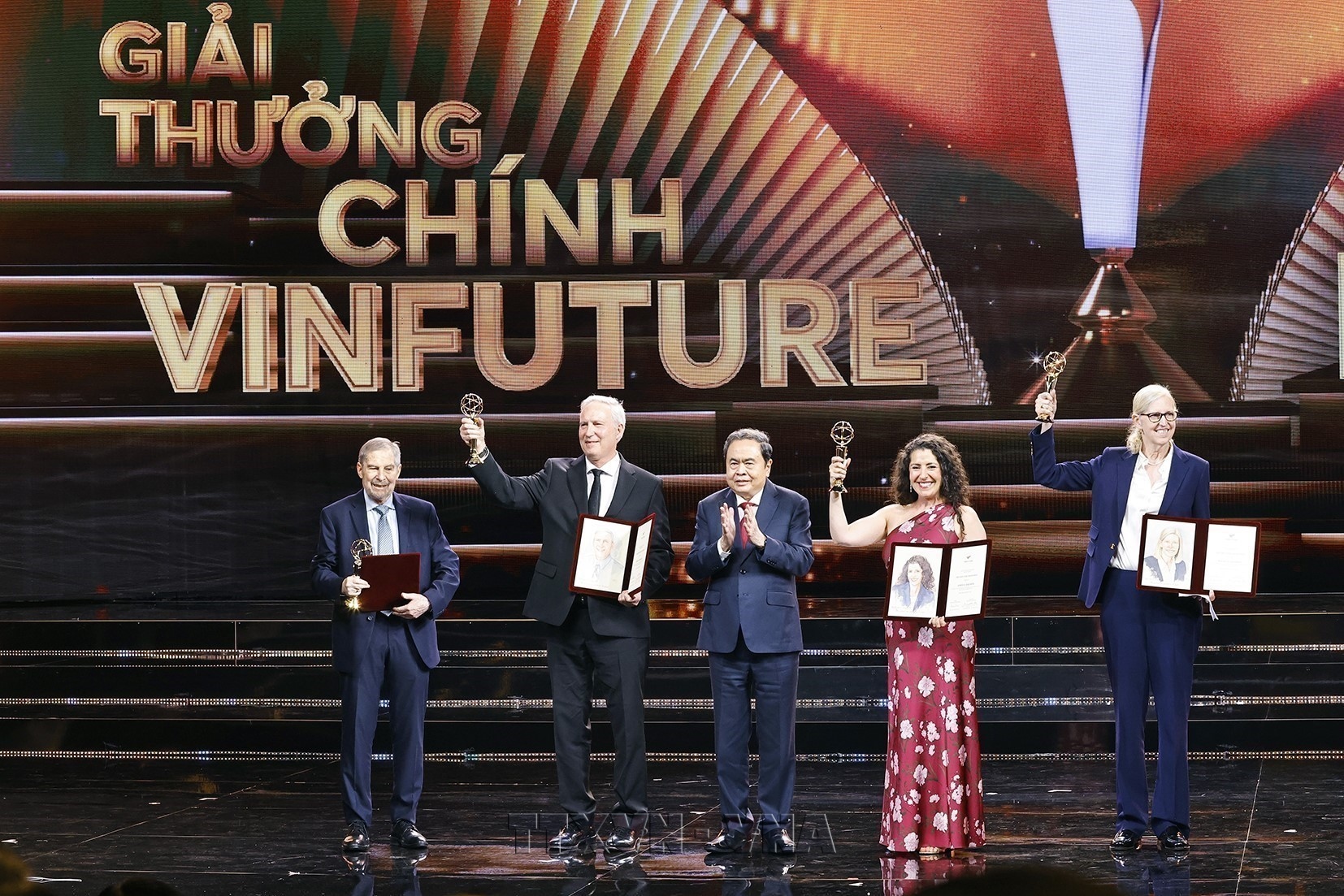
Via conferences, expert dialogues, networking and inspirational talks, VinFuture has brought many of the world's leading scientists to Vietnam not just to share knowledge, but to co-design research, advise on talent pipelines, and build practical solutions for the country’s most urgent problems.
Spinning off a foundational tech network
The most tangible yield is an international research network in foundational technologies. Handshakes struck during VinFuture Science and Technology Week have hardened into multi-year partnerships linking leading global scientists with Vietnamese universities and research institutes, lifting the country’s research capability.
Prof. Omar Yaghi from the University of California, Berkeley - one of the world's most influential materials scientists, a VinFuture Special Prize laureate who went on to win the 2025 Nobel Prize in Chemistry, is collaborating with VinUniversity to develop AIRES, an artificial intelligence (AI) platform for the discovery and design of new materials.
Similarly, Prof. Richard Friend from the University of Cambridge, recipient of the 2010 Millennium Technology Prize, and Prof. Konstantin Novoselov from the National University of Singapore, winner of the 2010 Nobel Prize in Physics, are serving as scientific advisors to VinUniversity's Centre for Materials Innovation and Technology (CMIT), supporting the development of advanced materials research in Vietnam, a discipline that underpins semiconductors, clean energy, and next-generation electronics.
Novoselov then brokered a tie-up between the CMIT and Singapore’s Institute for Functional Intelligent Materials (I-FIM), opening channels for researcher exchanges, joint PhD supervision, co-authored projects, and a pipeline of quality international publications from Vietnamese labs.
Concrete fixes: From cassava to stroke prevention
The connections are increasingly being wired into on-the-ground projects tackling Vietnam’s real-world challenges in sustainable development, agriculture, healthcare, and public health.
Prof. Ermias Kebreab from the University of California, Davis, member of the VinFuture Pre-Screening Committee and leading expert in sustainable agriculture, is joining the Smart Marine Aquaculture System (SMAS) project while backing green transition efforts in Khanh Hoa province.
For coastal Khanh Hoa, the project promises more resilient livelihoods, cleaner water, and better climate resilience, Kebreab said. Longer-term, it could become a model for other coastal areas, proving that development is sustainable when science and nature are effectively integrated.
Since 2023, backed by VinFuture and funding from Vingroup’s Thien Tam Foundation, Prof. Dr. Le Huy Ham, former Director General of the Agricultural Genetics Institute, has led a 2023–2027 project using molecular markers to breed cassava varieties resistant to mosaic disease while preserving plant architecture, starch content, and yield. Success would shield millions of farmers’ incomes, secure raw material flows for processors, and sharpen the global competitiveness of Vietnam’s cassava industry. In April, the first variety filed for official recognition.
VNPreventStroke, an AI-powered platform designed to predict stroke risk, is another standout. The idea was hatched during VinFuture Science and Technology Week 2024 after international scientists, local physicians, and researchers held a series of focused talks. Prof. Dr. Mai Duy Ton, Director of the Stroke Centre at Bach Mai Hospital, and Prof. Do Ngoc Minh from the University of Illinois Urbana-Champaign and VinUniversity, pitched a digital platform built specifically for the Vietnamese population.
The project has won in-principle funding approval and is being readied for rollout. In a country where stroke is a top killer and driver of disability, the impact could stretch well beyond a single study.
Separately, an AI-driven rehabilitation robotics system is being developed by Assoc. Prof. Dr. Mac Thi Thoa and colleagues at the Hanoi University of Science and Technology. The VinFuture network linked the team with Prof. Raymond Kai-yu Tong from the Chinese University of Hong Kong, a top global expert in rehab robotics, after academic exchanges in 2025.
Tens of thousands of Vietnamese patients endure long rehab stints after stroke or neurological injury each year, yet advanced equipment remains expensive and scarce in many facilities. The project aims to produce a “Made in Vietnam” AI rehab system that marries international know-how with local needs. If it works, it could lower treatment costs, boost recovery outcomes, and widen access for stroke survivors and neurological patients.
Beyond R&D, the collaborations are beginning to generate evidence that feeds directly into policymaking. A school-based e-cigarette prevention project shows how quickly partnerships can pivot into action. Via VinFuture’s InnovaConnect 2024, the Hanoi University of Public Health researchers teamed up with international tobacco control and public health experts. Using global best practices, they rolled out an intervention covering more than 2,200 students in Hanoi. The evidence that emerges could shape policies to shield young people from e-cigarettes, a threat drawing sharper scrutiny from regulators worldwide./.