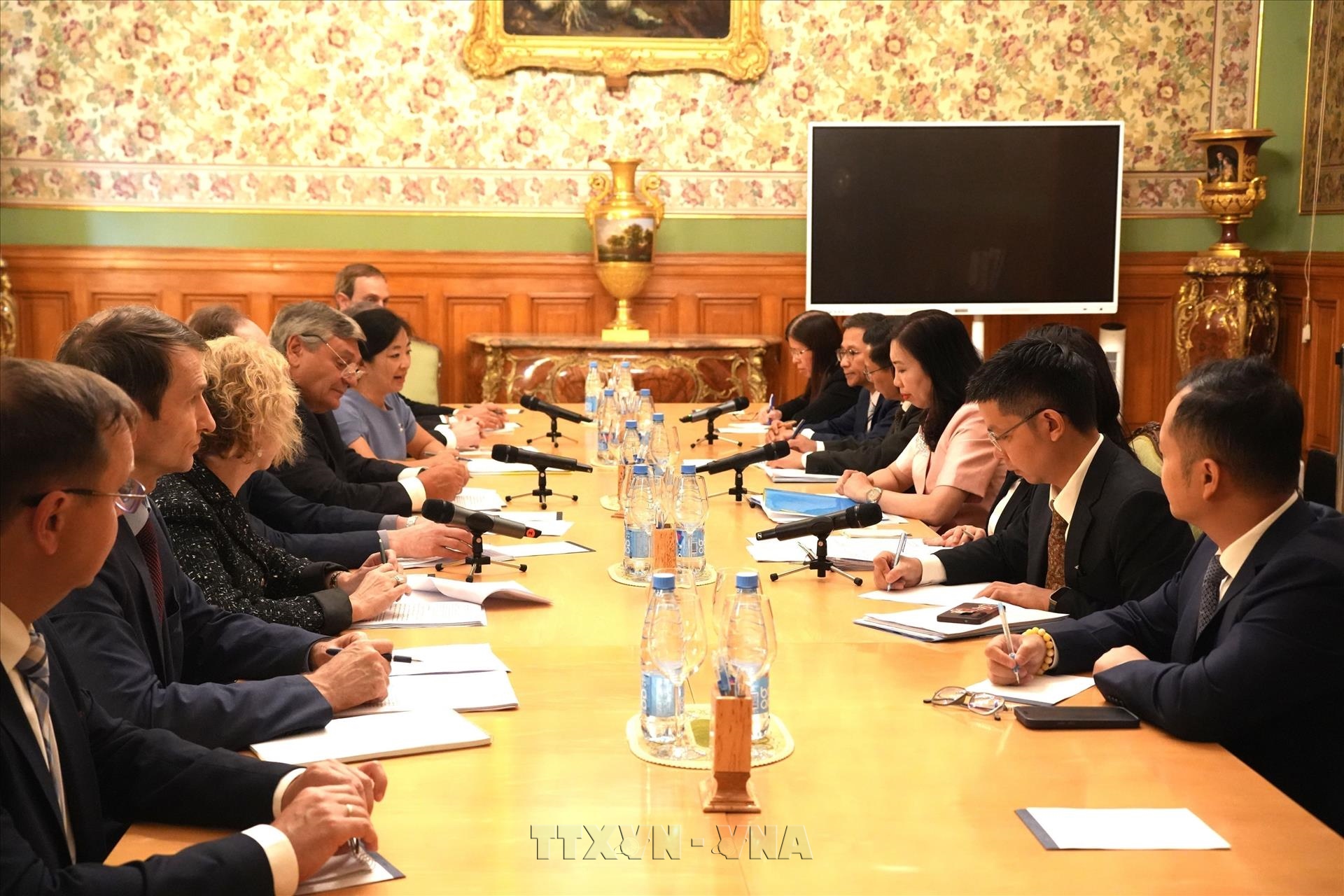
A view of the political consultation. Photo: VNA
The two sides reviewed bilateral relations since the previous consultation in Hanoi in February 2025 and discussed concrete orientations and measures to address difficulties and promote cooperation between the two countries and their foreign ministries. They agreed to closely coordinate preparations for high-level delegation exchanges, particularly those scheduled for the remaining months of 2026.
Welcoming the Vietnamese delegation, Rudenko affirmed that Vietnam is a reliable and sincere partner and a priority in Russia’s foreign policy toward the Asia-Pacific region. He expressed confidence that Vietnam would continue to achieve strong development and new accomplishments in pursuing the strategic goals set by the 14th National Congress of the Communist Party of Vietnam (CPV).
For her part, Hang affirmed that Russia has been and will remain one of the most important partners in Vietnam’s foreign policy. She stressed that the Vietnamese people will never forget the valuable support provided by the former Soviet Union and Russia today, which they consider a firm foundation for the two countries to expand cooperation in the new era.
She called on the two foreign ministries to further strengthen their coordinating and monitoring roles, and urged ministries and sectors to effectively implement high-level agreements, creating new milestones in bilateral relations.
The two sides highlighted substantive and breakthrough results achieved in bilateral cooperation in recent years. Political ties have been effectively maintained through the implementation of commitments reached during visits to Russia by General Secretary of the CPV Central Committee To Lam in May 2025, then Prime Minister Pham Minh Chinh in March 2026, and Prime Minister Le Minh Hung in June 2026.
For economic and trade cooperation, two-way trade has maintained positive growth. The two deputy ministers agreed on the need to make better use of the Free Trade Agreement between Vietnam and the Eurasian Economic Union (EAEU) to expand investment and facilitate balanced and sustainable market access for goods from both countries. Traditional energy cooperation has also expanded into new, green and sustainable energy sectors with high technological content.
Education, culture and people-to-people exchanges continue to be major bright spots in bilateral ties. Under the Vietnam-Russia Year of Scientific and Educational Cooperation 2026, the two sides have agreed to organise more than 100 activities. The number of Vietnamese applicants seeking to study in Russia continued to rise in 2025.
The two sides also supported the organisation of a “Russian Cultural Season in Vietnam” in 2027 and pledged to create favourable conditions for teaching the Vietnamese language in Russia and the Russian language in Vietnam, contributing to enhancing mutual understanding and educating young people about the two countries’ traditions.
At international forums, the two sides stressed the need to strengthen exchanges of views, coordination and mutual support at international organisations, particularly the United Nations, amid a rapidly changing global situation. Through such efforts, they said, Vietnam and Russia would contribute to maintaining peace and stability in the Asia-Pacific region and the world.
The foreign ministers reaffirmed their determination to effectively maintain the political consultation mechanism and further deepen the comprehensive strategic partnership in a substantive and effective manner./.