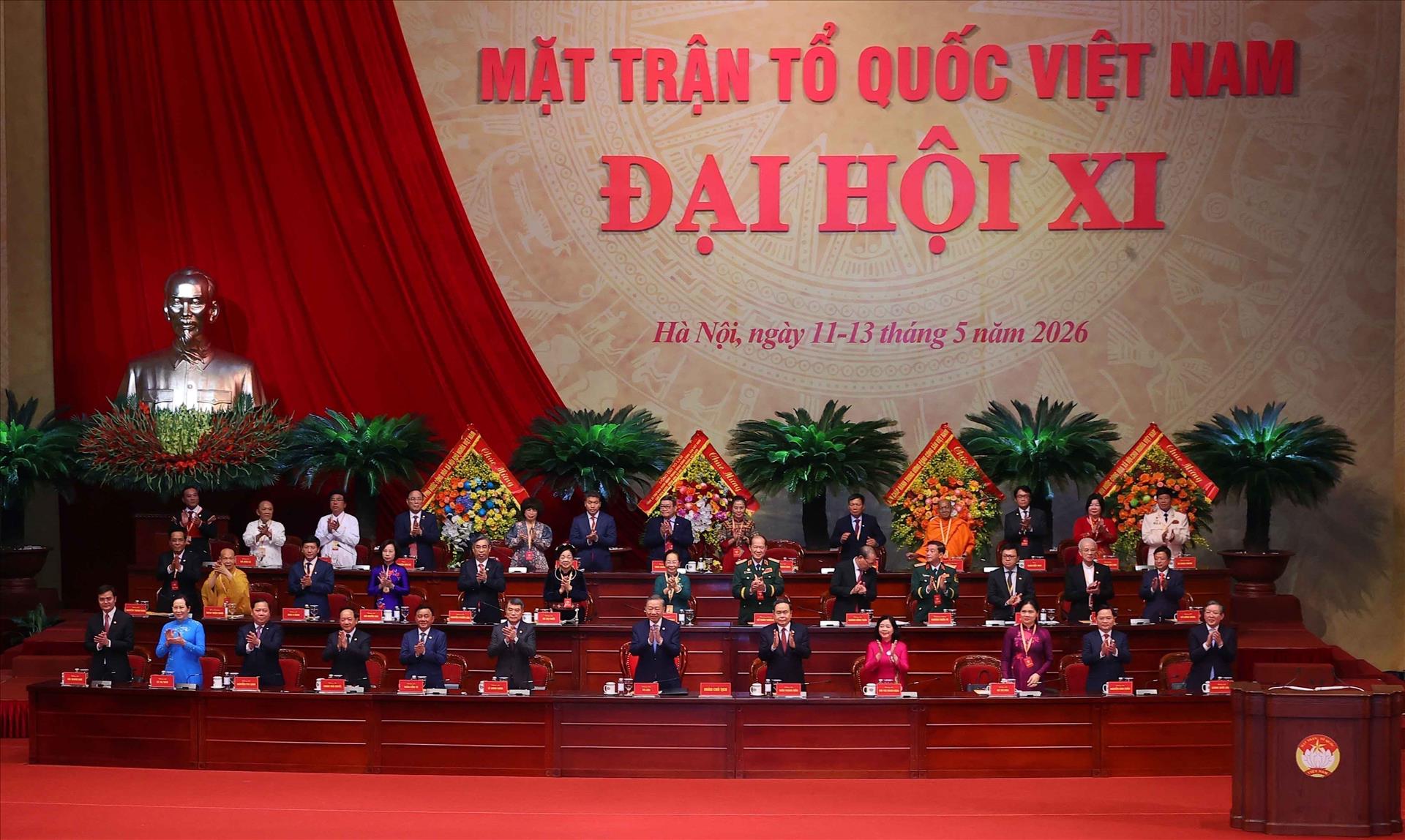
The gathering drew former and incumbent Party, State, Government and National Assembly (NA) leaders, senior ministry officials, war veterans, heroic Vietnamese mothers and 1,136 delegates representing the VFF’s chapters, intellectuals, ethnic and religious groups, the army and overseas Vietnamese.
Affirming VFFs new standing and operating model
In her opening speech, Politburo member, Secretary of the Party Committee of the VFF and Central Mass Organisations, and President of the 10th-tenure VFF Central Committee Bui Thi Minh Hoai said during the 2024-2026 term, the VFF system continually overhauled its operations under Party leadership and with State, Government and NA coordination and public consensus. It cemented its role as the nucleus of national unity, rallying all social strata, actively engaging in Party and administration building, sharpening oversight and social criticism, protecting citizens’ legitimate rights and interests, upholding democracy and broadening social consensus.
The VFF also took a proactive role in shaping mechanisms and policies, notably through the constitutional amendment resolution and the election of deputies to the 16th NA and all-level People’s Councils for 2026-2031. It drove patriotic emulation campaigns and delivered timely support to disaster-hit communities, especially the poor and vulnerable groups, putting the Party’s “no one left behind” policy into practice.
According to her, the congress convenes as Vietnam enters a new phase of major opportunities and challenges, with the nation striving to build a prosperous, civilised and happy country and an independent, self-reliant economy deeply integrated globally. She described it as the VFF’s first congress under a new organisational model.
The congress is tasked with assessing the state of social groups and the great national unity bloc, reviewing the 10th-tenure VFF Central Committee’s action plan for 2024-2026, and setting the directiosn, goals and action plan for 2026-2031. It will also amend and supplement the VFF Charter and conduct consultations to appoint the VFF Central Committee, Presidium, Standing Board and leadership for the new term.
With the spirit of “Unity – Democracy – Innovation – Creativity – Development”, the Presidium called on delegates to uphold their sense of responsibility, solidarity, and wisdom, and contribute substantive and quality opinions on documents so that the congress would become a major milestone in the process of renewing and improving the VFF’s effectiveness in the new revolutionary period.
Hoai expressed confidence that Vietnam’s traditions, the strength of great national unity, the Party’s leadership, the public creativity and aspirations would enable the country to hit its two centennial strategic goals and become a developed, high-income nation by 2045, with citizens enjoying prosperous and happy lives.
Identifying three breakthrough directions, seven action plans
The congress called on Vietnamese people at home and abroad to summon patriotism, the power of great national unity, and the spirit of self-reliance, resilience, and creativity. Rallying around the goal of “a prosperous people, a strong nation, democracy, justice, and civilisation”, it urged collective efforts to build the nation and step into a new era of national rise, while delivering the 10-year socio-economic development strategy for 2021-2030 and marching toward the Communist Party of Vietnam’s 100th anniversary and the centennial of the Vietnam National United Front.
Specific targets set by the congress required the VFF Central Committee and its member chapters to each launch at least one emulation movement in line with the 14th National Party Congress’s Resolution. VFF committees at all levels are expected to raise over 50 trillion VND (1.92 billion USD) for social welfare and community support.
All provincial-level VFF committees must pilot at least one community welfare model, while every commune-level VFF committee nationwide must establish at least one. By the end of the term, the congress aims for 100% of VFF officials and socio-political and mass organisations assigned tasks by the Party and State to be trained in Front affairs and digital skills.
The congress also mandated that all VFF committees, socio-political organisations and member bodies deploy a “Digital Front Portal” capable of receiving petitions and feedback around the clock. All communes and wards are encouraged to set up social media platforms to interact directly with citizens and collect public input.
The congress identified three breakthrough directions and seven action plans. The plans cover reinforcing communications, public mobilisation and social consensus to harness the strength of the great national unity bloc; representing and protecting legitimate rights and interests of citizens while raising the quality and impact of supervision and social criticism; promoting democracy; and actively engaging in Party, State and political system building.
Other action plans encourage people from all walks of life to compete in learning, labour and innovation, contributing to socio-economic development, preserving national cultural traditions, improving livelihoods, and bolstering national construction and defence.
Delegates also highlighted engagement in sci-tech development, innovation and building a digital society, alongside accelerating digital transformation inside the VFF system. Further priorities include upholding the people’s role and self-management in building united, safe, prosperous and happy residential areas; efficiently advancing people-to-people diplomacy and international cooperation; and overhauling operational content and methods while streamlining the organistional apparatus, improving efficiency and effectiveness, and raising officials’ capabilities to meet new demands./.