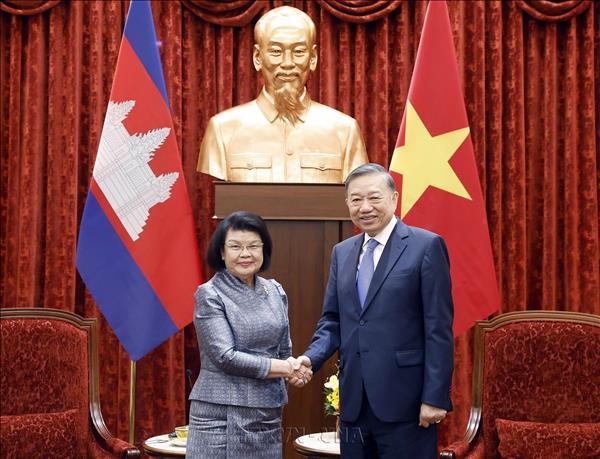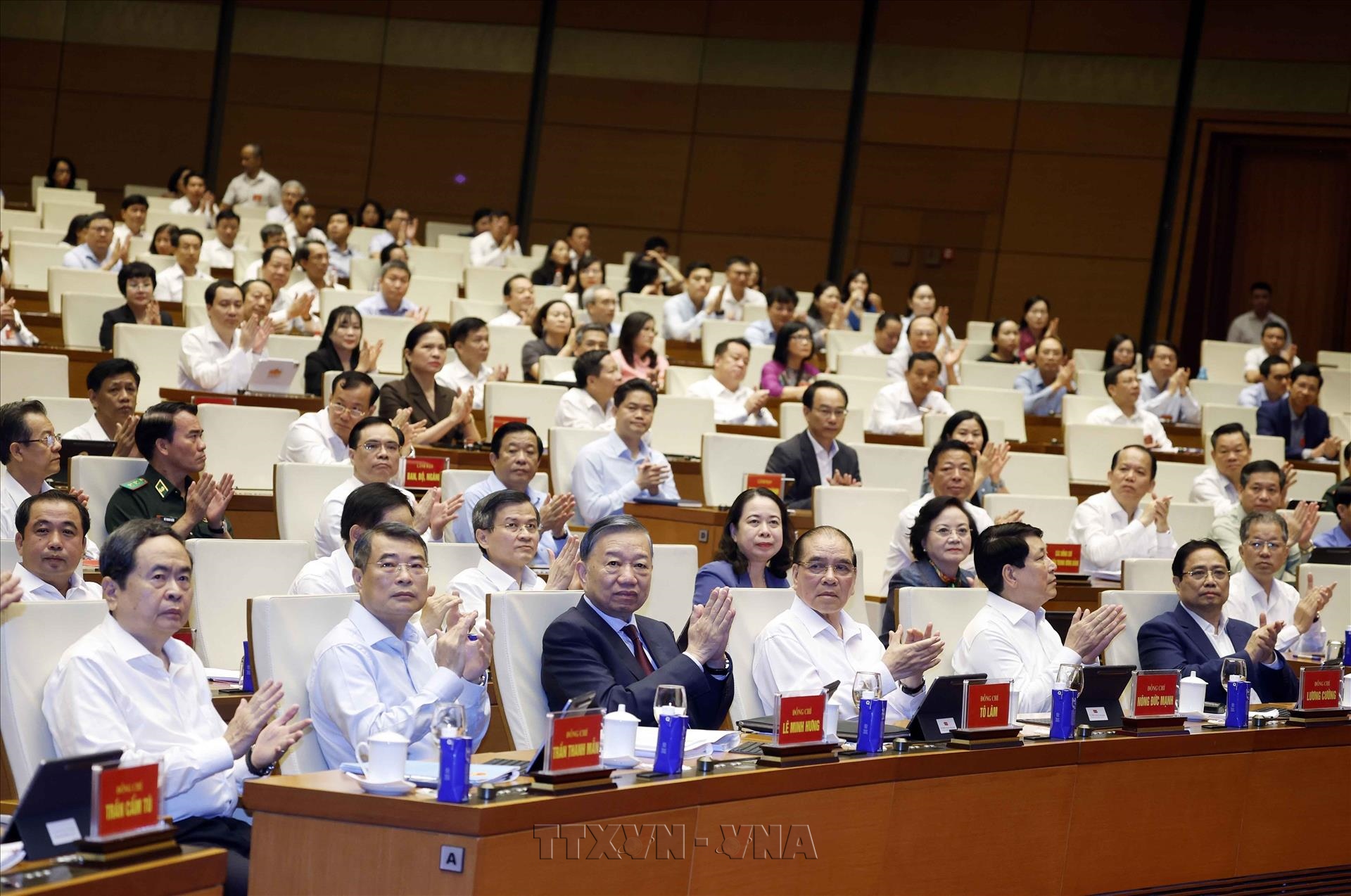
Party General Secretary and State President To Lam and delegates attend the national teleconference. Photo: VNA
In his remarks at a national teleconference in Hanoi on July 29 to study, disseminate and implement the resolutions adopted at the committee’s recent third meeting, the top leader said the third plenum had reached broad consensus on major decisions concerning Party and political system building, national development and defence.
The outcomes represent an important step in implementing the Resolution of the 14th National Party Congress, linking the agenda in 2026 with longer-term goals through 2030 and 2045, he said, stressing that the decisions are all aimed at strengthening the Party's leadership, enhancing national governance, development and defence, improving the efficiency of the political system, unlocking resources, raising people's living standards, and advancing the country's development.
He urged the entire Party and political system to firmly grasp the guiding principles, new elements and interconnections among the Party Central Committee's decisions and strategic shifts, stressing that correct understanding is the foundation for unified action.
According to him, the decisions form an interconnected and integrated framework aimed at comprehensively reforming the country's leadership, governance, development and defence. The Party building, institutional restructuring and cadre development must strengthen the Party's leadership and governing capacity while improving the effectiveness of the political system. Development space and national resources must be managed in a unified and efficient manner. The development model must be driven by productivity, knowledge, technology, innovation and people, while remaining firmly grounded in Vietnam's realities.
National defence, security, foreign affairs and environmental protection must take a proactive approach to risk prevention, enhance resilience and adaptability, and safeguard the country, he noted, adding that these tasks are closely interconnected and that weaknesses in any single area would undermine overall implementation.
The leader instructed ministries, sectors and localities to urgently translate the Party decisions into practical action plans with clear priorities and close coordination across sectors.
Resolutions must go hand in hand with action programmes, he said, adding that implementation plans should reflect the realities and specific conditions of each ministry, sector, locality and grassroots organisation.
Each programme, he said, should clearly define objectives, tasks, responsible agencies, coordination mechanisms, resources, implementation timelines, expected outputs, evaluation indicators and accountability.
He also instructed authorities to review and integrate programmes implementing the Resolution of the 14th National Party Congress, previous Party resolutions and documents adopted at the third plenum. Overlapping tasks should be consolidated, resources coordinated toward common objectives and clear accountability ensured to avoid duplication and fragmented implementation.
For new or unprecedented issues, he called for clearly defining guiding principles, responsibilities, pilot mechanisms, resources and oversight measures, while stressing that the absence of precedent must not be used as an excuse for delay, nor should implementation be rushed without adequate preparation.
He also underscored the need to promptly institutionalise the Party’s policies into clear, practical and enforceable legal regulations, urging competent authorities to proactively resolve issues within their mandate and immediately report matters beyond their authority together with proposed solutions, in order to avoid legal gaps, inconsistent guidance and unnecessary burdens for people and businesses.
Regarding the two-tier local administration model, General Secretary and President Lam said the Party Central Committee has no plans to readjust commune-level administrative boundaries, as the system is operating stably and effectively. Any proposed changes must be genuinely necessary, based on legal and practical considerations, receive public consensus, and better serve socio-economic development and people's interests.
He also stressed that implementation must follow a clear roadmap, with priorities in the second half of 2026 focused on ensuring smooth operations, removing bottlenecks and fulfilling socio-economic targets.
The General Secretary and President stressed that improving implementation capacity is essential to ensuring the effective operation of the political system. Under the Party’s unified leadership, each agency must fully perform its assigned responsibilities. The Politburo and Secretariat of the Party Central Committee will provide leadership, direction and supervision; the National Assembly and the People’s Councils at all levels will institutionalise, decide on, and oversee policies; the Government, ministries, sectors, and local authorities will organise implementation and allocate resources; while the Vietnam Fatherland Front and mass organisations will step up communications, public mobilisation, supervision and social oversight. The functions of each institution must remain clearly defined and coordinated.
The leader also highlighted the need for clearer decentralisation. The central level should focus on strategic planning, institutions, shared platforms and major resources, while provincial-level authorities should concretise policies, organise development space, coordinate resources, and create favourable conditions for commune-level administrations. As the frontline of public governance, communes must be capable of directly addressing the needs of citizens and businesses and assume responsibility for the tasks assigned to them.
He stressed that decentralisation must go hand in hand with adequate human resources, financial support, data, digital infrastructure and power control. Data should be accurate, complete, up-to-date and shared across agencies according to their authority, eliminating the need for citizens to repeatedly provide information already available in State databases.
General Secretary and President Lam called for continued efforts to build a contingent of capable, ethical and responsible officials, and strengthen accountability among leaders. Officials who work ineffectively or avoid responsibility should be replaced, whereas those who are honest, innovative and willing to act for the common good should be protected and encouraged.
He also underlined the importance of strengthening inspection and supervision from the outset of implementation, with greater use of data and measurable outcomes in evaluating performance. Public feedback, together with opinions from businesses, experts and grassroots officials, should serve as an important channel for assessing policy effectiveness. At the same time, communication efforts should proactively counter false and distorted information while remaining open to constructive criticism.
Concluding his remarks, the top leader urged Party committees and organisations, authorities and heads of agencies at all levels to move immediately from planning to action, with clearly defined responsibilities, timelines and implementation conditions. The effectiveness of every work must ultimately be measured by concrete improvements in governance, better public services and higher levels of public satisfaction, turning commitments into tangible results, he said./.