The southern people have a close friend – the Institute of Agricultural Science for Southern Vietnam. It has applied many of its scientific achievements, contributing to the strong development of the south’s agriculture.
The Institute of Agricultural Science for Southern Vietnam (IAS) was formally the Institut des Recherches Agronomiques de l’ Indochine established by the French in 1925. It was the first institute of agricultural science research in Indochina.
In its first 50 years, the institute attained only a few achievements in scientific research due to the impact of the world’s economic crisis and the prolonged resistance wars of the Vietnamese people against the French colonialists and American aggressors. It was not until after 1975, especially during the past 10 years that the IAS had success with many important achievements in scientific research, making contributions to the agricultural development of the South in particular and the whole country in general.
In its first 50 years, the institute attained only a few achievements in scientific research due to the impact of the world’s economic crisis and the prolonged resistance wars of the Vietnamese people against the French colonialists and American aggressors. It was not until after 1975, especially during the past 10 years that the IAS had success with many important achievements in scientific research, making contributions to the agricultural development of the South in particular and the whole country in general.
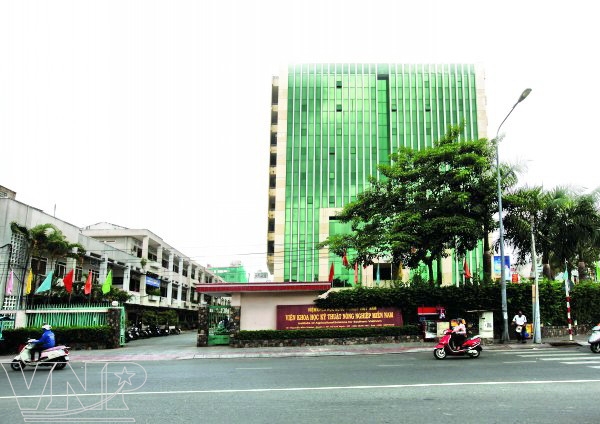 The headquarters of the Institute of Agricultural Science for Southern Vietnam in Ho Chi Minh City. Photo: Le Minh 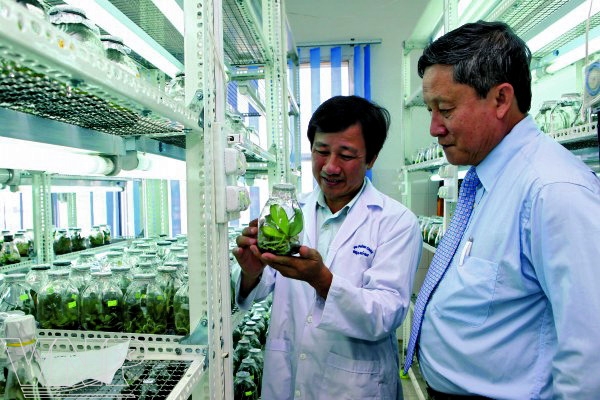 Dr. Bui Chi Buu (right), Deputy Director of the Vietnam Academy of Agricultural Sciences and IAS Director, checks results of the cultivation of orchid tissues at the Department of Biotechnology. Photo: Le Minh 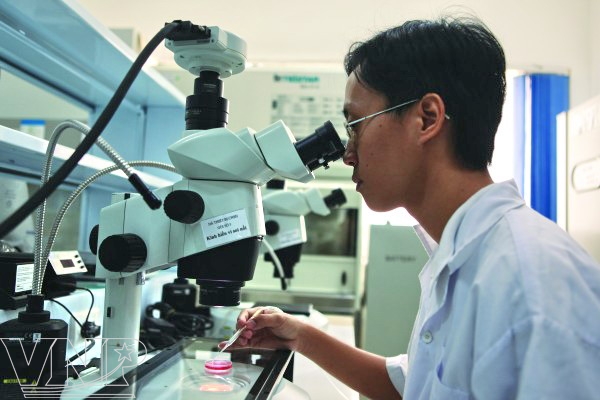 Separating genes under a microscope. Photo: Le Minh 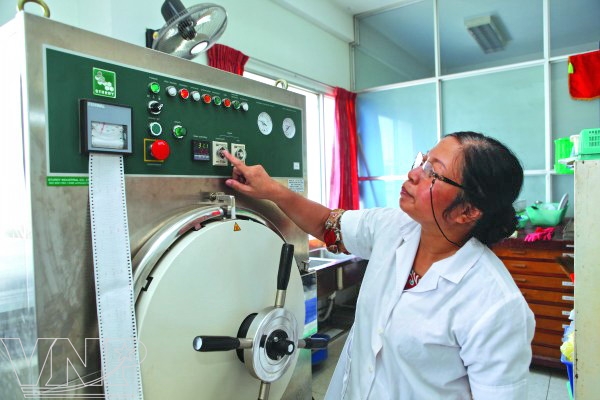 A bacterium and fungus sterilization steamer at the Department of Soil Science and Environment. Photo: Le Minh  Droughtmaster cows which yield a high ratio of lean meat are imported to Vietnam. Photo: Nguyen Luan 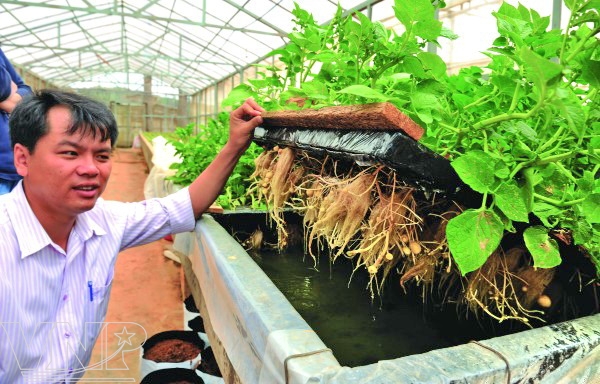 A model of growing potato plants using a water farming technique at the Potato-Vegetable-Flower Centre. Photo: Nguyen Luan 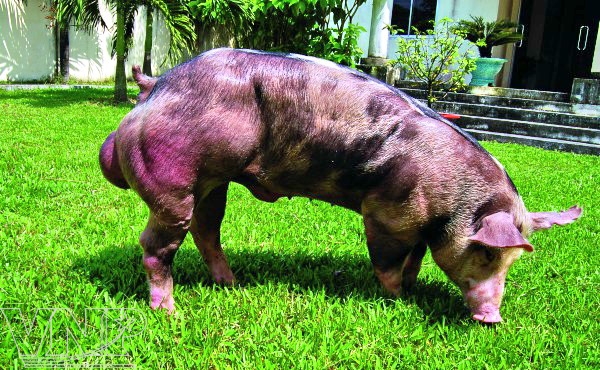 A male pig of the Pietrain strain is imported by the institute for breeding purposes. Photo: File 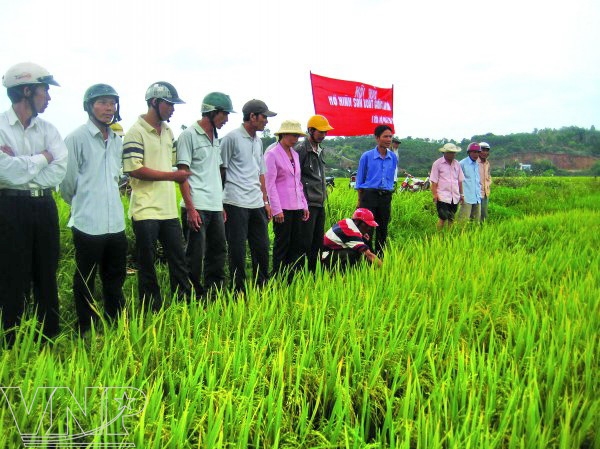 Field workshops are one of the ways to transfer technical breakthroughs to the farmers. Photo: File |
After the wars ended, the country faced untold difficulties. The cadres at the institute made great efforts to overcome these difficulties. They lived and worked with the farmers to learn about production reality and instructed the farmers on changing the structures of varieties of plants and their harvesting methods. They produced short-term rice varieties of high productivity and quality, applied new farming techniques and developed many categories of crops and strains of livestock and poultry. These helped resolve the food shortage to stabilize people’s lives after the struggles of war.
| The Institute of Agricultural Science for Southern Vietnam has a staff of 438 people, including over 200 graduates and post-graduates, three professors and associate professors, 31 doctors and 49 with masters degrees of science. The institute has 11 research departments and 9 centres for applied research. The Institute of Agricultural Science for Southern Vietnam Address: 121 Nguyen Binh Khiem, District 1, Ho Chi Minh City Email: iasvn@vnn.vn; iasvn@iasvn.org Website: http://iasvn.org |
After its initial achievements, to expand the research scope in the direction of agricultural multi-sectors, the institute directed its research departments and laboratories to carry out many basic and applied research programmes in crop and animal science. At present, in addition to the research departments at its headquarters in Ho Chi Minh City the institute has established nine experimental research centres for farming and animal husbandry in the key agricultural production areas, from the southeast and the Cuu Long River delta to Tay Nguyen (the Central Highlands). This has made a considerable contribution to the local production and improved the capacity of scientific research and application.
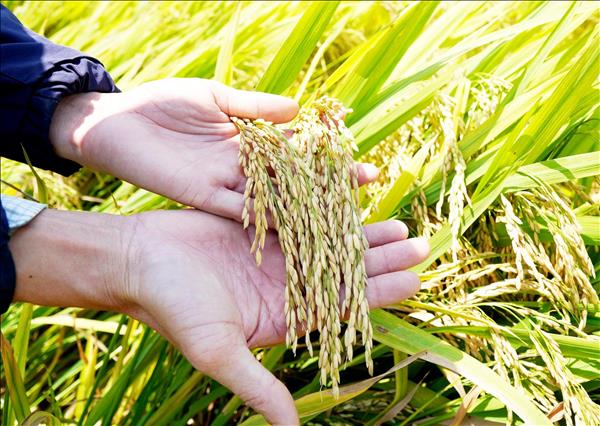
In agricultural and rural development, the research projects of the institute have met the requirements on agricultural production. This has been proven by the fact that the institute has provided many good varieties of plants for domestic demands and for export. Notably, the wet rice varieties of IR50404, Jasmin 85 and VND 95-20 have been the key varieties in the Cuu Long River delta for many years. The dry rice varieties and maize hybrid varieties V98-1, V98-2 and VN25-99 developed by the institute have been cultivated mainly in the southeast and Tay Nguyen. Seven of the eight staple maize varieties of the country are the institute’s products.
Apart from selecting and producing varieties of crops, IAS also studies, selects and hybridizes many strains of animals of high quality, such as cows, pigs and chickens, and the technology of raising them. Notably, the strains of cows, such as Droughtmaster, White Brahman and Red Brahman have a high reproductive and development capacity and give good meat. They are resistant to diseases and suitable to the animal raising conditions provided. Now the southeast is the largest area raising these cows in the country.
The research project on lean pigs of highproductivity, which is headed by Dr. Tran The Thong and Dr. Le Thanh Hai has been awarded the Ho Chi Minh Prize, the highest prize for science and technology, by the State.
The IAS has also attained great achievements in the research of land and fertilizers, which serve as a firm scientific basis for the effective use of the land as a natural resource. The technology of farming on alkaline land developed by the institute has contributed to the ability to use the fallow Dong Thap Muoi area of the south.
Every year, on average, the institute implements nearly 100 scientific research projects of State, ministerial and local levels. In international relations the institute has established ties with over 40 countries and hundreds of organizations, which has created favourable conditions for the training of human resources, increasing modern equipment and creating more funds for scientific research.
The IAS has made considerable contributions to the miraculous achievements of Vietnamese agriculture during the last 20 years. Vietnam has become the second largest rice exporter in the world and is ranked high among the countries having the largest number of top agricultural products. These are worthy prizes for the Vietnamese agricultural scientists, especially the scientists at the Institute of Agricultural Science for Southern Vietnam
In agricultural and rural development, the research projects of the institute have met the requirements on agricultural production. This has been proven by the fact that the institute has provided many good varieties of plants for domestic demands and for export. Notably, the wet rice varieties of IR50404, Jasmin 85 and VND 95-20 have been the key varieties in the Cuu Long River delta for many years. The dry rice varieties and maize hybrid varieties V98-1, V98-2 and VN25-99 developed by the institute have been cultivated mainly in the southeast and Tay Nguyen. Seven of the eight staple maize varieties of the country are the institute’s products.
Apart from selecting and producing varieties of crops, IAS also studies, selects and hybridizes many strains of animals of high quality, such as cows, pigs and chickens, and the technology of raising them. Notably, the strains of cows, such as Droughtmaster, White Brahman and Red Brahman have a high reproductive and development capacity and give good meat. They are resistant to diseases and suitable to the animal raising conditions provided. Now the southeast is the largest area raising these cows in the country.
The research project on lean pigs of highproductivity, which is headed by Dr. Tran The Thong and Dr. Le Thanh Hai has been awarded the Ho Chi Minh Prize, the highest prize for science and technology, by the State.
The IAS has also attained great achievements in the research of land and fertilizers, which serve as a firm scientific basis for the effective use of the land as a natural resource. The technology of farming on alkaline land developed by the institute has contributed to the ability to use the fallow Dong Thap Muoi area of the south.
Every year, on average, the institute implements nearly 100 scientific research projects of State, ministerial and local levels. In international relations the institute has established ties with over 40 countries and hundreds of organizations, which has created favourable conditions for the training of human resources, increasing modern equipment and creating more funds for scientific research.
The IAS has made considerable contributions to the miraculous achievements of Vietnamese agriculture during the last 20 years. Vietnam has become the second largest rice exporter in the world and is ranked high among the countries having the largest number of top agricultural products. These are worthy prizes for the Vietnamese agricultural scientists, especially the scientists at the Institute of Agricultural Science for Southern Vietnam
Story: Van Quy - Photos: Le Minh – Nguyen Luan – File