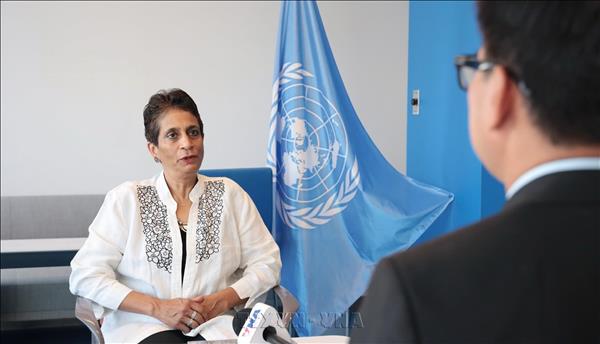
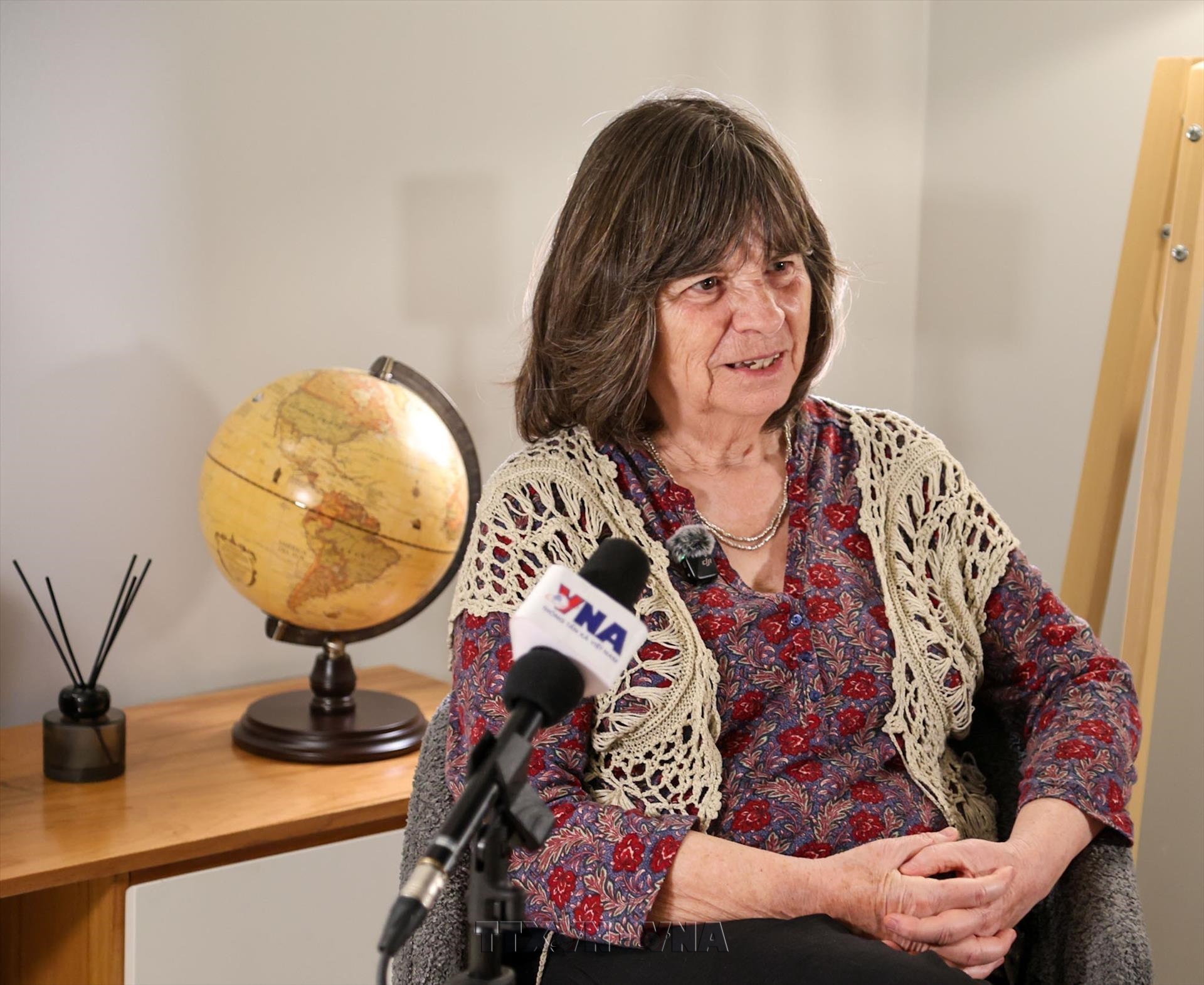
Patricia Abarzúa Muñoz, President of the Chile-Vietnam Friendship Cultural Institute. Photo: Thanh Tung/VNA
Speaking to the Vietnam News Agency (VNA) correspondent in Buenos Aires on the occasion of the 216th anniversary of Chile's Independence, Abarzua recounted her over six decades of ties with Vietnam and the institute's efforts to strengthen the friendship between the two peoples.
Abarzua recalled that she first learned about the reality of Vietnam in 1962 when a Vietnamese delegation visited Chile to attend a conference of the Unified Workers' Central (CUT).
Meetings with the Vietnamese representatives inspired journalist Fernando Murillo Viana, later awarded Chile's National Journalism Prize, to establish one of the country's first solidarity groups with Vietnam.
The movement later grew with the participation of prominent Chilean political and social figures, including then-Senator Salvador Allende, who would eventually become President of Chile, and Clodomiro Almeyda, who served as Foreign Minister during Allende's government.
During her university years, Abarzua actively joined the student movement and activities showing solidarity with Vietnam. She worked for the Chile–Vietnam friendship organisation and later became the Secretary General of the Chile–Vietnam Cultural Institute, a position she held until 1973.
The September 1973 coup d'état radically changed her life and put an end to the institute's activities. Its headquarters were raided and destroyed by the military, along with photographs, films, documents, and other materials.
Abarzua was forced into exile for four years, first in Italy and later in Spain, before returning to Chile.
Upon her return, she reconnected with her Vietnamese friends, including journalist Nguyen Khac Thin, then the VNA correspondent in Santiago. These contacts helped rebuild the bonds of friendship and eventually revive the Chile–Vietnam Cultural Friendship Institute, which continues its activities to this day.
Abarzua also recalled the numerous expressions of solidarity with Vietnam from the Chilean people during the war. She highlighted a march held from July 8 to 13, 1967, when some 2,000 youths and students walked nearly 200 kilometres from Valparaiso to Santiago to express their solidarity with the Vietnamese people. Salvador Allende participated in that march.
She also reminisced about Allende's visit to Hanoi in May 1969, when, as President of the Chilean Senate, he led a delegation to express the solidarity of the Chilean people. During that visit, Allende was received by President Ho Chi Minh.
Over the decades, Abarzua has visited Vietnam six times. Her most recent trip was as an international guest for the 50th anniversary of the liberation of the South and national reunification.
She noted that the transformations Vietnam has undergone left a profound impression on her.
"It is extraordinary to see the development of the cities and the country. Today, you have to go to museums to imagine what the war in Vietnam was like," she said, highlighting not only the infrastructure improvements but also the vitality, creativity, and strong work ethic of the new Vietnamese generations.
Regarding the institute's work, she described its activities as a vital bridge between the peoples of both nations. The organisation has promoted seminars, meetings, and cultural events about Vietnam and published President Ho Chi Minh's “Prison Diary” in Santiago.
She also recalled that to mark the 40th anniversary of Vietnam's reunification, 40 Chilean artists donated 40 artworks that were sent to Vietnam for a special exhibition.
"Vietnam is part of my life," affirmed Abarzua, emphasising that the friendship between the Chilean and Vietnamese peoples is built on shared values and mutual respect. In her view, Chileans particularly value the simplicity, kindness, and gratitude of the Vietnamese people.
She further highlighted the significance of Ho Chi Minh Park in Chile, whose creation was closely linked to the solidarity movement with Vietnam. She noted that even during the dictatorship, the space retained the Vietnamese leader's name. Later, alongside the first Vietnamese Ambassador to Chile, Nguyen Van Dao, she promoted the idea of erecting a statue of President Ho Chi Minh there, a project that eventually became a reality.
Looking to the future, Abarzua expressed her desire to continue promoting the image of a peaceful, dynamic, and developing Vietnam among Chileans, especially the youth.
She considers it crucial for new generations to learn not only the history of the struggle for independence but also the remarkable achievements Vietnam has made in its nation-building and development process.
For Abarzua, after more than six decades, the bond with Vietnam transcends mere social activity or a chapter in her life: it has become an inseparable part of her identity and a constant motivation to continue strengthening the friendship between the peoples of Chile and Vietnam./.