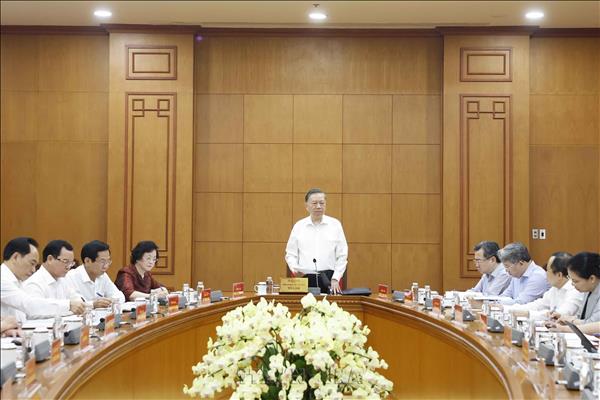
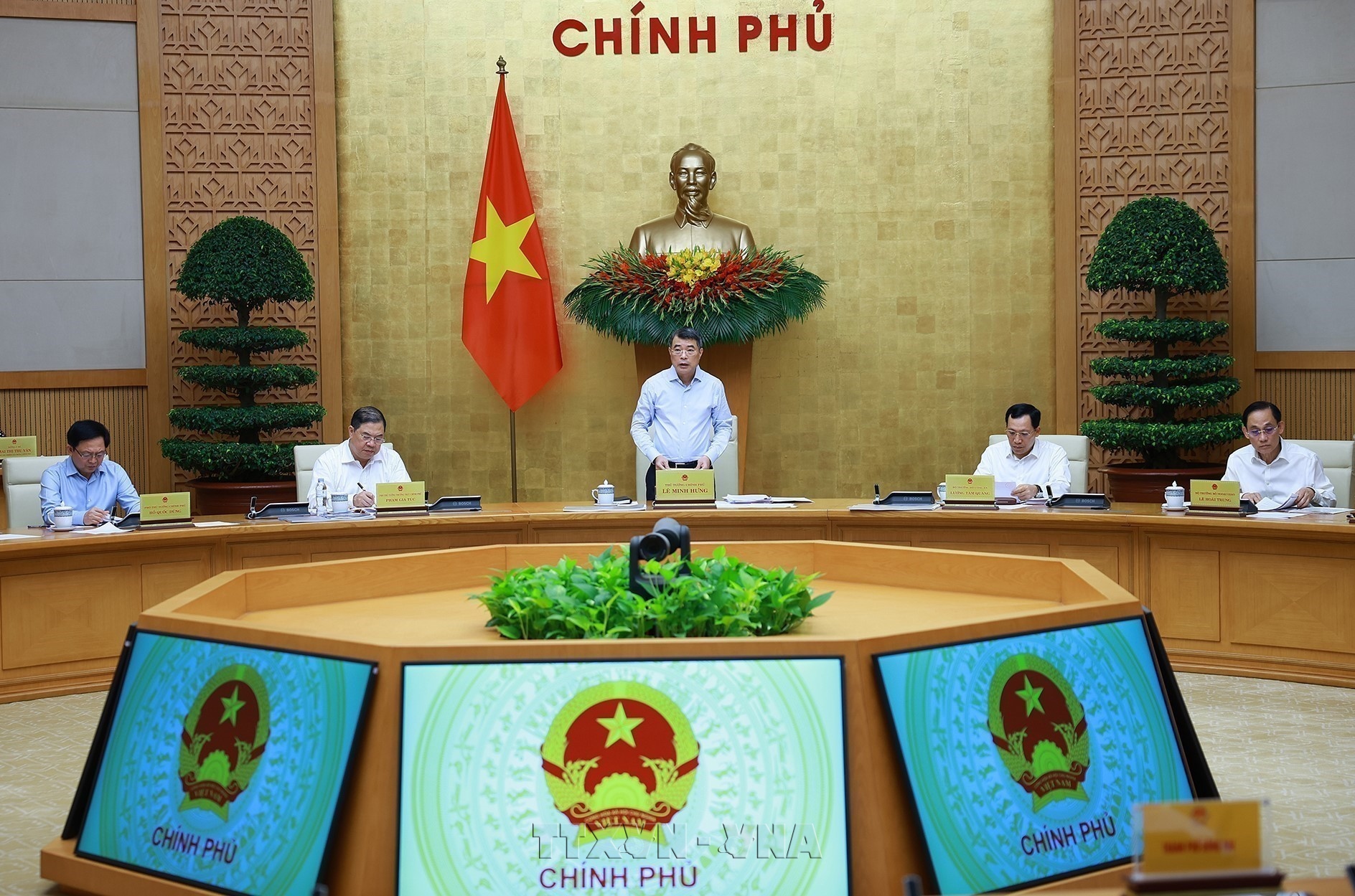
A view of the working session. Photo: VNA
The Government reviewed and commented on major bills, including the revised Law on Real Estate Business; the revised Law on Housing; policy dossiers for the Law on Organisation of Criminal Investigation Agencies; the revised Criminal Code; key contents and issues requiring consultation for the Law on Urban Development; orientations for a law combining the Law on State Budget and the Law on Public Investment; the revised Law on Food Safety; proposals on investment policies for the Lao Cai-Hanoi-Hai Phong railway and Ring Road No. 5 projects in the Hanoi Capital Region.
The cabinet members also discussed reports reviewing the laws on taxation, bidding, auctions, investment and related fields, requiring amendments and supplements to ensure consistency and uniformity with the draft laws and resolutions to be submitted at the first extraordinary session of the NA; as well as the proposal to establish Quang Ninh as a centrally run city.
Concluding the meeting, PM Hung underlined that documents expected to be submitted to the NA’s extraordinary session in August 2026 must be urgently finalised to ensure progress, quality and effectiveness.
The government leader requested ministers and heads of sectors to directly take charge of institutional building, prioritise resources and bear responsibility for legal development in their respective fields. Agencies must closely follow the working programme of the NA Standing Committee, coordinate with relevant bodies in appraisal, explanation and revision processes, and promptly report issues beyond their authority, he stated.
The PM assigned Deputy PMs to directly oversee the completion of draft laws, reports and proposals, while the Government Office was tasked with coordinating with ministries and agencies to finalise the documents and soon submit the meeting's resolution for implementation.
PM Hung gave detail guidance on the refining of particular bills and proposals, stressing that institutional reforms in the coming period requires stronger changes in policy-making and management mindset, avoiding sectoral interests that hinder overall development. Laws must serve development requirements, while agencies should limit unnecessary guiding decrees, urgently review and address overlapping regulations, particularly in land, planning, investment, construction, environment, public assets and decentralisation.
He also requested stronger discipline, improved progress and quality in law-making, and an end to delays in issuing guiding documents, noting that the implementation stage must be effective and must not become a “bottleneck of bottlenecks”.
The Government leader assigned relevant agencies to prepare laws, resolutions, reports and proposals already approved by the Government for the NA’s first extraordinary session, while continuing to complete dossiers expected for the second session of the 16th NA, involving around 47 projects.
He asked that all draft laws, ordinances and resolutions undergo careful review regarding necessity, legality, effective dates and implementation provisions to ensure feasibility.
PM Hung assigned the Ministry of Justice to lead amendments to the Law on Promulgation of Legal Documents to remove obstacles and ensure legal development and implementation are feasible, consistent and synchronised.
Regarding delayed legal documents, as of July 7, 22 decrees detailing the laws and NA resolutions already in force had not been issued, including seven effective before July 1 and 15 effective from July 1. The Government and PM requested ministries and sectors, in coordination with the Government Office, to urgently issue outstanding documents and avoid legal gaps.
The Ministry of Justice was tasked with coordinating the effective implementation of the KPI-based legal development assessment and scoring scheme approved by the PM./.