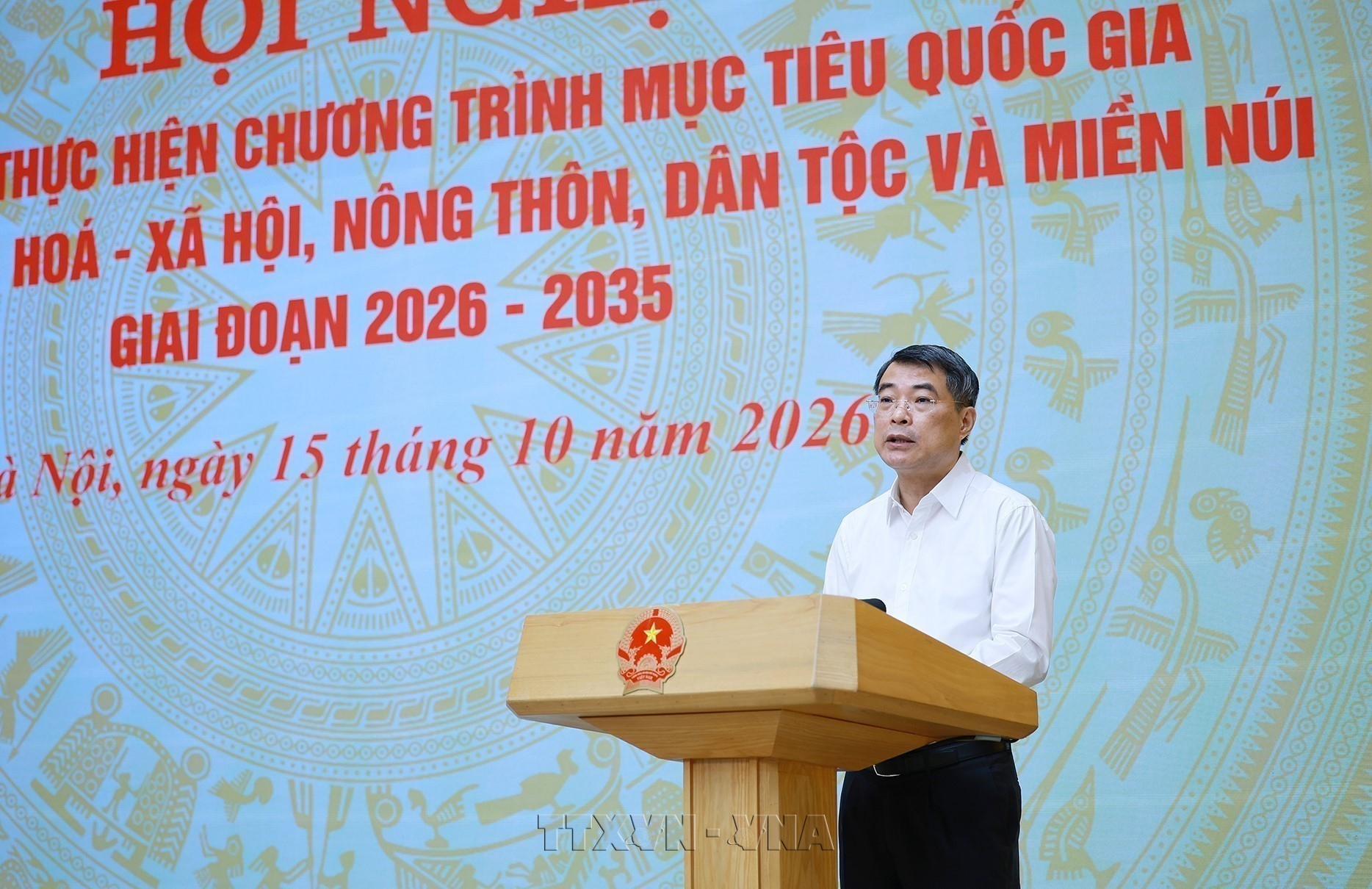
Prime Minister Le Minh Hung, head of the Central Steering Committee for the 2026–2035 national target program on cultural and socio-economic development, rural development, and development in ethnic minority and mountainous areas, chaired a conference in Hanoi on October 15 to launch the program.
The conference, held in-person at the Government headquarters, was connected online to the People’s Committees of provinces and cities nationwide.
In his opening remarks, Deputy Prime Minister Ho Quoc Dung, who is deputy head of the committee, said that the National Assembly adopted Resolution No. 46/2026/QH16 on August 24, 2026, approving the investment policy for the programme for 2026–2035.
The programme consolidates four national target programmes covering new-style rural development, sustainable poverty reduction, socio-economic development in ethnic minority and mountainous areas; cultural development; modernising and improving the quality of education and training; and healthcare, population and development.
To implement the resolution, the Government issued Decree No. 367/2026/ND-CP on October 12, 2026, detailing the programme’s contents, mechanisms and policies. On the same day, the Prime Minister issued Decision No. 1966/QD-TTg to consolidate the central steering committee and provide guidance on establishing and consolidating steering committees at the local level.
Dung stressed that the conference aims to accelerate implementation, deliver more visible improvements and ensure substantive results under the guiding principle of clearly defining policies, geographical areas and beneficiaries.
He emphasised comprehensive decentralisation, enabling local authorities to make decisions, organise implementation and take responsibility, and ensuring that all objectives, policies and benefits approved by the NA are fully delivered. People should be placed at the centre of the programme rather than treated merely as passive recipients of assistance.
The Deputy PM called on participants to discuss and clarify the programme’s core tasks and new elements under the legislature’s resolution and the Government’s decree, particularly coordination mechanisms and the division of responsibilities among the central steering committee, ministries and agencies. They were also asked to identify obstacles to effective implementation.
Under the conference agenda, the Ministry of Finance was scheduled to present key provisions of the resolution and decree, including planning, resource allocation, management and use, transitional arrangements, and tasks to be undertaken once the decree takes effect.
The Ministry of Agriculture and Environment will report on leadership, coordination, responsibility allocation and implementation arrangements, as well as monitoring, information sharing and reporting mechanisms.
Local leaders were expected to review the implementation of existing national target programmes and identify issues requiring clarification following their consolidation. Representatives of ministries and agencies will also exchange views to reach consensus on implementation arrangements in the coming period./.