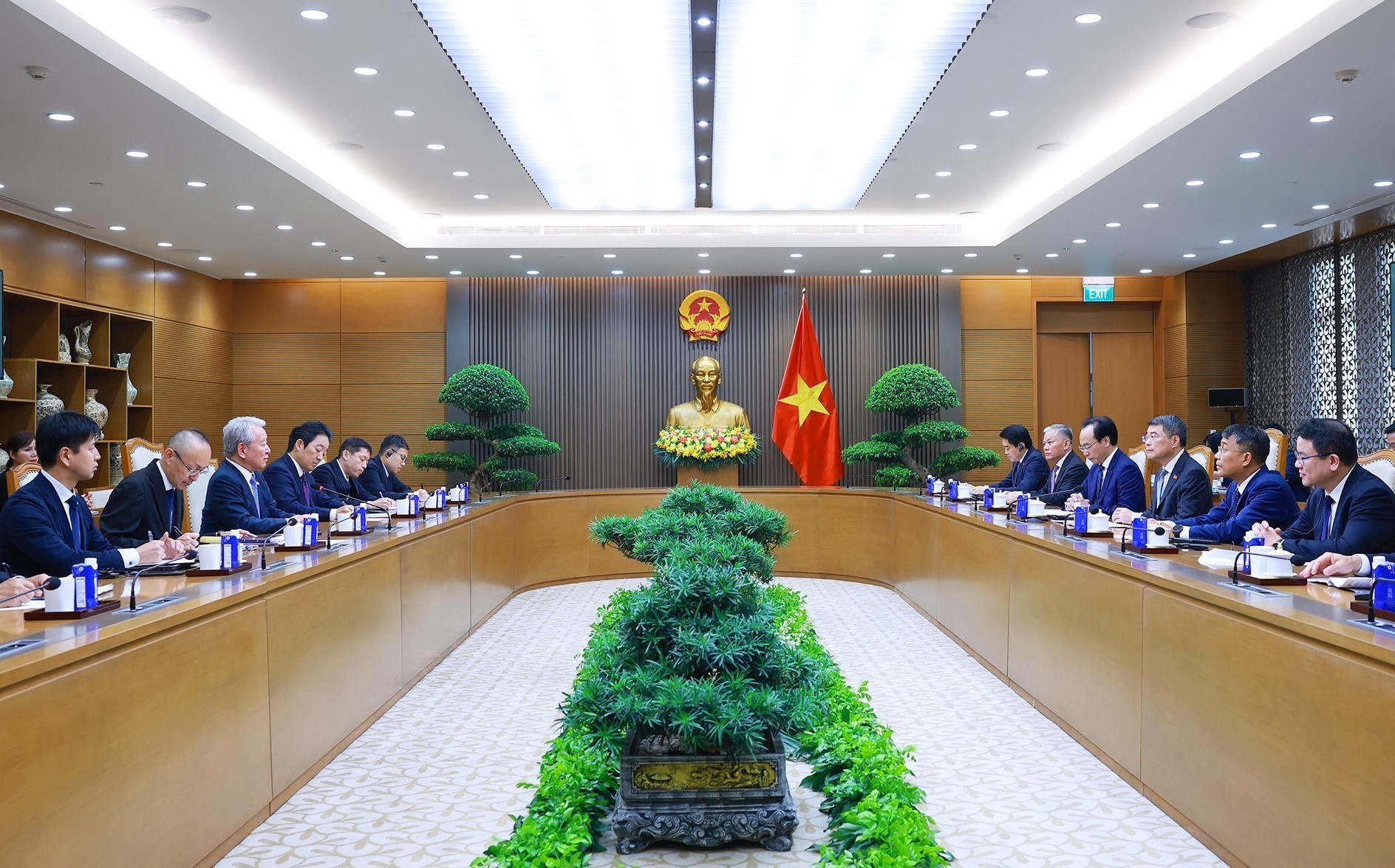
Prime Minister Le Minh Hung receives President of the Japan International Cooperation Agency (JICA) Tanaka Akihiko. Photo: VNA
Hosting JICA President Tanaka Akihiko in Hanoi on June 11, the Vietnamese leader thanked JICA for its long-standing support for Vietnam, noting that Japanese ODA with high technological content and sustainability, delivered through JICA, has played a significant role in local socio-economic development, economic restructuring, institutional reform, and climate resilience.
He highlighted the signing of three loan agreements worth nearly 90 billion JPY (560.7 million USD) in 2025 to help Vietnam improve essential infrastructure and strengthen climate change adaptation efforts.
The two sides welcomed the strong and substantive development of the Vietnam – Japan Comprehensive Strategic Partnership. Japan remains Vietnam’s largest ODA and labour cooperation partner while ranking third among foreign investors and fourth among trading and tourism partners of the Southeast Asian nation. Bilateral cooperation is also expanding to emerging areas such as science – technology, digital transformation, green transition, artificial intelligence (AI), semiconductors and economic security.
In 2025, ODA cooperation increased by more than 600 million USD, bilateral trade surpassed 50 billion USD for the first time, and investment rose by nearly 4 billion USD, with almost 300 new investment projects.
Notably, during the recent official visit to Vietnam by Japanese PM Takaichi Sanae, the two countries agreed to further strengthen their relations to realise sustainable development objectives in the new era.
Shortly after the trip, PM Hung said, the Vietnamese Government approved a list of cooperation tasks and assigned ministries and agencies to implement them under clear timelines and periodic review mechanisms.
Welcoming JICA’s proposal for a new ODA cooperation framework, he said its proposed areas largely match Vietnam’s development priorities as well as the orientations agreed upon by the two PMs. He urged JICA to work closely with Vietnam’s Ministry of Finance and relevant agencies to identify feasible projects and accelerate the signing of an agreement facilitating Japan’s non-refundable aid projects.
Sharing Vietnam’s key development directions, the Government leader suggested JICA provide Vietnam with new-generation ODA loans with more favourable terms and flexible procedures to support projects in semiconductors, AI, quantum technology, digital and green transformation, space technology, energy, infrastructure, disaster prevention and supply chains.
In addition, he encouraged the agency to accelerate studies for a budget-support loan in AI and digital transformation, while expanding training programmes for leadership and management personnel.
He also proposed JICA coordinate with Vietnamese ministries, sectors and localities to formulate a cooperation portfolio for 2026–2030, including accelerating the signing of a loan agreement for the O Mon III Thermal Power Plant project in 2026, and the Vietnam Japan University project—one of the flagship symbols of bilateral relations, as well as climate-resilient infrastructure projects in the Mekong Delta.
He asked for strengthening the trilateral working mechanism involving Vietnam’s Ministry of Finance, the Japanese Embassy and JICA to address bottlenecks affecting projects, propose solutions, and promote cooperation with localities, particularly Hanoi and Ho Chi Minh City, especially in strategic infrastructure development.
For his part, Tanaka praised Vietnam’s development achievements and directions, saying that JICA has proposed new directions for ODA cooperation with Vietnam in the coming period, concentrating on four pillars – developing high-quality human resources, promoting industrial development and supply chains, strengthening institutional and policy frameworks, and developing infrastructure.
The JICA leader expressed his impression of the messages delivered by the Vietnamese PM at the 3rd ASEAN Future Forum, stressing that science and technology remain a key area of cooperation between Japan, including JICA, and Vietnam.
He highlighted efforts to accelerate the launch of the LOTUSat-1 satellite, train leadership and management personnel to meet digital transformation and semiconductor workforce requirements, and implement Japan’s budget-support loan for Vietnam in AI and digital transformation.
At the meeting, the two sides also discussed measures to speed up several projects, including the Vietnam Japan University and Hanoi’s Metro Line No. 2's Nam Thang Long – Tran Hung Dao section.
The host said he hopes JICA will continue to promote the substantive implementation of bilateral cooperation initiatives through new approaches, making practical contributions to the two countries’ Comprehensive Strategic Partnership and supporting Vietnam in achieving its development goals.
Tanaka called for the PM's continued support and affirmed JICA’s commitment to assisting Vietnam to realise development goals and carry out more flagship projects of the bilateral relationship./.