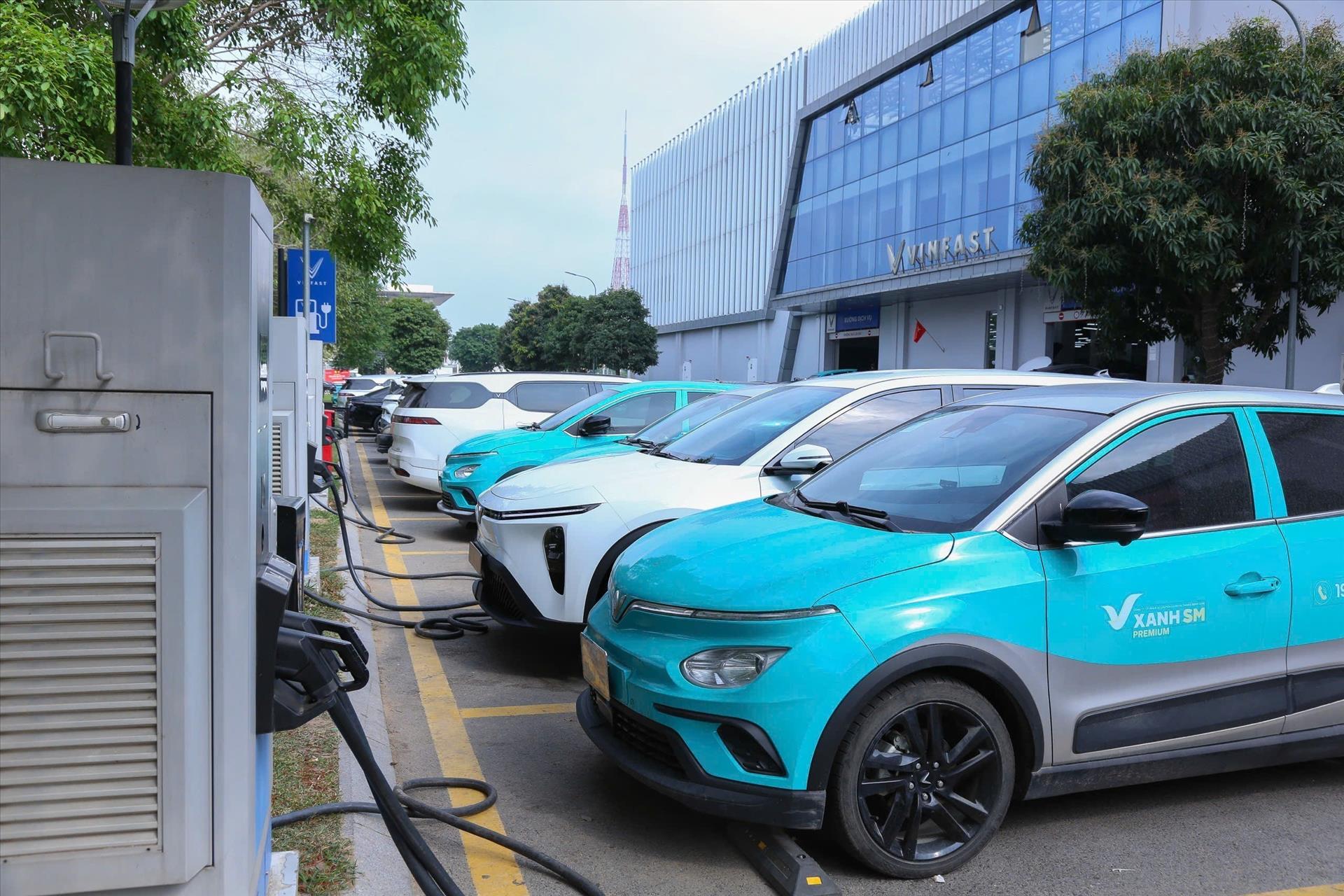
Investors are accelerating the construction and operation of electric vehicle (EV) charging stations at rest stops along the eastern section of the North–South Expressway, stretching from the north central province of Thanh Hoa to the southernmost province of Ca Mau, to provide green energy for transport.
According to the Department for Roads of Vietnam, the Vietnam National Petroleum Group (Petrolimex) is investing in nine rest stops. At the Mai Son–National Highway 45 rest area, 10 charging points have been installed on each side of the expressway. Each point has two charging ports, providing 20 EV charging spaces on each side.
The Xuan Khiem Group, which is investing in two rest stops on the Ham Nghi–Vung Ang section and the Vung Ang–Bung section, has completed the installation of three charging points on each side, equivalent to six EV charging spaces.
The Chau Thanh TTC Company, the investor of the Vinh Hao–Phan Thiet rest stop, has put into operation seven charging points on the right side of the route, providing 14 charging spaces, and six charging points on the left side, providing 12 charging spaces.
Investors are planning to install additional charging stations at rest stops and gradually expand multi-standard charging systems to meet the diverse needs of customers.
The Xuan Khiem Group, for example, has deployed rooftop solar power systems to partially meet its clean electricity demand. At the same time, it is studying proposals related to infrastructure for liquefied natural gas (LNG) and hydrogen supply, while seeking to have its rest stops included in a pilot programme for a national green transport infrastructure model.
The Chau Thanh TTC has also committed to researching and proposing green energy solutions, including rooftop solar systems, battery storage systems and fast-charging stations, in line with operational demand, technical infrastructure conditions and the orientation toward green transport development.
Petrolimex is likewise studying the development of infrastructure for LNG, compressed natural gas (CNG), hydrogen, biofuels and low-carbon synthetic fuels, targeting heavy-duty vehicles such as trucks and container carriers that are difficult to fully electrify.
According to the department, all rest stops are designed to accommodate EV charging systems. However, there are currently no unified regulations governing the number of charging points, charging capacity or the provision of green energy services at these facilities.
The administration has proposed that the Ministry of Construction develop standards and technical regulations for EV charging systems at rest stops to ensure consistency in the construction and management of charging infrastructure and green fuel supply facilities.
It also recommended that the ministry establish criteria for green rest stops and a roadmap for transitioning existing facilities to meet green standards, thereby ensuring a uniform approach to the development and management of EV charging infrastructure and green fuel services in the coming years./.