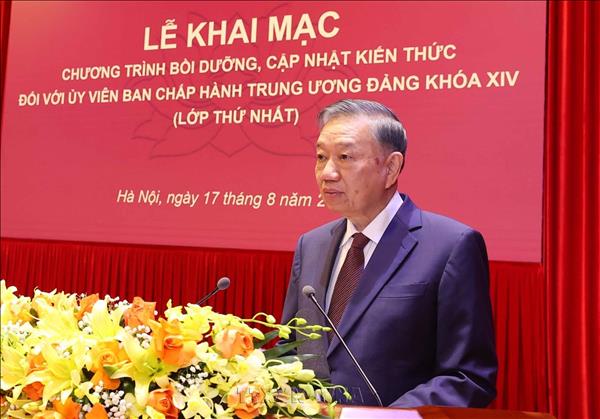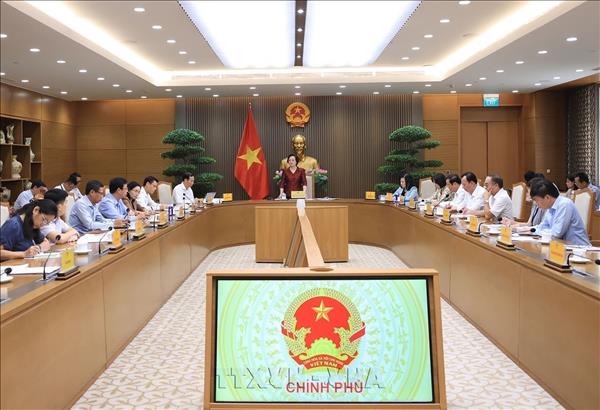
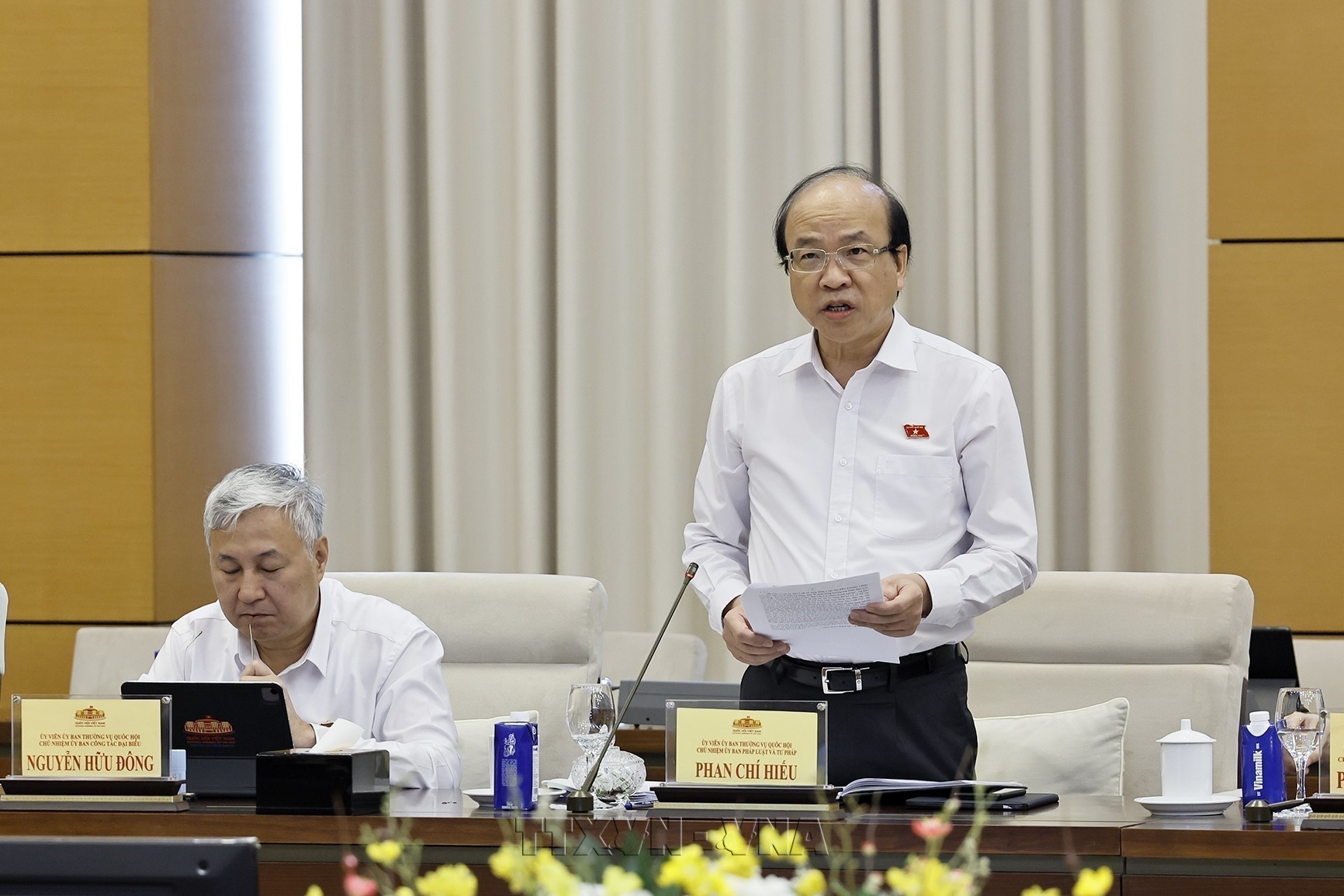
Chairman of the NA Committee for Legal and Judicial Affairs Phan Chi Hieu speaks at the session. Photo: VNA
Chairman of the NA Committee on Legal and Judicial Affairs Phan Chi Hieu said the committee's standing body agreed with the major orientations and many of the proposed revisions.
Speaking at the session, NA President Tran Thanh Man noted that the draft Law on Urban Development was initially designed for Ho Chi Minh City before its scope was expanded to other cities and additional provisions were incorporated. Given the tight timeframe and substantial workload, the NA will make its utmost effort to consider and adopt the contents as scheduled.
Regarding international financial centres, he said Resolution No. 222/2025/QH15 on international financial centres in Vietnam remains valid and provides broad authority for the Government to issue decrees with provisions differing from existing laws to implement the resolution.
Therefore, if international financial centres are incorporated into the draft Law on Urban Development, the scope of the draft law must be clearly distinguished from that of Resolution No. 222/2025/QH15. The resolution governs the organisation, operation, and specific policies of financial centres, while the draft law should regulate the urban space, infrastructure, and development conditions associated with them.
The design must preserve the stability of Resolution No. 222/2025/QH15 and avoid creating two mechanisms for financial centres, while opening up more development space for cities with potential and preventing legal mechanisms from missing opportunities to create new growth poles, particularly amid the requirement for double-digit growth. Article 23 must clearly reflect this, the NA leader stressed.
On sea-reclaimed urban areas, he asked relevant agencies to prepare a report for submission to competent authorities for consideration.
Regarding international financial centres, NA Vice President Nguyen Thi Hong said Article 23 of the draft law and Resolution No. 222/2025/QH15 have different scopes and will complement each other in supporting the development of special cities such as Ho Chi Minh City.
She agreed with the Government's principle of having one centre at two locations, while requiring consistency in organisation, management, and supervision. Locating the centre in two cities would not mean applying different financial instruments, but would enable Ho Chi Minh City and Da Nang to capitalise on their respective strengths and characteristics.
She also called for a review of Clause 3, Article 23. Although the explanatory report states that licensing conditions, risk management, prudential supervision, and core market rules must be consistent throughout the centre, the clause still gives the executive authority in Ho Chi Minh City the power to set conditions and directly issue licences.
Concluding the discussion, NA Vice President Nguyen Khac Dinh praised the Government, the drafting agency, and the reviewing agency for their detailed work on the explanation, incorporation of feedback, and revision of the draft law within a short period.
He urged the two agencies to continue coordinating closely to finalise the draft, ensuring highly general provisions that can remain applicable over the long term. The law should not create difficulties for one group in order to facilitate another, nor solve today's needs at the expense of tomorrow's development.
On August 17, the NA Standing Committee reviewed feedback and worked on revising a draft resolution to replace Resolution No. 96/2019/QH14, covering crime and law violation prevention, the operations of the People's Procuracy and People's Courts, and the enforcement of civil and criminal judgments./.
Speaking at the session, NA President Tran Thanh Man noted that the draft Law on Urban Development was initially designed for Ho Chi Minh City before its scope was expanded to other cities and additional provisions were incorporated. Given the tight timeframe and substantial workload, the NA will make its utmost effort to consider and adopt the contents as scheduled.
Regarding international financial centres, he said Resolution No. 222/2025/QH15 on international financial centres in Vietnam remains valid and provides broad authority for the Government to issue decrees with provisions differing from existing laws to implement the resolution.
Therefore, if international financial centres are incorporated into the draft Law on Urban Development, the scope of the draft law must be clearly distinguished from that of Resolution No. 222/2025/QH15. The resolution governs the organisation, operation, and specific policies of financial centres, while the draft law should regulate the urban space, infrastructure, and development conditions associated with them.
The design must preserve the stability of Resolution No. 222/2025/QH15 and avoid creating two mechanisms for financial centres, while opening up more development space for cities with potential and preventing legal mechanisms from missing opportunities to create new growth poles, particularly amid the requirement for double-digit growth. Article 23 must clearly reflect this, the NA leader stressed.
On sea-reclaimed urban areas, he asked relevant agencies to prepare a report for submission to competent authorities for consideration.
Regarding international financial centres, NA Vice President Nguyen Thi Hong said Article 23 of the draft law and Resolution No. 222/2025/QH15 have different scopes and will complement each other in supporting the development of special cities such as Ho Chi Minh City.
She agreed with the Government's principle of having one centre at two locations, while requiring consistency in organisation, management, and supervision. Locating the centre in two cities would not mean applying different financial instruments, but would enable Ho Chi Minh City and Da Nang to capitalise on their respective strengths and characteristics.
She also called for a review of Clause 3, Article 23. Although the explanatory report states that licensing conditions, risk management, prudential supervision, and core market rules must be consistent throughout the centre, the clause still gives the executive authority in Ho Chi Minh City the power to set conditions and directly issue licences.
Concluding the discussion, NA Vice President Nguyen Khac Dinh praised the Government, the drafting agency, and the reviewing agency for their detailed work on the explanation, incorporation of feedback, and revision of the draft law within a short period.
He urged the two agencies to continue coordinating closely to finalise the draft, ensuring highly general provisions that can remain applicable over the long term. The law should not create difficulties for one group in order to facilitate another, nor solve today's needs at the expense of tomorrow's development.
On August 17, the NA Standing Committee reviewed feedback and worked on revising a draft resolution to replace Resolution No. 96/2019/QH14, covering crime and law violation prevention, the operations of the People's Procuracy and People's Courts, and the enforcement of civil and criminal judgments./.