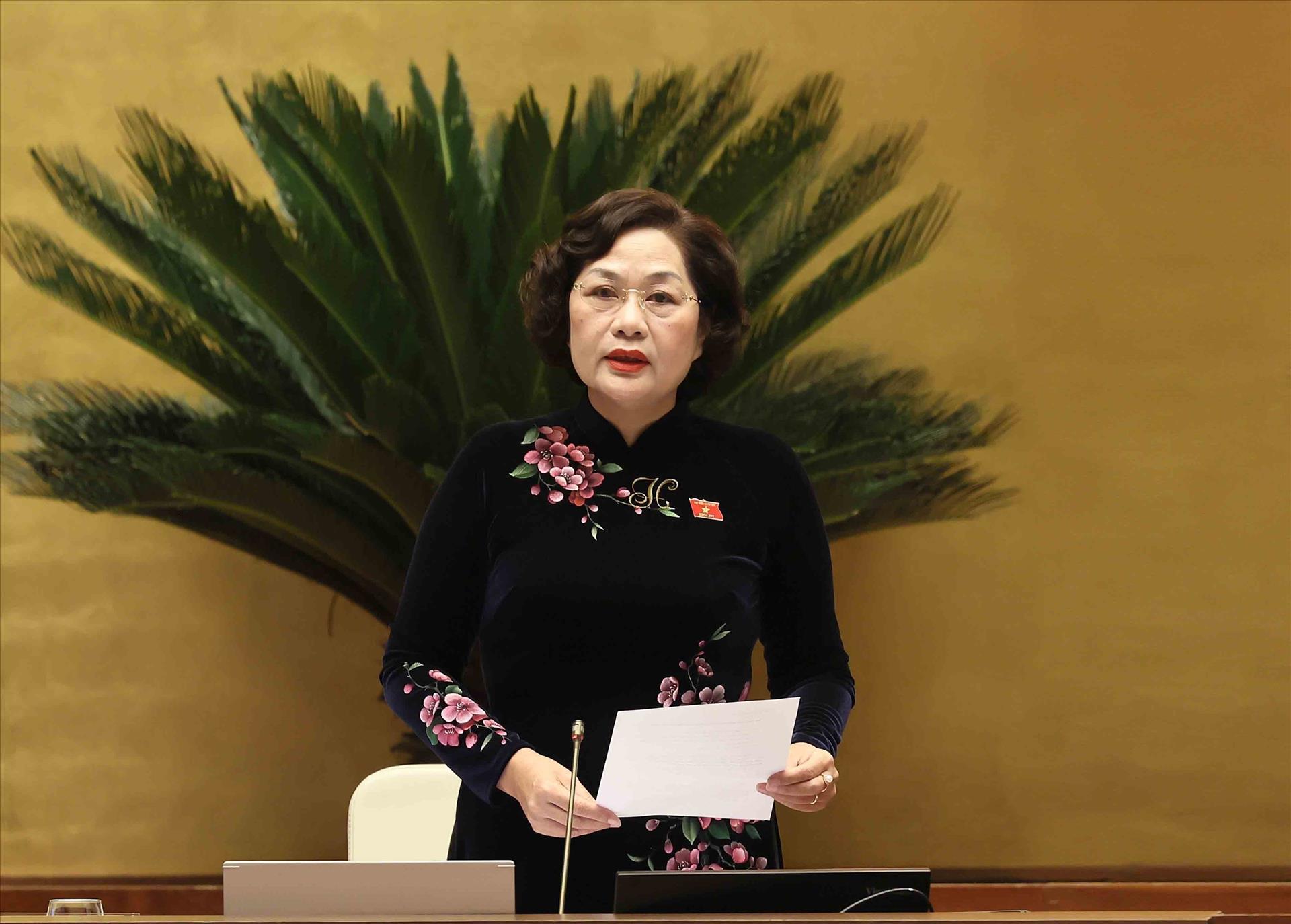
NA Vice Chairwoman Nguyen Thi Hong presides the plenary session. Photo: VNA
At the first session of the 16th National Assembly (NA), deputies on April 21 morning reviewed socio-economic and budget performance in 2025 and early 2026, with particular focus on grassroots governance and remuneration policies for civil servants and public employees.
Deputy Thach Phuoc Binh from the Mekong Delta province of Vinh Long stressed that adjusting the base salary is not merely a technical step but a decisive factor affecting income, motivation and the overall quality of the public workforce.
Vietnam has gradually raised the base salary in recent years – from 1.49 million VND to 1.8 million VND and then 2.34 million VND per month – with a further increase to 2.53 million VND scheduled for July 1, 2026. However, Binh argued that the key question is not whether to raise salaries, but by how much.
While the planned increase represents an 8.12% rise from the curent level – higher than the inflation last year (3.63%) and in the first quarter of 2026 (3.51%), and broadly in line with the region-based minimum wage growth in the enterprise sector (about 7.2%), it remains insufficient to ensure a basic standard of living for most public employees, particularly new recruits and those in major cities.
A newly recruited civil servant with a salary coefficient of 1.86 will earn roughly 4.7 million VND per month before insurance deductions, below typical minimum living costs in urban areas, estimated at 6–7 million VND. This gap forces many workers to rely on supplementary income, resulting in undermined job motivation and quality of life.
Meanwhile, Binh noted, essential expenses such as housing, utilities and health care have risen faster than overall inflation, adding further pressure on household budgets.
From a comparative perspective, even after the base salary is raised as planned, entry-level public salaries would only slightly exceed the average region-based minimum wage and barely match the highest regional threshold.
Given these factors, Binh proposed raising the base salary to between 2.65 million VND and 2.7 million VND per month, equivalent to a 13–15% increase from the current level, as a more appropriate and feasible option.
Such an adjustment, he said, will strike a better balance between fiscal capacity and the need to deliver meaningful improvements in income, while laying the groundwork for deeper wage reform in the coming years.
Talking about the performance of commune-level administrations following administrative unit mergers, Nguyen Dang An, a deputy from the northern province of Lang Son, said the restructuring has delivered initial gains, with operations stabilising and public services becoming more accessible to citizens and businesses.
However, he pointed out that staff arrangements and organisational structures still face bottlenecks. At present, commune-level administrations typically operate with only two specialised divisions—economic and socio-cultural affairs—each subject to guidance from many provincial departments, leading to overload and limited specialisation.
Shortages of qualified personnel remain a key concern, particularly in technical fields such as construction, transport and information technology, even as workloads have increased significantly compared to the pre-merger period. This, he said, underscores the need for systematic training and retraining programmes.
Public service units in health care and education are also under strain due to staff cuts while existing caps on contract labour limit local flexibility in filling gaps.
An called for a comprehensive review of staffing allocations based on population, area and regional characteristics, including mountainous and island regions.
He added that the implementation of policies for non-specialised staff at the commune level and in residential clusters remains unclear in some cases, requiring more detailed guidance before transitional arrangements expire in mid-2026. Adjustments to criteria for residential units formed after administrative mergers were also recommended to better reflect current realities./.